articles
1. Greetings
Rev. Jonas Kang

Rev. Jonas Kang
General Secretary, KWMA & Chair, COALA
In 2023, the Korean church convened its regular Mission Strategy Consultation; which takes place every four years. Throughout 38 years of service as both a field missionary and a mission organization leader, I have had many opportunities to meet local church leaders on the mission field. In those encounters, I came to realize that Korean missionaries often do not show as much respect for the local church as we should.
At the NCOWE (National Consultation on World Evangelization), the Korean church acknowledged this shortcoming, repented; and reaffirmed its commitment to honoring local churches. Above all, we renewed our conviction that mission must proceed as a partnership rooted in the leadership of local churches.
In response, many Global South mission leaders sought closer fellowship with the Korean church. This led to the Second Global South Mission Consultation (COALA: Christ Over Asia/Africa/Arab Latin), held in Bangkok in April 2024. Subsequent gatherings followed: COALA 2.5 in Busan, COALA 3.0 in Panama (April of 2025),and now COALA 3.5 in Seoul, during the WEA General Assembly. At present; more than fourteen international mission networks are participating.
Leslie Newbigin described Western-centered mission as Christendom Mission. While it was once the most effective strategy of its time, Andrew Walls reminds us that its “expiration date” has now passed. Today, mission scholars agree that we live in a polycentric era of mission. As Western missions have declined, non-Western churches are now simultaneously sending missionaries around the world.
Missionaries, however, have an inherent limitation: they must one day leave the field. Outsiders, whether missionaries or sending churches; can never truly be the owners of the local church. I believe that in this era, the central actors in mission must be the local people themselves. Therefore, partnership with them in mission cannot be emphasized strongly enough.
There are compelling reasons why partnership mission is essential:
• Many non-Western churches face significant economic limitations.
• Missionaries, as outsiders, cannot assume ownership of local churches. Their role is temporary serving as partners who provide support in contexts where churches may lack sufficient capacity for a season.
On August 18; 2025; the leaders of Korea’s major denominations gathered and recommended that Korean missionaries on the field pursue partnership-based mission. Their exhortations were as follows:
1. Leave the leadership of ministry in the hands of the local church.
2. Focus on disciple-making (Matt. 28:19).
3. Pastoral leadership belongs to local believers; while missionaries should focus on evangelizing those outside the church.
4. Relate to the local church by invitation, serving as part of their fellowship.
The upcoming COALA 3.5 will provide non-Western churches, both those sending and those receiving missionaries, an opportunity to put these principles into practice: welcoming missionaries as partners in mission; under the leadership of the local church. This book contains a selection of presentations from the past three COALA gatherings. It is my sincere hope that it will serve as a valuable resource for leaders who long for healthy and faithful mission.
Thank you.
Dr. Samuel E. Chiang

Dr. Samuel E. Chiang
Deputy Secretary General—Ministries World Evangelical Alliance
I wish to extend my heartfelt congratulations to COALA at this significant moment in its journey. I can still recall hearing it with my own ears in Panama, from the front of the stage, when a Korean speaker declared with boldness and clarity: “COALA is not Korean, it is global.” Those words are good as gold. They remind us that in the Kingdom of God our word is our bond, and they are deeply welcomed as a sign of integrity, vision, and trust.
This is indeed a new day for the global Church—a new day of a global table, of global collaboration, of the nations walking together in step with the Spirit. The Korean church, with its history of prayer and missionary zeal, is joining hands to support this process, not as the owner of COALA but as a faithful partner at the global table. For this we give thanks.
COALA represents more than just a movement. It is a signpost of a missional reformation rooted in the Global South and extended to the whole Body of Christ. It is a reminder that we are called into mutuality, humility, and cruciform love as we pursue the Great Commission together.
We bless COALA for the days and years to come. May the Lord grant wisdom, courage, and perseverance so that this reformation will bear lasting fruit for the nations.
With gratitude and anticipation.
Rev. Seung-Joong Joo

Rev. Seung-Joong Joo
Senior pastor, Juan Presbyterian Church & Chairman of Board of director, KWMA.
Dear brothers and sisters of the World Evangelical Alliance, and esteemed global mission leaders gathered for COALA 3.5 On behalf of the Korea World Missions Association (KWMA), it is my great joy and honor to welcome you to this significant gathering.
Today we are not simply attending another meeting—we are standing at a historic turning point. For centuries, the center of mission has largely been in the Global North. Yet now the time has come for the churches of the Global South—Asia; Africa, Latin America, and the Arab world—to rise as the leading agents of world mission. This is not merely an option, but a historical necessity and a divine calling.
The COALA movement embodies this new paradigm. COALA is more than a network—it is a vision of polycentric mission, where the expansion of God’s Kingdom is no longer dominated by one region but carried forward through shared responsibility and partnership among all churches everywhere.
The Korean church, too, seeks to walk in step with this global transformation of Christianity. We desire to learn humbly, embrace change, and move forward together with our brothers and sisters from the Global South. We honor the passion, cultural richness, and fresh perspectives of these churches and long to collaborate in this Spirit-led journey.
May this gathering become a decisive moment in opening a new era of mission for the global evangelical church. Once again, I warmly welcome you all, and I pray that God’s abundant grace and the guidance of the Holy Spirit will rest upon your lives and ministries.
Thank you.
Rev. Deok-Young Hwang

Rev. Deok-Young Hwang
Senior pastor, Saejungang Chruch & Chairman of Executive committee, KWMA.
Dear brothers and sisters of the World Evangelical Alliance and esteemed global mission leaders gathered for COALA 3.5 As the Chairman, Executive Committee of the Korea World Missions Association (KWMA), I warmly welcome you to Korea and to this significant gathering alongside the World Evangelical Alliance Assembly.
We clearly recognize that God is opening a new era of mission through the decline of the Western church and the remarkable growth of the churches in the Global South. The passion and vitality of the Global South churches are shaping the future of world mission. The Korean church earnestly looks forward to working closely in partnership with the Global South to carry forward God’s mission together.
The Korean church is also prayerfully discerning the direction of mission in the era after the unification of the Korean Peninsula. Unification will not only be a national event, but a pivotal moment for the evangelization of Northeast Asia and the wider world. We deeply hope that the young missionary generation of a unified Korea will join with you in opening a new future for world mission.
Furthermore; we must prepare for next-generation missions. The youth of today will be the leaders of tomorrow. It is our calling to nurture them in faith; equip them with vision, and encourage them to join hands with the global church—especially with our brothers and sisters in the Global South—to open a new chapter in world mission.
I pray that your visit to Korea, your participation in COALA, and your presence at the WEA Assembly will become a milestone in opening a new future for the mission of God’s Kingdom through the unity of the global evangelical church. Once again, I warmly welcome you all and pray that the abundant grace of God and the fullness of the Holy Spirit’s guidance will always be with your ministries.
Thank you.
Hwa Yung

Hwa Yung
MWCLC & Bishop Emeritus, The Malaysian Methodist Church
Dear Friends in Christ,
Welcome in His Name! I have been asked by the COALA leadership to bring a word of greeting to all who are joining us in our conference. One way to do so is to explain why COALA is meeting and needed. It is not possible to cover all the important reasons for COALA’s emergence two years ago. But I will briefly touch on two here.
First, COALA came into being because some leaders from the Majority World (MW) increasingly felt the need to take ownership for the mission that Christ gave his church. In the last 125 years, from 1900 to 2025, more than 1.5 billion have been added to the churches in the MW. With some 65% of the world’s Christians now in our churches, these MW mission leaders felt that it was time for them to come together and act.
We in the MW churches are deeply grateful to the missionaries from the West who courageously and sacrificially brought the gospel to us in the past. But the time has come for us in the MW to step up and take our share of responsibility for global mission. It should be clearly stated that COALA is not intended as a tool to displace Western missions. Rattier, the goal is that it would be a means by which churches in both the West and the MW can come together in genuine mutuality and true partnership to advance the gospel!
Second, for genuine partnership to come about, there must be some serious mindset changes on both sides. Most Christians in the West are still ignorant of the massive growth of the churches in the MW and the resultant impact globally. A simple example is that most Western seminaries and training colleges today still lack any serious study courses on the growth of MW churches over the past 125 years. On the other hand, many Christians in the MW continue to find their identity in some form of Western Christianity because they lack the confidence to develop Christian identities of their own that are firmly rooted in both the gospel and their own context. Added to that, many are still locked into a dependency mentality wherein they continue to look to the West, not just for their theological identity, but also for support and money! These and other examples of mindset change needed must take place before there can be true mutuality and real partnership in the global church in mission.
If you identify with these and other similar concerns, we warmly welcome you to this conference so that together we can develop genuine partnership across the global church built on mutual respect and trust. We foresee obstacles aplenty and much hard work ahead. But we journey with the Lord of the harvest who informed us that, “In the world you will have tribulation. But take heart; I have overcome the world” (John 16:33b). May the Lord richly bless our time of worship and prayer, as well as fellowship and discussion together!
Peter Micheal Oyugi
Peter Micheal Oyugi
Movement for African National Initiatives (MANI)
It is a moment of profound excitement and strategic urgency as we look at the transforming landscape of world missions. The reality is clear: the Majority World is the new heartland of Christianity holding the stewardship of the Gospel for this era. We praise God for the abundant blessings and guidance He is pouring out on your churches and mission movements!
The established models of Christendom Missions are increasingly proving ineffective. A new epoch demands a new paradigm—a polycentric;collaborative movement driven by the majority world. Our gathering is not merely an optional meeting; it is a strategic imperative to forge a shared mission theology;models;and strategies that truly reflect the power and context of the Majority World.
Under God’s guidance, the COALA movement is seeking to answer this call. This gathering will serve as a vital opportunity to solidify the strategic outcomes and collaborative spirit generated in previous meetings. It is a moment to deepen our commitment;refine the emerging documents;and integrate the critical insights gained so far.
As we gather for COALA 3.5 may we remember the foundations of the Majority World Movements. For the Global South to fully realize its potential as the driving force of 21st-century missions; our movement must be built on four crucial pillars: Intentionality, Collaboration Commitment, and Interdependence.
• Intentionality: We must be intentional in defining our own mission theology and practices. We cannot simply inherit outdated models; we must purposefully discern the Holy Spirit’s leading within our unique cultural, economic, and political contexts. This intentionality ensures our strategies are relevant, sustainable,and truly indigenous.
• Collaboration: The sheer scale of the unfinished task demands collaboration that transcends national, denominational, and even continental borders within the Majority World. Collaboration is the antidote to fragmentation, pooling our resources, sharing best practices;and maximizing our collective impact. We are stronger together than any single movement could ever be alone.
• Commitment: Sustaining a new mission paradigm requires unwavering commitment. This means dedicating personnel, finances; and prophetic voice to the movement’s long-term vision, even when challenges arise. Our commitment ensures the momentum gained at COALA gatherings translates into lasting, on-the-ground transformation.
• Interdependence: Finally, we must foster genuine interdependence—a recognition that while the Majority World is capable of self-directing its mission, we are all part of Christ’s one global body. This is a shift from dependence on the historical West to a mutual relationship where all partners equally share resources; wisdom, and responsibility. Interdependence honors the principle that every part of the body has a vital role to play.
Details regarding the exact location in Seoul and the schedule of Strategic Working Sessions and Plenaries will be provided upon confirmation. I look forward to being in Seoul for this strategic time of consolidation and shared commitment.
Together, we have the opportunity to participate in God’s mission for His glory and honor!
2. coala2.5
Jay Matenga (WEA)
Polycentric Missions: An Indigenous Engagement
Prelude
Kia ora koutou katoa, e nga rangatira i hui hui nei,
(Life and wellbeing to all respected leaders),
Nga mihi nui kia koutou katoa. Tena koutou, tena koutou; tena koutou katoa.
(I bring you greetings; three times I respectfully acknowledge you).
He iti noa taku wa; na; me iti noa oku mihi.
(Space is limited and so must my greetings be).
I roto i te poto, kd aku whakapapa iwi kd Ngati Kahungunu ki Wairarapa, kd Ngati Porou, Ko Ngai Tahu oku iwi.
(To keep it short; I have just identified my tribal heritage).
Kb Jay Matenga toku ingoa;
(My name is Jay Matenga), Executive Director of the World Evangelical Alliance Mission Commission. I’m a contextual theologian of indigenous Maori heritage.
Introduction
The second gathering of this emerging COALA network) in Bangkok Thailand, 1-3 May this year published a statement of “Recommendations for Mission Practice for the Majority World”.1 In that statement paragraph three of the preamble reads, “many in the global church today recognize that we are now living in a new era of polycentric missions, wherein missions today is from everywhere to everywhere.
To paraphrase; the statement goes on to speak of:
• The primacy of the Holy Spirit.
• The importance of the local and multi-church connections.
• The need for missionary humility and service to the local church.
• Contextual and cultural sensitivity.
• Promoting growth in the depth and breadth of indigenized Christianity.
• And, careful use of outside resources for mutual benefit
In the concluding call for unity and partnership, the statement reaffirms that our “era of polycentric missions” requires the development of all kinds of partnerships to bring resources together “into a powerful synergistic whole for world mission”.
Bravo!
Positioning The Majority World
COALA sits as the most recent iteration of Majority World missions initiatives. We’ve just concluded Lausanne 4. Did you know that immediately following Lausanne ’74 the World Evangelical Alliance established the Mission Commission as we know it today?2 A missions commission has always been central to the World Evangelical Alliance since the original in 1846, but in 74 the commission was given more autonomy and under Dr Clyde Taylor’s leadership the first Executive Director of the Mission Commission was appointed in 1975.
She was Dr Chun Chae Ok from South Korea. Dr Ok had a distinguished service as a pioneer missionary to Pakistan for thirteen years. With her appointment; a new purpose was added to the Mission Commission’s remit. That was, to become a “bridge-building body between the new Third World Missions and the traditional Western Missions so that help can travel in both directions in the furtherance of the Lord’s work worldwide”.3 1975. Already the emerging Majority World missions force was apparent.
1988 was significant turning point in cross-cultural missions with the genesis of the Third World Missions Association. It officially formed in 1989, chaired by Dr David Cho with Jonathan Santos and uncle Reuben Ezemadu alongside.4 This eventually became the World Link Missions Association focused on training missionaries from new sending nations. I can detect the DNA of TWMA and World Link in the COALA vision and values.
But even as the Third World Missions Association diminished, so a new Majority World missions movement emerged. In 2016 the Majority World Christian Leaders Conversation formed following a meeting of eleven missions practitioners.5 This quickly developed into regional chapters but momentum was interrupted by the global pandemic. Peter Tarantal of Operation Mobilisation^ was central to the development of this movement and at the time was Chairman of the Mission Commission. The chairman who appointed me as Executive Director in 2020.
All that to say, COALA participants; you here are the latest in an honourable history of Majority World missions leaders seeking to promote fresh participation in God’s purposes throughout the world and the WEA Mission Commission continues with you.
We represent a new generation facing a radically different global context and a diminishing interest in long-term foreign or cross-cultural missions—not just from the West but also the Majority World. If the change is not yet apparent in your context; it is coming. We can deny that all we want, we can pour resources into trying to change it. We can double down. As a missions mobiliser at heart, who literally helped write the book on the subject of mobilisation (Mission in Motion6),it pains me to recognise it. The old paradigms of missions are fading away. The Spirit of God is doing a new thing. As Mission Commission Deputy Leader Ken Katayama has paraphrased Isaiah 43:19, “do we DARE perceive it?
Polycentric Defined
Even though it’s the topic I have been asked to speak on, I have to confess that I do not believe the “new thing” God is doing is polycentric. Missions obsession with polycentrism is perplexing to me. If s an overbaked term used in an underbaked way. The way it is being described bears very little resemblance to the meaning of polycentricity in social and political science. I know I’m stepping on toes here. You can use it if you want;and I think the COALA2 statement is as good an application as fve seen, but we don’t need it.
No, the new thing God is doing is the exact thing the Spirit has been doing since Pentecost 1991 years ago—incarnating and propagating the gospel in tribe after tribe,people after people, language after language, nation after nation. And as human beings turn to follow Jesus, to pledge allegiance to Him, we begin to participate as the people of God in the purposes of God by co creating New Creation for the glory of God, everywhere.
In its technical sense;polycentric;polycentricism, or polycentricity has very little to do with from everywhere to everywhere. I recall Allen Yeh saying something to the effect that “Polycentric Missiology” might not have been best title for his 2016 book, and I agree.7 When it comes to World Christianity;it is probably best to consider it as pluricentric—the single body of Christ spreading throughout the world. One authority;in many places.
Polycentric means many (poly) authorities (centres). It is all about where power and influence emerge within a given context. It is a term developed by political social sciences with quite a specific meaning. Polycentrism asks, where are the centres of power here and how can we best align those authorities to maximise the most benefit for all within a common system. Seen universally;the global Church has one centre—that is Christ. But it has many expressions, it is plural;pluricentric. Set our sights on the local;however, and polycentrism emerges. We’ll come to that in a minute.
English semantics aside, I do not believe that we are anywhere near a polycentric missions era. Not yet. But it is emerging. We are not yet in it because the missionary initiatives born in the Majority World were and, in most ways, still are following Western missiology based on Eurocentric theological consensuses. There are varying degrees of cultural difference in the way missionaries and mission societies in the Majority World conduct missions;but in mainstream missions we still have Eurocentric missions done with minor cultural nuances… and a lot of intercultural frustration. Global Evangelicalism is much more diverse than the industrial missionary complex typically models.
Take it or leave it, but I don’t think polycentrism is a helpful metaphor for discussing global missions. We can draw far better images from Scripture to capture what the Spirit of God is doing in the world today and how we can participate in it from everywhere to everywhere. Using these secular political models constrains us too much to an overly complicated Industrial way of thinking. We can find better terminology as Majority World missiologists and missions practitioners, let’s not settle for coopting highly academic technical phrasing.
Prioritising the Centre
If we are to talk of polycentrism in the true meaning of the concept; it can come in helpful when it shines a light on the importance of the local; the indigenisation of the gospel. This is my indigenous engagement with polycentrism. I have come to recognise that wherever the gospel is planted, there we need to acknowledge local authority for protecting., nurturing, and ultimately propagating it. Mature local Christian leaders need to be respected as guardians of the gospel for their people.
I am talking about local self-determination, self-governing;self-supporting;self-propagating, and self-仕teologising, but I would add self-giving, to describe when an indigenous church participates as part of the global church—because no part of the body of Christ exists in isolation and we’re all to contribute to spreading the gospel. It is in the self-giving that we see the people of God participating in the purposes of God toward co-creating New Creation for the glory of God. In other words, missions. And;if they cross culturo-religious boundaries,you can call it cross-cultural missions if you prefer.
If we dare perceive the “new thing” that God is doing right now, I would argue that it is the collapse of the hegemonic authority of Global North Christianity… and consequently its missions influence. The tide has well and truly turned. We all know that the demographic centre of Christianity has shifted South. I am also perceiving Global North Christianity losing the moral authority to dictate what theologies emerge or disappear, how church should be conducted;or how we participate in God’s purposes in the world.
Obviously historic and universal non-negotiables of the faith remain, but the meaning of the core tenets of the gospel and the theologies that enhance our relationship with and understanding of God need to be allowed to emerge from within, from the very dirt of a context;not imposed from outside. That takes time but the newer churches in the Majority World are maturing into it.While I don’t think we find true polycentrism within the global Evangelical missions movement yet, we do find it within local expressions of World Christianity;and it’s been there all along. Scholars and demographers of World Christian history have been arguing this for a while including Allen Yeh, which is why his book w이jld have better referred to World Christianity than missiology. Because change-makers were local believers carrying the authority and the theology, that emerged from their centres. They were not missionaries or senders of missionaries;they were indigenous church leaders like Bishop Azariah at Edinburgh 1910;and theologians;like Rene Padilla at Lausanne 1974.
Polycentrism is not about the ‘where from’ but the ‘who’s there’. It’s about the indigenous authority of the recipients of the gospel. It is about the local not the global. If we were to shift our lens to the local, to the insider, to the indigenous to a context;our strategies would shift because we are seeing from a different vantage point. We need to learn to see with greater empathy. To seek to understand their world and to repent of our superiorities and prejudices—our ethnocentricity.
We need to learn what it means to honour the local and let the locals lead. Thaf s not to say we outsiders don’t get involved or that we withhold our resources, but that we engage humbly and generously. We should acknowledge their authority;the power that God has given them as a people to shape their life and wellbeing; whether they know God or not. Yes, even if they don’t follow Jesus, they still have God-given authority. If we try to take that away and impose our culturally formed ideas of life and wellbeing, we diminish them. We subjugate them. We colonise them. We only end up suppressing the grace of God that lies latent within their cultures awaiting the gospel to awaken New Creation in their midst.
Polycentric Response
What should our response be then? Firstly, we need to acknowledge that globalisation has impacted local contexts. This is an unavoidable fact. The local and global interact in almost every part of the world. But on whose terms? Usually the powerful; the ones with the most means. Money dictates methods. Sadly, this is also true with cross-cultural missions.
Multicultural groups represent an intersection of difference and polycentrism can help insofar as it demands a certain equality of participation for mutual benefit within culturally mixed missions and local churches. From a biblical perspective; in keeping with the Apostle PauFs theology, I believe this kind of Christ-following collaboration for Kingdom of God purposes can be seen as “co-creating New Creation”. Co-creating in New Testament Greek is synerged; synergy, often translated as co-labouring. But we don’t need polycentrism to get us there. Are we not simply talking about intercultural Christian fellowship, koinonia? Is this not central to the power of the gospel, where the work of Jesus eradicates barriers of hostility between us and equalises power? For the 2023 Mission Commission Global Consultation, GC23, MC chairperson Ruth Walls and I set the tone in the very first plenary session. I said that in a transcultural gathering like GC23, no-one should feel comfortable. If we feel comfortable then we are probably participating from a position of power not from the position of learner. In a highly diverse context; even such as COALA, we should always be feeling discomfort as we try to understand and learn from our brothers and sisters from other backgrounds.
Ruth went on to say it’s like we’re all bringing our unique cultural ingredients into the kitchen, to cook up some grand fusion of a banquet. Some of delicacies from other cultures might not be to our taste, but they all add rich flavour to the overall recipe. Alone, some ingredients may not be to our liking—balut; durian, full strength kimchee; or Vegemite. But added to the mix, oh! What a delicious feast!
Unlike GC16 in Panama; we did not mention polycentrism at all at GC23—by my design. Instead;we aimed to fire up imagination of what it might look like to be more balanced in our appreciation of one another and more respectful of each other’s centre of authority. We also sought to model making room for others to shine in their giftedness, from their positions of authority. For those who were there; I hope you sensed that. Apart from the introduction; I did not speak again but served. You would be working hard to find me in the GC23 group photo. That’s not shyness. That’s deliberate decentring. Leadership from below. That’s not to illicit praise for me, it is just one small example of how we should be making room for others and maturing in the process, as Romans 12 beautifully illustrates.
Feeling mutually uncomfortable is all well and good in transcultural contexts where we convene international meetings to promote intercultural exchange. When it comes to local settings;the indigenous should feel comfortable. It is their context. It is their home, and we are the guests. It is only appropriate that we should defer to their authority. If the relationship is strong; we can expect to be able to speak into situations. That is what being part of the body of Christ is about, but we need to leave it for them to decide what to do with our input, if anything.
I should clarify here that I am not speaking of any kind of apartheid. I do not believe that God created nations so that they remain ethnically pure. That is an aberration of the truth and perversion of the gospel. We must be authentic to who we are but willing to lay it aside in love and service of one another. It is self-determination with self-giving in community towards mutuality.
Whether we talk about it as a polycentric era or, as I would prefer, a World Christianity era, the most effective way for us to strength participation in God’s global purposes is to live according to the kenotic attitude of Christ; which Paul explains most clearly in Philippians 2:5-11.
Conclusion
God is doing a new thing. Do we dare perceive it? Do we dare honour the local and hold back from imposing our cultural Christianity upon them? Do we dare say to the Western missions paradigm, “仕lank you for all you have done, but let us reset the drawing board, lay aside your assumptions; and find new ways forward from here, together”? Do we dare work in new ways to co-create New Creation in specific contexts, inspired by many voices from across the global church? Regardless of our backgrounds, do we dare look in the mirror and acknowledge our own ethnocentricities; our biases and prejudices; and repent? Let us beware of repeating the same colonial mistakes with a different skin tone.
Let us dare to commit to upholding the COALA2 recommendations:
• The primacy of the Holy Spirit.
• The importance of the local and multi-church connections.
• The need for missionary humility and service to the local church.
• Contextual and cultural sensitivity.
• Promoting growth in the depth and breadth of indigenized Christianity.
• And, careful use of outside resources for mutual benefi七
With God’s help we will. Amen
Executive Director, World Evangelical Alliance Mission Commission By Dr Jay Matenga
Terry Casino (Withee International)
Polycentric Missions through Biblical Missionomics
Polycentric missions is as old as biblical history. To think of it as a brainchild of missiologists and church leaders in the 21st century would be a misnomer, as if it did not exist in biblical history, or it simply emerged during the rise of modern Protestant missions. As a missional concept and practice,it is much older than all missionary initiatives and activities in the history of the church combined. To be clear;the mission of God (Missio Dei) and the missions of God’s people (missiones ecclesiae) weave together in polycentric missions. After all, “ Mission infuses all that the Church does.” We will explore polycentric missions by identifying its common perceptions;dimensional elements; and biblical matrix within the framework of Christ’s Central Commission. We will also examine the implications of biblical missionomics to polycentric
missions.
Common Perceptions about Polycentric Missions
The nomenclature of polycentric missions rose to prominence amid the decline of the traditional “center” of missions in the Western in contrast with the growth of indigenous churches in the Majority World. No longer could churches in the Global North claim that world missions is their monopoly because many concede that the center of missionary movement has already moved elsewhere. As the linguistic currency of polycentric missions gained more traction, common perceptions also developed and its solid biblical foundation lost in missiological conversations.
Four major well-known perceptions are noted here.
Some proponents view polycentric missions as a post-colonial concept; especially in regions that suffered from centuries of colonial and imperialistic control. Advocates point to the liberation of national churches and the rise of indigenous movements across the Global South. To them; the “non-Western missionary movement” is something new, while in fact, what is new is the “awareness” of its existence through the centuries.4 The appeal to de-Westernize Christianity reinforces this perception. David J. Cho asserts: “The process of de- Westernization of Christianity in Asia, Africa; and Latin America as the new type of Christianity is very different from the Western form and is more enthusiastic and much more concerned about the immediate workings of the supernatural through prophesy (sic), visions;ecstatic utterances;and healing.”
Others see polycentric missions as a post-Christendom reality. Many mainstream churches in the Global North are in decline;but their Evangelical counterparts are growing. The “explosion” of ethnic congregations and diaspora faith communities in urban centers in Western societies cannot be underestimated. The secularization of churches in the West is a sad reality. However, although some Western countries may seem unfriendly toward the church, they have not closed their doors to Christian missions.
Another group considers polycentric missions as a particularly New Testament movement. Advocates seem to limit their view of mission(s) within the perimeters of the New Testament, which undermines Old Testament missionary intention. They assume that missionary initiatives were inaugurated only on the Day of Pentecost (Acts 2). This narrow timeframe disregards God’s seamless acts of saving and reconciling people; it also ignores the missionary identity,calling,and role of God’s covenant people in the Old Testament.
The rest simply understands polycentric missions as a Majority World issue with no implications to churches in the Global North. It is assumed that churches in the Global South can successfully fulfill Chrisfs missionary mandate even with the absence of partnership relations with churches in the West. However, even with the weaknesses, failures, and paternalistic tendencies that are often attributed to Western missionaries;to write off their contributions could be a mistake. This lone-ranger mindset appears risky because it undermines the importance of universally shared missions mandate, the value of reciprocal relationships) and the necessity of efficient collaboration in missions and ministries. After all, the pioneering missionaries who articulated and promoted the three- self principle for indigenous missions movement (self-supporting, self propagatings and self-administering) at the dawn of the 20th century were Westerners;namely; Henry Venn, Rufus Anderson, and Roland Allen.
Dimensions of Polycentric Missions
Polycentric missions is multicentered (multiplicative); multidirectional (centripetal- centrifugal),integral (wholistic-holistic);innovative (adaptive);transcultural (reciprocal);collaborative (relational);and contextual (indigenous). These dimensions derive from the concentric spiritual source and foundation (“Father, Son, Holy Spirit) of missions in biblical history. Conversely, missions is not monocentric (West is the gravity center), linear (From the West to the rest), parochial (Evangelism is local);colonial (West is best), or paternalistic (mother-daughter church structure/control) .
The Matrix of Polycentric Missions: A Biblical Framework
Three interrelated matrixes provide the framework for understanding polycentric missions: creation, migration, and persecution. Each matrix offers a platform to appreciate the motif and practice of polycentric missions. Hence, formulating a biblical-theological framework is essential to avoid misconceptions about polycentric missions. These matrixes feature the intention, motion) and direction of mission(s) in biblical history.
Creation care is the primary matrix that spans two sets of human civilization. God gave Adam and Eve a specific mandate: “Be fruitful and increase in number; fill the earth and subdue it. Rule over the fish in the sea and the birds in the sky and over every living creature that moves on the ground” (Genesis 1:28, NIV). The colossal task involves responsibility, mobility, and thrust. Dispersion is paramount here as humans multiply in number. The human journey was not designed to be stationary (monocenter) but mobility (scattering). Interestingly,after the Great Flood, God gave Noah the same mandate that Adam and Eve received (Genesis 9:1/7). Noah, however; received it twice-an emphatic gesture by God. Chris Wright explains, “Humanity has been given a purpose, a mission, under God. Our mission begins with being human, not just being Christian. We were put on the earth with a task and a goal, which our Christian identity does not replace or rescind.,,In a word, ecological care offers pathways for humanity to move to multiple directions.
Migration is another matrix for polycentric missions because it accentuates multidirectional dispersions and scattering of people. From Adam to Noah, individuals;families;tribes;people groups, communities, and kingdoms migrated due to extenuating circumstances and events. The first mass movement happened after God’s intervention in the construction of the Tower of Babel (Genesis 11:1-9). Notable migration flow followed;e.g., the patriarchs, Exodus, and the Exiles, among others. Evidently, God moves ahead, with, and through people to create spaces for divine-human encounter. Human mobility could either be voluntary (economic;marriage;etc.) or involuntary (conflicts, wars, ecological disasters, etc.). Migration in the Bible is complex, but it creates strategic opportunities for missions initiatives. Persecution also serves as a matrix for polycentric missions. In the Old Testament, persecutions existed and persisted, e.g., Abel, Joseph, Hebrew slaves, prophets, the Exilic community, to mention but a few. In the first century; Chrisfs persecution led to his crucifixion. Stephen, one of the appointed Seven, became the first Christian martyr (Acts 6-7) when persecution broke out in Jerusalem. Then, a series of persecution of believers ensued, which, in retrospect; served as the first step in fulfilling Chrisfs Central Commission (Matthew 28: 19-20; Acts 1:8). Although Philip was not an apostle, he became the first gospel witness beyond the border of Jerusalem and Judea. Consequently; as persecution increased; believers scattered and proclaimed the gospel across Judea, Samaria; and eventually, the “ends of the earth.” Nonetheless, the church survived the onslaught and attacks of opposition and persecution that continue even in many places today.
The Central Commission
Did the Risen Christ have polycentric missions in mind? Missions theme and practice saturate both Old and New Testaments. Due to lack of space; we will focus on the following twin passages that amplify Christ’s Central Commission: Matthew 28:19-20 and Acts 1:8. Both texts unpack the nature, scope, methods; extent, and purpose of mission(s).
In Matthew 28:19-20, Jesus mandates the disciples to “go and make disciples of all nations. This mandate defines the identity, calling, lifestyle; and tasks of the disciples because every aspect of Christian life revolves around the mission of God, as embodied in the missions of the church. The scope of the Central Commission extends to “all nations” (panta ta ethne);which is multicentered in operations and multidirectional in thrust. The main verb here is “make disciples,” and to accomplish this; Chrisfs followers must move (go), organize (baptize),and train (teach) new believers. These three components interweave with each other, but the goal is to point people to the Risen LORD to receive forgiveness and experience saving grace.
Echoing Isaiah 43:9-12; 44:8) Jesus reiterates the missional task of the church before his ascension: “But ye shall receive power, when the Holy Spirit is come upon you: and ye shall be my witnesses both in Jerusalem, and in all Judaea and Samaria; and unto the uttermost part of the earth” (Acts 1:8, ASV). We sometimes ignore the Greek words “ts” (both) and “Kcd” (and) in this text. But their appearance (“both/and” “T£ .. . kci(”) demonstrates “one grand sweep” of the apostles and the church’s missionary work. Judea and Samaria are referenced in one article and should be considered as “a unit.’’19 It is unfortunate that most modern translations drop the conjunction “both” and that changes the multidirectional thrust of biblical missions. A more consistent translation from the original language would be, “not only in Jerusalem but also. . .”Here, “both” (“ts”) indicates simultaneous efforts for and equal importance of missions spheres. It rules out common views of missions as linea,monocentric;and unidirectional.Again; “both” shows the concentric spiritual source (“Father, Son; Holy Spirit”) of missions. Precisely stated; the multidirectional drive of Acts 1:8 shows that reaching the ends of the earth o)uld mean the Ethiopian eunuch (8:26-40), Cornelius (10:1-11:18), Rome (Acts 28); or “beyond the boundary of Luke’s story” for another generation to witness (Acts 28:31).
Missionomics Principles for Polycentric Missions
Doing polycentric missions is easier said than done because it requires prayerful planning, resources;and personnel who embrace a multicentered; multidirectional; and indigenous mindset. One biblical motif that is often neglected in missionary practice is missionomics- -the economics of biblical missions. Scott Moreau defines it as the “exchange of goods and service in missions,” spiritually socially, and economically. When applied properly, missionomics could create corridors for meaningful collaboration, trustful partnership,and reciprocal gestures in global missions. Three key principles of missionomics highlight divine provision, miracle;and kindness.
First, learn to use local resources. Missions requires a radical commitment to withdraw oneself from a materialistic lifestyle in compatible with Jesus’ attitude. Christ sent out the Twelve after giving them “power and authority to drive out all demons and to cure diseases” (Luke 9:1-5;NIV); however, they should disassociate themselves from worldly attachment and embrace people’s hospitality. “Take nothing with you,” Jesus stipulated; and the list expands: learn the risks and dangers of missionary journey (“no staff”), learn to travel light and never beg (“no bag”), learn to eat local meals (“no bread”), learn to depend on God for subsistence, resources;and needs (“no money”), learn to wear local clothes (“no shirt”), and stay in the same house (“remain and leave from there’’). To succeed, a disciple must fully trust God for provision, immerse in local community; and focus on the task instead of enriching oneself.27 Additionally; missionaries must stay in the same house from start to finish to avoid “switching to better-situated patrons., In David E. Garland words,“They are neither to be beggars; going from house to house;nor peddlers,hawking the gospel for profit.”
Second; look within the local community for resources and personnel. The feeding of the five thousand teaches this important principle (Matthew 14:13-21; Mark 6:31-44; Luke 9:12-17; John 6:1-14). Jesus asked the disciples where to get food to feed the multitudes,although he already knew what to do. Burdened; Philip explained that they need a half year’s wages to feed the people. But Andrew was resourceful and found a boy with “five small barley loaves and two small fish.” Jesus distributed food out of the boy’s loaves and fish. After the meal, the disciples collected twelve baskets full of pieces of the five barley loaves. It is common habit to rush into looking for resources outside the local community; while in fact they could be available within. God can use a young, unemployed child to accomplish his purpose on earth. Had the disciples insisted on collecting money from people to buy food, the multitudes would have missed God’s miracle that day.
Third; learn from people who God uses to maximize results with minimum resources. Out of his unceasing kindness; God calls, empowers;and commissions persons despite their brokenness;displacement;or circumstances in life. Adam came from dust, Abraham was old,Joseph was twice a slave;Moses was an “abandoned” child,Rahab was a harlot; Ruth was a poor migrant widow;David was young and inexperienced;Matthew was a despised tax collector;Paul was a feared persecutor, and Peter was a fisherman. God used all of them as agents of change despite their backgrounds; they were able to maximize results with meager resources. Paul Pierson observes, “God calls his people to serve in real historical contexts that change all the time, in places where people are hurting in every way—spiritually psychologically, physically.”
Conclusion
A solid biblical-theological framework is indispensable to polycentric missions because it weaves into the broader canvass of God’s mission as embodied by the missions of God’s people. Polycentric missions demonstrates the connection, correlation and continuity of mission(s) in both Old and New Testaments. Missio Dei provides orientation to the missions of the church;not the other way around. Sound principles of missionomics are relevant to polycentric missions today, as they were in biblical times. It is important for national churches and indigenous missions movements to strive to maximize results with minimum resources in obedience to Chrisfs Central Commission. If the church fails to engage in polycentric;multidirectional, and indigenous missions today;it may end up becoming a museum tomorrow.
The African Church and Polycentric Missions - Steve Mbogo (African Enterprise)
The African Church and Polycentric Missions
Introduction
The perception of Christianity as solely Western led to its initial resistance in Africa during the 1960’s independence struggles. However, historical evidence, such as the encounter between Philip and the Ethiopian eunuch (Acts 8:27), contradicts this view. Africa’s rich Christian heritage predates the 19th-century missionary era often cited as the beginning of Christianity on the continent.
Africa’s Land Mass
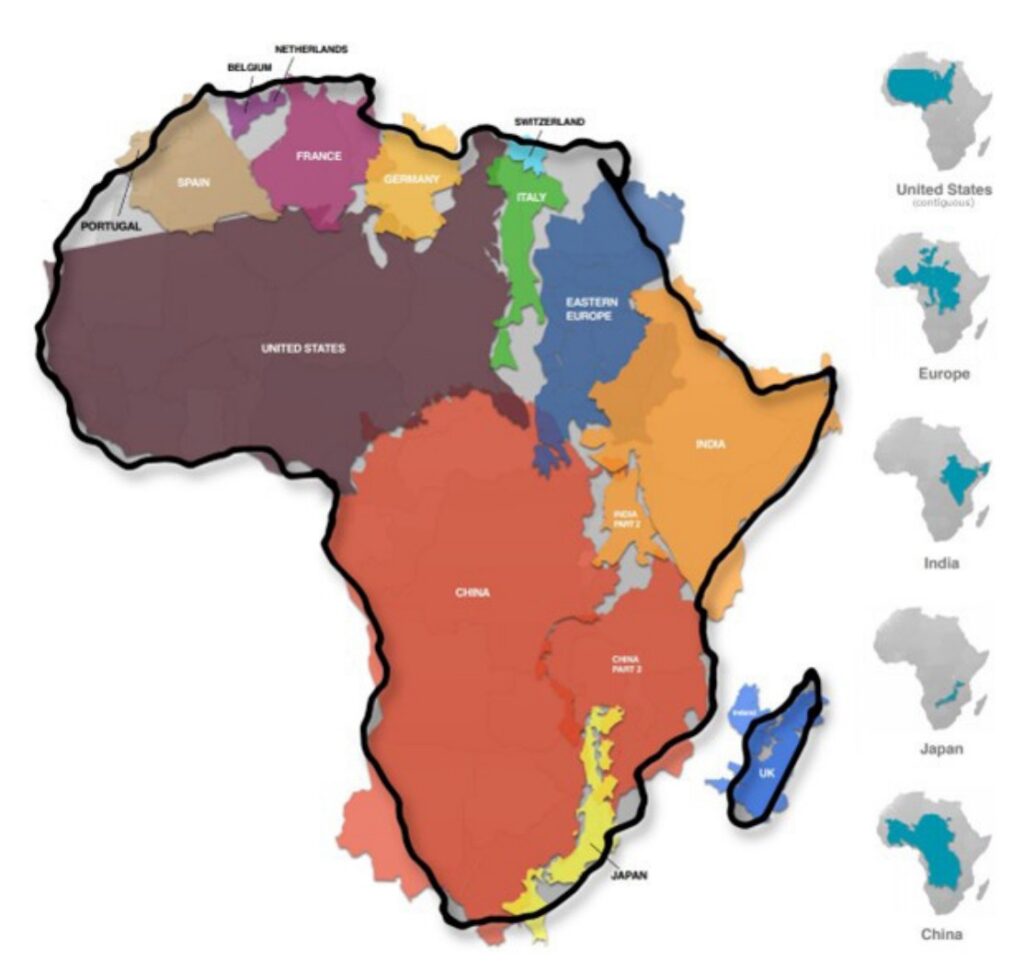
Africa comprises of 54 nations. It has a land area of 30.37 million sq km (11.7 million sq mi). You can fit into the African map the U.S., China; India; Japan, Mexico; Portugal and many other European nations [1].
• https://www.visualcapitalist.com/map-true-size-of-africa/ [ibid]
• Africa also has the world’s 65% uncultivated arable land (African Development Bank ‘2024) [3].
Africa’s Population
Africa’s population is currently around 1.5 billion, population. The median age for Africa is 19 years; This is equivalent to 18.3% of the world making Africa the youngest continent [4]
The History of the African Church
The story of how the early church expanded through Asia Minor and found a foothold in Europe is common knowledge. However, the story of how it expanded on the opposite side of the Mediterranean through North Africa is less well known. At one point, the largest cities in the Roman empire were, besides Rome, Alexandria in Egypt and Carthage in present-day Tunisia. These cities also became strongholds for the early. Christian church. Early Christian thinkers; such as Tertullian, Cyprian, and Augustine, were all born in North Africa and served in Carthage [5].
The Modern-Day African Church
Africa is the most Christian continent in the world today (Templeton Religion Trust ’2024). For over a thousand years; Europe has had the most Christians; with Latin America from 2014 leading [5]. And then in 2018, for the first time in history, there were more Christians in Africa than on any other continent in the entire world. The continent now has well over 670 million Christ-followers. This growth is well viewed in relation to the rest of the globe in the chart below:
• Map: Christians; 2018
• 2.5 billion total. 33% of global population [6]
This growth as noted in the Lausanne, Manila 2019 Global workplace forum report, is quite phenomenal granted that in 1910 at the time of the Edinburgh World Missionary Conference, Africa was 9.4 percent Christian and is now 45% Christian (ibid). The significance of the African church’s growth in relation to the rest of the world is graphically captured by Peter Brierley’s global church growth graph below:
• Map: African Christians are the key to Global Christian Growth, p]
The graph shows the impact of the African church’s growth on the rest of the global church. Globally; the growth of the church is ahead of the globe’s population growth. However, without Africa’s growth, the growth rate of the global church is behind that of the global population. This can only be an indication that Africa will continue to contribute to the global church’s growth. [8]
Expressions of the Church
The African church is largely referred to as Catholic; Evangelical or Pentecostals. In 2020 60% of Sub-Saharan Africa was Christian (that is about 650 million), with North Africa being prevalently Islamic (Statistica.com) [9]. According to the Pew Research Center 13% of Sub Sahara Africa is Evangelical (2011) [10]. The Gordon-Conwell Theological seminary gives a figure of Evangelicals as 23 % (in 2015) [11]. The Pew Review (2011) also gives Pentecostals in Africa as being 15% of Africa’s population [12]. It is evident that evangelical numbers in Africa are contested. The Pew Review does correctly in my view note that many Pentecostals and Charismatics identify as Evangelicals. This is more so in Africa and therefore the figures of evangelicals are most likely over 30 %. The prevalence of Pentecostals is well captured in the Lausanne paper (“Pentecostalism in African Christianity” 2024):
In almost all denominations in Africa; one can recognize the profound influence of Pentecostal spirituality. Whether they worship in an Anglican or a Methodist church, African Christians offer exuberant songs of celebration to the Lord; often with overwhelming emotion. Spiritual warfare and exorcism are everyday ministries for African pastors. African Christians’ strategic response to the influence of globalization has produced a creative synthesis which combines the universal truth of Christianity with charismatic spirituality born out of their tradition. [13]
The same gospel expressed: Contemplated (writing) in the West, Meditated (prayer) in Asia and Sung (danced) in Africa.
An added common expression of the African church is the commitment to engage in the quest to transform the living conditions of the flock. As noted in the Lausanne paper on Prosperity;
Health, and Human Flourishing in Africa“Christian mission and evangelism are seen as fulfilling a divine mandate when they aim to include the alleviation of pain and suffering—whether physical or spiritual—and systemic social injustice in their message of conversion.J,[14] While this practical engagement of the church is in keeping with the holistic gospel (addressing all of human needs) there is need to guard against the prosperity teaching (not gospel!).
Missionary Posture
The notion of Africans as missionaries to the unreached; unevangelized; and unchurched world
is not just a hope. Perbi and Ngugi in their groundbreaking book: From Africa to the Rest Again, observe that, Today the leaders of global mission organizations like SIM) Navigators; SIL, Langham Partners, and Global Christianity Forum are led by a Nigerian, Kenyan, Cameroonian, Nigerian, and Ghanaian, respectively. The most multinational congregation in the world;comprising 110 nationalities; was founded and is led by a Ghanaian in Canada. A number of denominations from Africa (such as Redeemed Church of God – Nigeria and Church of Pentecost – Ghana) have planted churches in over 100 countries on all continents. [15]
The Nigerian church is one example of the African church’s polycentric missionary posture. Olanrewaju; Adeoluwa observes that; The Nigerian church has been engaged in cross-border and cross-cultural missions for more than 150 years. Since then, it has played an important and growing part of the global missions movement. And Nigerians are eager to play a bigger role in collaboration with global partners. [16]
He further notes; Nigeria has around 105 million Christians. About half are Evangelicals. In relation to 仕iis, the 15,600 missionaries from NEMA’s 159 registered member agencies less than 0.03% percentage of evangelicals. We want to see 10% of Nigeria’s Evangelical population sent as missionaries. And as we see the continued rapid growth of the Nigerian church, we feel a burden to take more active leadership in the forefront of global mission. [17]
One of the key to the Nigerian church’s ongoing missionary thrust is collaboration through the Nigeria Mission Association (NEMA) that was formed in 1982. Mission agencies and churches collaborate under the non-denominational national mission association to leverage on their varied potential. NEMA and GHEMA (Ghana Evangelical Mission Association) inspired in 2013 the formation of Africa Mission Association (AfMA) a continental Mission Association whose mission is to inspire national Mission associations across African nations (I am a founding member and serve as Vice Chairman; Enoch Ghado – Ghana also present in this conference serves as Treasurer).
Through AfMA’s inspiration and guidance National Mission Associations are now being formed across Africa, including in Kenya,Uganda, Ethiopia, Malawi among others (AfMA plays a role similar to Missio Nexus – North America; COMIBAN – Latin America; AMA – Asia Missions Association etc). It is important to note that majority of African nations do not have an Interdenominational National Mission Association. AfMA’s role among others is to inspire such national interdenominational associations. While the African church has generally had a history of cross-cultural missions, we do anticipate major continental collaborations as nations inspire other nations and therefore an impact that will see the African church increasingly becoming a polycentric center by sending increased volumes of missionaries to the world.
Africa’s Youthful Resource
Africa’s median age as earlier noted is 19 years. The world’s median age is 30.6. For comparative purposes,Europe’s median age is 42.3; North America 38.5; Latin America 31.3; China 39.6; India 28.4; Russia 39.9; Middle East (broad estimate) 26.8; South Korea 45.1 – and Monaco the highest median age at 56 years. [18] 70 % of Africa’s population is under the age of 35. That translates to around 0.98 B (900,000) youth. According to the global economic players this huge population of young people portends a catastrophe due to lack of jobs and the nations limited ability to educate and equip them for work. Ighobor, Kingsley casts the youth challenge clearly in an article titled Africa’s Youth: a “ticking time bomb” or an opportunity?
Youth account for 60% of all African unemployed, according to the World Bank. In North Africa, the youth unemployment rate is an eyebrow-raising 30%. It is even worse in Botswana; the Republic of the Congo, Senegal; South Africa and several other countries . . .
Simply put, underemployment is not a solution to poverty; concurs the International Labour Organization (ILO), which reports that up to 82% of African workers are “working poor.” According to the African Economic Outlook, on average; more than 70% of Africa’s youth live on less than US$2 per day, the internationally defined poverty threshold (Un, Africa Renewal magazine; May, 2013) [19].
He further notes; “This is an unacceptable reality on a continent with such an impressive pool of youth; talent and creativity,” stresses Mthuli Ncube; chief economist at the AfDB. Alexander Chikwanda; Zambia’s finance minister, puts it succinctly: “You仕l unemployment is a ticking time bomb,” which now appears to be perilously close to exploding [20]
Recent Gen Z’s uprising as seen in Kenya have brought to the fore the fact that the needs and concerns of the youth cannot be ignored. [21] The uprisings in Kenya caught the political and government class by surprise with the unfortunate outcome of a partly burnt National Parliament building and other government assets and over 40 youths being killed. A major government reshuffle; and the President accepting not to sign the contested tax-bill 2024 was evidence that the youth’s impact had been acknowledged. However, the rioting youth also accused church leaders of being corrupt and of turning their pulpits to a political stage. While the government took note and acted, the question remains as to whether the church heard the youth and took any action.
In-spite the legitimate concerns that demand for the engagement of all including the church to empower and create opportunities for our youth, the youth are equally of great polycentric missiological significance for the African and global church. Africa’s church youth that is equally a huge percentage of the African church is a huge kingdom resource that the African church should train, equip and mobilize for world missions.
The World economic forum 2022 engaging on the African youth makes the following strong case for the youth as Africa’s greatest asset, a position that should equally be embraced by the African Church: “Much has been said about Africa as the land of promise and opportunity: precious natural resources; geostrategic positioning, or investment potential. While true; these insights often forget to consider our continent’s most valuable asset by far: young Africans. Only through embracing their drive can Africa truly reach its potential” (world economic forum 2022) [22].
Diaspora
The impact of the youth is also evident in the huge numbers of Africans – majority being youth moving to other nations. Dr. Sam Owusu founder of Calvary Worship Center, Vancouver, recognized as the most multicultural church worldwide (Vancouver speaking at the Christ is the Answer annual missions conference 5th September 2024, https://www.youtube.com/watch?v=-MIv_tNBrEw) [21] makes the case for Africa as a polycentric mission base and Africans being well placed to go to the nations of the world as education (students), workers and entrepreneur missionaries. Using his own example; he makes the case on how Africans by virtue of their numbers and resilience are well suited to go to the nations. This story is repeated in the lives of many Global South diaspora workers who have gone to developed nations and made a big difference while beginning from very humble beginnings. This adaptability as noted of the Nigerian church can be said of other African nations:
Nigerian culture fosters a can do spirit that unleashes amazing creativity and flexibility to overcome challenges. When faced with a difficulty; a typical Nigerian response is “No problem.” In missions, this helps Nigerian missionaries adapt quickly, cope with uncertainties; access difficult terrain, and survive with minimal support. [23]
However, the African church does need to equally learn from other nations that have been engaged in missions. The Filipino church is an example for diaspora workers as a major mission strategy in the middle East and Europe. The Asian News notes:
There is no denying that among the new missionaries; the Filipino migrant workers take an important place. Found in practically all parts of the world; they bear not only the hope of lifting their families from poverty: most of all, they bring their faith. There have been numerous reports of Filipino domestic helpers in Italy and elsewhere who have influenced their employees to return to the Catholic faith.
The Episcopal Commission for the Pastoral Care of Migrants and Itinerant People estimates about 7.53 million [2.3M; 2023 figures. Need to crosscheck the other figure – could entail unregistered emigrants] Filipinos are currently working abroad; affecting 8 million families or more than 60% of the Filipino population. The government has recognized them as “modern heroes’* for their sacrifices; giving service to others and contributing to a more harmonious, peaceful world. Religious leaders abroad have likewise recognized them as instruments of evangelization and inspirational models for a culture of peace. [24]
Challenges and Opportunities:
Shallow Christianity: It has been said for long that Africa’s Christianity is ‘a mile wide and an inch deep/ While this can be said of Christianity around the globe and with some parts being worse off than Africa; Africa needs more than ever before to take on the discipleship challenge. Africa’s lead as the continent most populous with Christians will only continue. It’s projected that by 2050 a half of all evangelicals on the globe will live in Africa and that Africa will have more Christians than the next two continents (Asia and Latin America) combined (Lausanne Paper Excerpt: Africa to the Rest; 2024) [25].
The big question we as Mission agencies in Africa are therefore reckoning with is “what kind of Christianity will Africa export to the rest of the world?” This calls for the African church to increase its depth in discipleship and this includes giving congregants a global missions perspective and passion. This demands for churches to invest financially in young people who are the majority with an holistic view of life [including entrepreneurship (traditional missionary centers had a church, school and clinic – without entrepreneurship being inculcated – the cross, chalk and needles – minus the coin), biblically defining work as sacred and not a curse] and being committed to equipping the youth and the church at large to be of service globally. This could answer the question paused in the cited Lausanne paper: How come there will be more missionaries from continents with fewer Christians than from the one with the most Christians? My answer – we need to commit to discipleship programs that are holistic – empowering them with faith and the skills to go to the nations of the world.
Secularism: As Africa’s economies grow, the African church is equally experiencing the shift of Africa’s communities into secularism. While schools and government spaces (in Sub-Sahara Africa) have been known to be places where faith can be exercised; this is no longer the obvious. The African church therefore needs to be prepared on how it is going to engage in this increasingly secularizing space. As has been the case with the developed nations – increased secularism adversely affects the church’s discipleship and mission capacity. Writing on the need to reposition the African church in view of secularism, Wanjiru Gitau and others in the Lausanne paper “From Africa to Rest” notes:
A lot of emphasis in this last phase of the African church’s growth has been on church planting, largely focused on conversion and numerical increase. Beyond numerical increase, it is not clear that any substantive segment of African churches is investing in the shaping of a Christian vision addressed to metamorphosing (literally changing frequently) populations. Theological curricula in seminaries that train pastoral clergy have a role to play in forming such a vision; but there is more to such a vision. In the face of multiple competing secularized visions that entirely edit out spirituality, there is an urgent need for churches to invest consciously in inspiring a biblically shaped ethical and moral vision for their societies (Lausanne Paper Excerpt: Africa to the Rest, 2024) [26].
Engage in Africa’s Governance and Natural Resources: Africa is one of the continents that is still endowed with vast volumes of mineral resources. While some of the rest of the world has depleted its natural resources, Africa still has vast amounts and for many of these natural resources controls a majority. According to UNESCO: Exploration for minerals in most African countries is still in the embryonic stage and no doubt Africa’s share of minerals will in the future continue to grow. Africa possesses about 80 percent of total world reserves of phosphate rock, 74 percent of chrome ore 89 percent metallurgical grade chromium, 40 percent of manganese ore, 19 percent uranium ore, 21 percent of bauxite, 8 percent of nickel ore, 75 percent of gold ore, 97 percent of diamonds; 10 percent crude oil and 7.6 percent natural gas. [27]
These vast volumes of resources point to a prosperous economic future for Africa. According to the African Development Bank, Africa’s natural resources worth is US$ 6.5 Trillion. The world’s leading nations are currently actively engaged in the mining industry in many African nations that are home to most of these resources. This includes nations such as the Democratic Republic of Congo, Sudan, Liberia, Egypt and South Africa among others. Sadly; the race for Africa’s resources has also led to many political con社icts. As noted by the National Geography . several African conflicts and civil wars have been caused and funded by the diamond industry. Diamonds that come from these regions are known as conflict diamonds or blood diamonds.^ [28]
The Democratic Republic of Congo is a case study on the impact and relationship between minerals and wars: . . . the 21st century brought one more complication to peace efforts in the Democratic Republic of Congo: the proliferation of mining operations. DRC is home to some of the world’s largest reserves of metals and rare earth minerals used to produce advanced electronics. As the world has become more reliant on cobalt; copper, zinc, and other minerals, local and external groups have become more incentivized to get involved in the Congolese conflict . . . The abundant natural resources—especially precious minerals—found in Congolese soil have globalized the conflict in eastern DRC . . . More than seven million people have been internally displaced due to the constant threatof violence and atrocities; as well as extreme poverty and mining expansion,especially in the North Kivu,Ituri,and South Kivu provinces. Since the beginning of 2024, nearly 358,000 people have been displaced in DRC, 80 percent of which has been caused by armed conflict. New UN-verified data also reveals that there has been a 30% increase in grave violations against children in eastern DRC during the first quarter of 2024 compared to the last three months of 2023. A staggering 23.4 million Congolese suffer from food insecurity, making DRC the country most affected by food insecurity in the world. The displaced population urgently needssecurity support; medical aid, and other humanitarian aid. Approximately 1.1 million Congolese nationals are seeking refuge beyond the Congo’s borders. [29]
DRC; whose population is 109 M (worldometer) is documented as the nation that has seen the most devastating war since World War 2, and with the highest number of refugees worldwide of 7.2 M per the UN, March 2024. [30) According to the Joshua Project DRC has 231 people groups and only 3 are unreached (Joshua Project). While this is the case, could it be that this natural resource and Church resource are being held captive by the enemy from being used to leverage for the Kingdom of God worldwide? Could it be that Africa with its numerous conflicts (Geneva academy states there are 35 non international armed conflicts going on in Africa – including Nigeria; Sudan, Ethiopia among others[31]) at large is thus being held back by the enemy from leveraging its natural resources and human resource in God’s mission of reaching the entire world with the Gospel. Could it be said that there are 35 likely polycentric centers being held back from leveraging their human and natural resources to the global mission?
The fact that many of Africa’s minerals are also exported raw for refining in the developed nations remains disadvantageous for Africa and a form of exploitations since most of the profits go to the developed nations. The relevance for this (Africa’s natural resources and their impact such as wars) in global missions is a call to the African church to be engaged with its continent’s resources and governance. The church cannot afford to stand aloof. It needs to engage with the continents resources and governance by raising workers who will be part of the policy makers that will ensure the continent benefits the most from this resources that are exploited by foreign nations and with the little that remains often being misused due to corruption that equally begins with African officials. God must be having a big reason in resourcing Africa so immensely. We believe this are the resources needed for Africa to fulfil its place in global missions;a mandate whose time has come.
Conclusion
It is evident that Africa’s numerical advantage will continue for decades to come to grow and consequently a continued increase in numbers of the African church. There is need to ensure the African church is well discipled if this numerical advantage is to make Africa a polycentric missions power house. With Africa being seen as the hope of the church; this qualitative growth is expected of the African church by the rest of the world. To achieve and maintain this pivotal polycentric position, the African church needs to galvanize all its resources including its youth, its diaspora population and natural resources. Collaboration needs to be fostered through interdenominational mission associations. The African church also needs to guard against secularism while ensuring its members are discipled to be holistic so as to make a missional difference at home and relevantly to the nations of the earth. May the African church and the Global South church be the light that shines far while also shining bright at home!
———————————————————————————————————————————————————–
[1] https://www.visualcapitalist.com/map-true-size-of-africa/
[2] Ibid
[3] https://www.afdb.org/en/news-and-events/press-releases/2024-annual-meetings-africas-voice-needs-be-heard-says-african-development-bank-president- 71259#:~:text=Africa%20will%20be%20the%20workshop;make%20the%20continent% 20globally%20competitive.
[4] https://www.worldometers.info/world-population/africa-population/
[5] https://lausanne.org/about/blog/africa-to-the-rest
[6] https://ocresearch.info/sites/default/files/field/image/Christians_2018.png#overlay- context=content/africa%25E2%2580%2599s- [7]
Ibidamazing-christian- growth%3Fq%3Dcontent/africa%25E2%2580%2599s-amazing-christian-growth
[8] https://ocresearch.info/?q=content/africa,s-amazing-christian-growth
[9] https://www.statista.com/statistics/1282701/population-of-sub-saharan-africa-by- religion/#:~:text=Christianity%20is%20the%20main%20religion,unaffiliated%20were% 20approximately%2031%20million.
[10] https://www.pewresearch.org/religion/2011/12/19/global-christianity-movements- and-denominations/
[11] https://scielo.org.za/scielo.php?script=sci_arttextCpid=S0256-95072016000200002
[12] Ibid
[13] Lausanne Paper Excerpt: Pentecostalism in African Christianity https://lausanne.org/global-analysis/pentecostalism-in-african-christianity
[14] Lausanne Paper Excerpt: Prosperity, Health, and Human Flourishing in Africa (https://lausanne.org/global-analysis/prosperity- health-and-human-flourishing-in- africa)
[15] https://lausanne.org/about/blog/africa-to-the-rest
[16] Missio Nexus, January – April 2024, Vol 60. Issue 1
[17] Ibid
[18] https://www.cia.gov/the-world-factbook/field/median-age/country-comparison/
[19] https://www.un.org/africarenewal/magazine/may-2013/africa,s-youth-Kticking-time- bomb’’-or-opportunity
[20] Ibid
[21] The Economist,9th July 2024
[22] https://www.un.org/ohrlls/news/young-people’s-potentiabkey-africa’s-sustainable- development
[23] Missio Nexus, January – April 2024, Vol 60. Issue 1
[24] https://www.asianews.it/news-en/Filipino-Migrant-Workers,-missionaries-all-over- the-world-435.html
[25] Lausanne Paper Excerpt: Africa to the Rest (https://lausanne.org/about/blog/africa- to-the-rest
[26] Ibid
[27] https://repository.uneca.org/handle/10855/42518
[28] https://education.nationalgeographic.org/resource/africa-resources/
[29] (https://www.cfr.org/global-conflict-tracker/conflict/violence-democratic-republic- congo#:~:text=DRC%20is%20home%20to%20some;involved%20in%20the%20Congol ese%20conflict
[30] https://www.worldometers.info/world-popula仕on/democratic-republic-of-the- congo-population/ [31] https://geneva-academy.ch/galleries/today-s-armed-conflicts
Polycentric Mission and the Future of Global Missions - Jonas Kang (KWMA)
Polycentric Mission and the Future of Global Missions
1. Introduction
The landscape of missions is changing dramatically in response to the rapidly evolving global context. The mission movement; which has traditionally been centered in the Global North (Western countries); is now shifting toward the Global South. This shift is causing a realignment of the central forces in World Christianity; with the mission epicenter moving toward what is now known as the Majority World. These changes, and the speed at which they are occurring, are affecting both non-Western and Western church mission movements; including those in Korea.
The mission activities of non-Western churches; including the Korean church, have been heavily influenced by American and European churches. However, as Western churches and missions experience decline, non-Western churches are entering a season of growth. Yet, if non-Western churches continue to follow the patterns of Western Christianity, they may find themselves replicating the current struggles of Western churches in five, ten, or more years. For this reason, even China*s house churches are beginning to explore ways to recover the unique DNA of the Chinese church. In his keynote address at the 2023 European Leadership Forum in Poland, Malaysian missiologist Dr. Hwa Yung questioned why Western churches have brought their declining form of Christianity to the non-Western world, criticizing the mistake of leading non Western Christianity to follow in the footsteps of a declining Western church. Some Western scholars also emphasize that non-Western churches and missions must break away from the revival patterns of the Western church and seek new alternatives to survive (Andrew F. Walls). Todd Johnson of Gordon-Conwell Theological Seminary pointed out that many mission strategies have emerged from white-centric missionaries with a negative outlook, arguing that as Christianity moves southward; new mission strategies should come from the leaders of these emerging Christian nations.
2. Polycentric Mission as a Suitable Strategy for This Era
Polycentric mission is significant because it is a strategy designed to mobilize more people for mission work. We are currently witnessing a shift in the central forces of global missions, with the focus moving from the Global North to the Global South. For a long time; global missions were viewed through the perspective of leaders from the Global North, emphasizing the importance of going out to the world. However, Ralph D. Winter defined mission as “work that crosses cultural boundaries.”
At the 1910 Edinburgh Missionary Conference, the slogan “from the West to the rest of the World” was adopted, reflecting a Western-centric mission model. Missionaries were sent from the West to non-Western regions, where they established various projects (schools; hospitals; churches, centers, etc.) as methods of evangelizing locals. This model; which required substantial financial support, is known as Christendom mission, a term first used by Lesslie Newbigin.
According to Newbigin, Christendom mission refers to the era when Western missions exercised power (financially) as the main driving force of missions.In my experience in Korea, Thailand, and other countries in Asia, Latin America, and Africa; schools, hospitals; and churches were established by Western missionaries who created mission stations. In this way. Western missionaries sent to non-Western countries (mission fields) built schools, hospitals, and various purpose-driven centers and churches for mission purposes. This Christendom mission model was instrumental in evangelizing regions around the world; leading many in Asia, Africa, and Latin America to know Jesus. Western and Korean churches also understood the beginning of missions as simply “going” (Matthew 28:19), meaning a geographical move. For this reason, since 1988, the Korean church has enthusiastically sent missionaries abroad.
Furthermore, the structure of missions involved missionaries and mission organizations doing the work while churches provided support. Thus, the missionaries sent by Korean churches followed the Western mission model; while the churches primarily engaged in prayer and financial support. Andrew F. Walls noted that while the Christendom mission model was one of the most effective methods God has used thus far; it is now time for a change, as we are in an era where missions are centered on non-Western churches. Hence; polycentric mission is needed in this era.
The term ”poly” comes from the Greek word meaning “many.” Polycentric mission refers to a strategy where many non-Western churches send out missionaries, indicating that there are multiple mission centers in the regions where these missionaries are sent. This term also describes the current reality; where churches from various non-Western regions (Asia, Africa;Latin America) are actively sending missionaries. Lesslie Newbigin, who first introduced the term “Polycentric Mission/* emphasized that future missions cannot rely solely on the Western church but must be multi-centered; with churches around the world independently becoming the main drivers of missions and missionary sending.
Polycentric Mission is a mission policy aimed at concluding the global mission movement before the return of Jesus. In fact. Western mission organizations began implementing polycentric missions over 40 years ago to mobilize non-Western churches, recruiting missionaries from the Global South. After Newbigin’s introduction. Western mission organizations recognized that completing global missions solely with Western missionaries was impossible; leading them to start recruiting missionaries from non-Western regions. For example; SIM (since 1967 with Japan’s Michika Aoba), WBT (since the 1980s with missionaries from nine Asian countries including Japan, Singapore; and Korea); OMF (since 1964 after transitioning from CIM to OMF with the inclusion of Asians), and OM (since the 1970s with the sending of hundreds of East Asians; including Koreans) began recruiting non-Western missionaries. Today, even in Western organizations, leadership often includes individuals from various non-Western nationalities. Therefore; polycentric mission is not just an option but a necessary requirement of our time. Moreover; the recent expansion of Christianity in Asia and Africa, coupled with the lack of missionary candidates from Western churches; underscores the need to change the existing Western-centric mission patterns. Some notable changes include the relocation of headquarters of Western organizations from the Global North to the Global South and the appointment of leaders from non-Western backgrounds in international organizations. For instance; leaders from non-Western countries now lead international mission organizations like SIM (Nigeria); OMF (Taiwan),CEF (Korea),WEC (Korea); CWM (Korea), Interserve (India), Lausanne (a Korean American), and OM (Singapore). Additionally; voices from non-Western speakers are increasingly being heard in international mission forums; and non-Western leaders are bringing changes to the way international mission organizations operate. We are entering an era where a “New Normal” in mission concepts is necessary.
3. The Current State of Missions in the Global North and Global South
Currently, there is a decline in the number of missionary candidates emerging from North
America and Europe. Western churches have increasingly focused on issues other than the gospel; such as religious pluralism, homosexuality; social injustice,structural evil, environmental concerns; and poverty. This shift in focus has contributed to the decline in missionary enthusiasm. The mission to evangelize unreached people groups (UPGs) before the Lord’s return (Matthew 24:14) requires committed missionary candidates. However, it is becoming increasingly difficult to expect such candidates to come from Global North churches. Over the past 50 years;the number of Western missionaries has remained stagnant, while the number of missionaries sent from the Global South has increased by 170,000.
3.1 Today, the Central Force of Christianity Resides in the Global South
The Global South is currently the fastest-growing region for Christianity. Africa, in particular, has the largest number of Christians on any continent, and the number of Christians in the Global South is 2.7 times greater than in the Global North. In other words, the countries that were once considered mission fields have now become mission-sending nations, forming the Majority World of Christianity. Given this reality, it is becoming increasingly difficult to find missionary candidates in the Global North, leading to the need for mobilization within the churches of the Global South. Consequently; Western church mission strategies are increasingly looking to the Global South. Examples include the International Mission Board’s Global Missionary Partner (GMP) system and OM’s scholarship support for missionary candidates from the Global South.
3.2 Former Mission Fields Becoming Mission-Sending Nations
While many countries in Asia, Africa, and Latin America are now sending missionaries, the economic levels of these Global South countries differ significantly from those of the Global North. As a result; when missionaries from the Global South are sent to the mission field; it is often difficult for them to follow the mission models established by Global North missionaries, such as church planting; building projects, schools; and centers. Therefore; there is a need to develop new mission methods that can be applied by missionaries from the Global South in their mission fields. Recognizing these realities; the Korean church should view 2024 as a turning point for initiating a new. Global South-centered mission movement. A new wave of mission activity (Next Mission) is required in this era.
4. Why the 4th Lausanne Conference is Being Held in Korea
The first Lausanne Conference (July 1974) took place in Lausanne; Switzerland; in Europe. The second conference (July 1989) was held in Manila; the Philippines, in Asia; and the third conference (January 2010) took place in Cape Town, South Africa. The upcoming 4th Lausanne Conference; scheduled for September 2024, will be held in Incheon, Korea; in Asia. Considering that Europe, Asia,and Africa have already hosted the conference,it might have seemed logical for the 4th conference to be held in Latin America. However) the decision to hold it in Korea reflects more than just logistical considerations; I believe it also points to a hidden purpose of God in using the non-Western church.
While Korea is the host country for the 4th Lausanne Conference; it will be co-hosted by all Asian countries,symbolizing the united effort of Global South nations in organizing the conference.
4.1 What These Times Are Revealing
We must decide whether Korea; as the last major player in Western missions; should continue to develop and advance Western mission models and know-how; or whether it should join with Global South churches (Asia, Latin America, and Africa) to create new mission models that can be implemented by the missionaries they send. Western missions and Korean church missions must cooperate to allow mission movements to emerge naturally within the Global South church. As effective mission models and examples emerge from the work of Global South missionaries, we should share these and build a healthy network of mission partnerships.
5. The Non-Western Mission Leadership Meeting in Bangkok (Coala 2)
From May 1-3; a roundtable meeting of non-Western church mission leaders was held in Bangkok, under the theme “From Christendom to Polycentric Mission.The meeting focused on discussing the current state of missions in the Global South and exploring new directions for mission. Attendees included mission leaders from KWMA (Korea World Missions Association), COMIBAM (a mission movement in 26 countries in Latin America; including Argentina, Brazil, Costa Rica, El Salvador, Nicaragua; and Mexico); COMINAH (representing Latin American churches in the United States); and others. Additionally; leaders from the house church movement in Country C (a rising mission powerhouse that has sent over 2,000 missionaries despite persecution and repression, with plans to send 20,000 cross- cultural missionaries by 2030), the India Mission Association (IMA), and various leaders from Singapore; Indonesia; Mongolia; Bangladesh, Pakistan, Sri Lanka, Malaysia, Nepal; the Philippines; Thailand, and Egypt participated. The participation of these 38 mission leaders from 20 countries represented the diversity and significance of the Global South in the mission field.
5.1 The Content and Significance of the Statement Proposed by Non- Western Leaders At the Bangkok roundtable; a joint statement titled “Recommendations for Mission Practice for the Majority World” was adopted and announced. The statement is divided into three parts: 1) Preamble; 2) Recommendations on MW (Majority World) Churches’ Engagement in World Missions; and 3) Unity and Partnership.
The main points of the statement are as follows:
First,it emphasizes that God’s mission must rely on the power of the Holy Spirit. No system, resource; or financial support can replace mission work led by prayer and the guidance of the Holy Spirit. Missions is a work that absolutely requires God’s intervention.
Second; it emphasizes the importance of local; indigenous-centered missions. In this era of World Christianity; local churches are already established in mission fields. The statement declares that it is no longer healthy for missionaries to lead mission work centered on themselves or their sending churches rather than the local church or denomination. During the COVID-19 pandemic; nearly 40% of Korean missionaries temporarily returned to Korea. While missionaries may leave the mission field due to family crises; retirement,or death, only local believers remain in the field, regardless of circumstances. Therefore, the local church must be responsible for mission work, and missionaries should work as closely as possible within the framework of the local church or in close cooperation with it.
Third; while finances are important and necessary in missions, they should not dominate mission work. Financial power can create hierarchical relationships and hegemony within missions and the church. Some suggest combining the financial resources of wealthy Western countries with the human resources of the Majority World, but this approach risks turning global missions into another form of mercenary work. Instead; missions should focus on building a sense of community through friendship and love,meeting each other’s needs without relying heavily on money. Coala 2 has decided to avoid money-centered mission projects. Fourth, the statement recommends that missionaries should be sent in response to requests from local churches or organizations through networks; rather than missionaries coming to the field on their own initiative or being sent solely based on the vision of the sending church. Missionaries should meet the needs of local churches by working within their systems; which will lead to healthy and fruitful mission outcomes.
Fifth, missionaries should remember that they are not the ones giving birth to new churches but rather those assisting in the process,like midwives. While missionaries can establish (birth) churches; most open countries already have established local churches. Therefore; missionaries must eventually leave the mission field, and they should respect the leadership and ownership of local churches rather than adhering strictly to the laws of the land. Missionaries should adopt a mission philosophy that recognizes that God is the one who builds the church, and the role of the missionary is to serve as a midwife in this process.
5.2 Practitioners Meeting: From Christendom Mission to Polycentric Mission
Today and tomorrow (Sep 30 – Oct 1), following the 4th Lausanne Conference, we are gathering at Suyeongro Church with leaders from the Global South to discuss strategies and mission movements that enable missionaries from these regions to be sent out and effectively minister. Leaders from Africa (MANI & Africa Enterprise); MENA, COMIBAM, and Asia are participating.
Additionally; we have received support and participation commitments for polycentric missions from leaders in the UK, European churches; and recently the WEA MC.
As a result; dialogues between the Global North and Global South have begun, with the first meeting between UK mission leaders and Korean mission leaders taking place at the invitation of the UK church in Oxford (May 13-16, 2024). Following this. Global South and European church leaders will meet in Poland in May 2025, and Western and non-Western leaders will convene in Penang, Malaysia; in 2027. Simultaneously; within the Global South, a preparatory meeting for theologians and missiologists was held in Dubai from June 24-27, 2024, and a gathering of 300 theologians and mission leaders from Global South churches is planned for Dubai from September 8-12, 2025, to discuss theology and mission policies centered on the Global South.
To help the Korean church and mission community understand these significant trends in missions; since the NCOWE in June 2023, we have held a series of roundtable discussions: with senior pastors of large churches and mission leaders in Gangneung (SKY Hotel), with pastors of medium-sized churches and mission leaders in Songdo (Sheraton Hotel); with missiologists (professors from mission graduate schools) in Yongsan (Novotel),and with field missionaries and mission organization leaders at the KWMA office. Additional meetings have been held with foreign missionaries serving in Korea and Korean church leaders at Yonsei University Alumni Hall, and roundtables organized by KWMC, KWMF, and KWMA in Barcelona. Moreover, upcoming meetings include a gathering of secretaries (heads) and chairpersons of the Korean denominational mission boards on October 24-25, 2024 (Pullman Ambassador Hotel, Jangchung-dong), the Haeundae Forum (November 11-13, 2024, Weston Beach Hotel), the Asian Evangelical Alliance General Assembly in Mongolia (August 7-10, 2024, Genghis Khan Hotel); and a Korean Church Denominational Leaders Meeting on March 13-14, 2025. The Korean mission community sincerely desires change in mission practices on the field and among sending churches and missionaries.
6. Understanding World Mission Trends: A Linear Perspective and Mission Christi
The question of how we view history (historical perspective) can be addressed in two ways: through a linear perspective or a cyclical perspective. These two perspectives offer different views on the unfolding of historical events and the nature of time.
6.1 Explaining World History with a Cyclical Perspective
The cyclical perspective suggests that history repeats itself, viewing events not as isolated incidents but as part of a continuous cycle that will recur in future epochs. Spengler, a cyclical historian, argued in “The Decline of the West” that civilizations; like humans; go through phases of birth, growth, decay; and death. Arnold Toynbee also described history as cyclical; progressing through stages of birth, growth, decline; and disintegration. In this view, the past; present; and future are understood as part of a great cycle in which events continuously influence each other. This perspective is associated with ancient Greek or Roman views of history and can also be seen in the religious concepts of reincarnation in Hinduism and Buddhism.
6.2 God’s redemptive history (mission history) can only be explained through the linear
perspective of the Hebrews. The Bible sh이jld be understood from a linear perspective; which is also the historical view of the Hebrews, developed further by Augustine. In this view; God is the ruler of history, using specific individuals throughout time, from the creation of the world by Adam to the final return of Jesus (Parousia); to accomplish His purpose of redeeming fallen humanity. I believe that the missionary perspective aligns with this redemptive historical perspective.
Throughout biblical times, the apostolic era (Paul; Peter, Thomas, etc.), the post-apostolic era, and the era of the church fathers; God used specific individuals. The Bible shows that figures like Abraham; Isaac; and Jacob were used in each era to further God’s redemptive plan. In the New Testament era, there were the 12 apostles of Jesus and Paul, and as history progressed through the post-apostolic and church fathers^ eras; God continued to use faithful individuals to fulfill His redemptive work. In modern missions; we can see God’s work through figures like William Carey in the era of coastal missions^ Hudson Taylor and Adoniram Judson in the inland missions era; and Cameron Townsend and Ralph Winter in the era of missions to unreached people groups. For the Korean church, God used missionary heroes like Underwood, Appenzeller, Heron, Samuel Moffett, and Scranton, as well as Korean pastors like Kim Ik-du, Son Yang-won, and Lee Seong-bong. Since the Reformation, God has employed the Christendom mission model centered on Western churches. Now, following the actual circumstances of our time, God is using non Western churches, marking the beginning of a new era of Polycentric Mission.
6.3 From Missio Dei to Missio Christi
The mission practices of non-Western churches, including those in Korea; have been heavily influenced by the paths first taken by American and European churches. “Missio Christi” (Mission of Christ) is a traditional mission concept that focuses on God’s mission as accomplished through the life; work, and resurrection of Jesus Christ. Under this concept, churches send out missionaries, emphasizing the work and gospel of Jesus (the incarnation, cross, resurrection, and other redemptive acts) as the core of their mission. The church is the institution created by God for the purpose of evangelism (missions). Howard A. Snyder emphasized that God does not have any other institution for missions besides the church.
Therefore; the church sends missionaries, spreads the gospel of Jesus, and establishes churches to carry out the redemptive work commanded by God.
However, the post-Christian shift in Western churches has led to a decline in missionary activity;as some Western churches; influenced by liberal theology, have gradually accepted religious pluralism, thereby reducing their missionary efforts. In this context, at the 1952 International Missionary Council (IMC) conference in Willingen, Switzerland; Karl Barth proposed the concept of “Missio Dei” (Mission of God), which garnered significant attention. Missio Dei refers to God’s mission, asserting that the primary agent of mission is God, not the church. The church is not given a mission by God but rather participates in the mission that God is already undertaking.
For example, the role of the church as a tool in God’s mission is seen as part of His salvation plan, and the church’s participation is structured as a passive obedience to the overarching mission of God.
Additionally; Missio Dei expands the concept of mission beyond evangelism to include all church activities such as worship, education, service, evangelism, and social work. The church participates in these areas under the name of God’s mission, emphasizing peace (shalom) with God and the need to change societal structures (structure evil) to achieve human dignity, thereby viewing social salvation as within the scope of mission.
In summary; the church is seen as a tool used by God in His mission, tasked with witnessing to the world and fulfilling God’s will. Thus, the Uppsala Conference (1968) recognized the improvement of impersonal structures within society as a legitimate mission. This led to the understanding of mission as encompassing political and human rights improvements, as well as the concept of holistic mission.
Ultimately, this perspective placed the goal of mission in humanization. Therefore; many Western liberal churches today view current issues like homosexuality not as matters of biblical truth but as human rights issues. Influenced by this liberal theology, some Western churches seem to have abandoned the doctrine of biblical inerrancy.
While Missio Christi focuses on the redemptive work accomplished through Christ; Missio Dei emphasizes the broader salvation activity initiated by God. Although both concepts are God-centered, they differ in their focus and approach to the role of the church in mission.
Conclusion
I believe that the future of global missions depends on the mission movement of non-Western churches. Polycentric Mission, centered on non-Western churches, is not about displacing Christendom missions but rather recognizing it as the method God is using in our time when considering the broader context of God’s redemptive history.
Therefore; Polycentric Mission should receive the blessing of the advanced Western churches, while also developing new mission strategies for approaches that cannot be replicated by non Western churches. Our hope is that God will allow us both continuity and discontinuity in the global mission movement; ensuring that it continues until the Lord’s return. Thank you.
Cristian Castro (COMIBAM)
The Ibero-American Missionary Movement and the Global South
Please allow me to start this presentation with the end in mind and then move on to some thoughts on the birth, growth^ and development of the Ibero-American missionary movement;which I am qualified to speak about this morning.
In 1987, the first Ibero- American missionary congress COMIBAM’ 87 was held in Sao Paulo, Brazil, with the participation of over 3,200 attendees; including missionaries , pastors; and observers. They gathered to hear God’s voice concerning the role and responsibility of the Latin church in global missions. It was during this congress that the famous phrase was proclaimed: “Latin America ceases to be a mission field to become a missionary force,” in response to the 1916 declaration of the International Missions Congress in Panama City,where international agencies divided up missionary work and declared Latin America a “mission field.”
I am convinced that the leaders of COMIBAM’87 did not foresee the extent and power of such a declaration, which came about in an atmosphere of faith and celebration, not of pride. Over 37 years have passed since that declaration, and under the guidance of the Holy Spirit) the missionary movement has grown, matured, and embraced it. But there is still much work to be done.
Recently; the COMIBAM Research Department provided me with official data from the study “The Ibero-American Church and the Global Mission of God,” with the participation of approximately 1,200 pastors from across Ibero-America. The information is both revealing and challenging, though I must caution that these are not final numbers; as they are updated daily.
However; I take this opportunity to share with you some highlights of the research:
1. On Ibero-American Missionaries:
– There are over 30,000 Ibero-American missionaries serving full-time in 200 countries.
– 36% serve in indigenous and tribal contexts.
– 27% serve in Islamic contexts.
– 21% serve among the Latin diaspora in the USA and Europe.
– 12% serve in Hindu contexts.
– 9% serve among the Islamic diaspora in Latin America, the USA, and Europe.
– 9% serve in Buddhist contexts.
2. On the Latin Church’s Participation in Global Mission:
– Over 60,000 churches are directly involved in sending and supporting missionaries in the field.
– More than 137,000 churches across Ibero-America are actively involved in various forms of God’s Global Mission.
– 19% of churches pray for missions and missionaries.
– 25% of churches give offerings for missions and missionaries.
These figures represent years of work, mobilization, prayer, investment, faith, tears, and joys. In 1987, there were only around 1,300 known missionaries in Latin America and a few churches involved in missions. Today; 37 years later, the Latin missionary force has grown, and the number of churches engaged in missions has multiplied. We are not yet the “missionary force” that was declared; but I am convinced that, under the Lord’s guidance and for His glory alone, we are on our way to becoming one.
I grew up in one of the suburbs of San Jose; Costa Rica; where I witnessed the work of missionaries from the United States; Europe, or South Korea. I was what Carlos Cardoza calls in his book uthe object of the mission.Somehow, I was blessed by those who left everything to preach the gospel in our countries. But I never imagined that one day I would no longer be the “object of the mission” but the “subject of the mission/’ as Carlos Cardoza proposes in the same book, meaning “the one who must now bring the gospel to others.”
Latin America: A Declared Mission Field
As I mentioned earlier, in 1916, the World Missions Congress was held in Panama; organized by foreign missions. During that congress, Latin America was declared a mission field, and countries were assigned to different international missions. Historical records show that at that time, 50 missionary societies were working in Latin America; with 235 delegates attending the congress. Of those, only 27 participants were Latin.
The official language of the congress was English, meaning the voice of the Latin church was very small; if not almost nonexistent. This fact is relevant because it indicates that; at that historical moment; the small Latin church was not considered a participant in global missions. Furthermore, foreign missionaries did not consider Latinos as a possible missionary force; as Pablo Carrillo mentions in his book ^Huellas en el Desierto*: “The predominantly foreign missionary community in Latin America did not imagine that the people being reached with the gospel would one day become a missionary force within and 이itside their countries.”
The Influence of Lausanne on Latin America
The Lausanne Congress on Evangelization; held in Lausanne, Switzerland; in 1974, was the most important milestone in the history of evangelical missions at that time. Its influence reached Latin America through the many Latinos who attended, as well as through literature and subsequent consultations organized by the Lausanne Movement. More accurately, pioneers of Latin American evangelical missiology, such as Samuel Escobar, Rene Padilla; and others, made significant contributions to the Lausanne Congress in forming a missionary mindset based on a comprehensive understanding of the gospel.
The emphasis on the theology of the Kingdom of God and the consequences of the church’s presence in society greatly impacted the direction of global missiology and global missionary work. We praise God for this Latin American contribution to the global evangelical community.
The Birth of the First Latin Missionary Movements
In 1976; the 五rst national missionary association on the continent; the AMTB (Brazilian Transcultural Missions Association), was organized through the initiative of several nationa leaders and foreign missionaries working in Brazil, with Jonathan Dos Santos as its first president. The AMTB was founded by nine missionary agencies; with the participation of several denominations.
A few years later, another Latin American country took on the challenge of becoming a missionary force. Thus; in 1982, in a small town in C(5rdoba, Argentina; Villa Giardino; under the leadership of pastors and missionaries, the World Missions Network (RMM) was born to mobilize the Argentine church to reach all nations.
The Birth of COMIBAM: From Field to Missionary Force
The leadership of AMTB and RMM was prophetic in their time for the church, emphasizing the need for our continent to take responsibility in God’s mission. Consequently, the Latin American Evangelical Fraternity (CONELA) convened a meeting of leaders in 1984 in Mexico to discuss organizing an international congress to promote the development of the missionary vision in the region.
COMIBAM’87 was thus held, where more than 3,000 representatives from all Latin American nations, Spain, and Portugal; as well as observers from other countries, gathered to discuss global missionary work and commit to the formation of a missionary movement from Ibero-America. It was during this occasion that Luis Bush emphatically proclaimed: “In 1916, Latin America was declared a mission field. Today,in 1987, Latin America declares itself a missionary force.”
COMIBAM International developed relationships worldwide with other national; regional, and global networks, helping to establish working groups, convening consultations; and producing books in Spanish and Portuguese.
The Development of the Ibero-American Missionary Movement
To systematically understand this process; we must remember some key dates in the development of COMIBAM and its concrete contributions to the missionary movement:
• 1987 – First Ibero-American Congress in Sao Paulo, Brazil. Mobilization efforts are strengthened throughout Ibero-America; and serious commitments to global missionary work emerge.
• 1991-1992 – Consultations in the area of cross-cultural missions are promoted. More missionary training centers are established; and those already in existence grow and are strengthened.
• 1992 – The * Adopt a People* (AUP) strategy is disseminated; promoting outreach to the
“unreached.” The results include the establishment of a regional prayer program, the creation
of manuals and materials on AUP,and an increase in the number of missionaries sent to the
field.
• 1997 – The Second Ibero-American Missionary Congress; COMIBAM’97, is held in Acapulco, Mexico. It was an opportunity to evaluate and project what the mission is, what it needs; and what elements are necessary to carry it out. As an Ibero-American missionary movement; an analysis is conducted of new trends in global missionary work.
• 2000 – The First General Assembly of COMIBAM is held in Lima, Peru; bringing together over 100 leaders from Ibero-America with the aim of structuring and consolidating the work, formulating a basic organization, and emphasizing the three main networks of the missionary
process.
• 2003 – The First Leadership Summit of COMIBAM International is held in Guadarrama, Spain, with a focus on developing proposals and strategies to strengthen the movement.
• 2006 – The Third Ibero-American Missionary Congress; COMIBAM’06_, is held in Granada, Spain, under the theme: “Results and Challenges among the Unreached.” The goal was to evaluate the missionary movement from the field’s perspective. Over 1,800 movement leaders and 300 active Latin American field workers gathered.
• 2017 – The Fourth Ibero-American Missionary Congress; COMIBAM’17, is held in Bogota, Colombia; under the theme: “With Jesus on Mission.More than l,700 leaders, missionaries, and observers gathered.
• 2023 – The 2nd Ibero-American Consultation on Unreached Ethnic Groups is organized in Panama City, with the participation of more than 130 delegates from all over Ibero-America to reaffirm our commitment to 1,850 unreached or unevangelized ethnic groups.
We could say that COMIBAM has gone through several historical stages since its inception, development; and growth. Currently; I dare say that we are in a stage of reinvention and growth. We are in a process of maturity; moving towards becoming a polycentric movement; developing several centers of action. An example of this is that we have already started the work of COMIBAM Asia, COMIBAM Europe; and very soon COMIBAM Middle East. The purpose is to first serve the Latino workers who serve in these regions but also the Latin Christian diaspora that has moved to these areas for work reasons and to collaborate with the global missionary movements of these regions such as: IMA, KWMA, and many others.
COMIBAM in Motion
Therefore; we can conclude that over these years, COMIBAM International has been a space for national missionary movements in the region and the church to meet, formulate strategies; and collaborate with the global missionary community. We have dedicated ourselves to supporting and serving the Ibero-American missionary community. We seek to stay attentive to changes and new opportunities in the global missionary context,serving as a bridge between missionary organizations in our region and those in other parts of the world.
To date; we thank God for the thousands of churches and pastors who participate in God’s Global Mission, and as I mentioned earlier, for the commitment to accompany the church in the task of praying and taking the gospel to at least 1,850 unreached ethnic groups.
We are on the verge of celebrating our 5th Ibero-American Missionary Congress; COMIBAM’2025, in Panama City from April 22 to 25, 2025. We expect more than 1,500 leaders; pastors, missionaries, and mobilizers. We are convinced that the congress will be a point of meeting, reflection, and celebration, but it will also be a time to listen to the Lord regarding the future of the Ibero-American Missionary Movement.
By faith and in dependence on God, we dream for the future with: 10,000 new Latin missionaries, for a total combined of 40,000 workers in the field; seeing 200,000 churches mobilized, praying, sending, and supporting missionaries in the field; and Latin workers reaching the 1,850 unreached ethnic groups targeted by COMIBAM.
It excites me to know that we are not alone in this pilgrimage. I feel accompanied by each one of you and the emerging movements we represent. I ask the Lord to give us the humility to continue carrying His word together to all nations, especially to the least evangelized.
Manik Corea (SCGM)
Setting Sail for Open Sea-COALA and the rise of polycentric Christianity
COALA started as a round-table conversation among Asian and Latin American mission representatives.
We were in Korea at the 9th NCOWE in 13-16 June,2023. As we listened and prayed with our Korean brethren from the Korean World Mission Association (KWMA), they shared about a collective desire among their missionaries to change the dynamics and methods of Korean missions globally. We all felt at the same time, a desire to repent; prayer with, discuss and discern how missions in our regions (Asia and Latin America) can likewise adapt to the new season of polycentric missions that God had brought us into.
The conversations round that table were encouraging; sensitive, supportive and consensus building. As well as the Korean leaders, present were others representing mission agencies and mission associations from India, Philippines, Taiwan, Malaysia and Singapore.
Additionally, David Ro represented the East Asian Regional Directorship of the Lausanne Movement. Cristian Castro, Executive Director of COMIBAM International represented the 25 national mission organisations and network in the Ibero-American (Latin America) region. Dr Bambang of Indonesia, the General Secretary of the Asia Evangelical Alliance; had the last word and he encouraged us that this was to be the style of leadership common in Asia – where we sought to listen to each other – everyone having a voice around a common table. He; as the most senior (in terms of position and responsibility among us) was the last to speak, and brought us together towards a consensus with insight and wisdom.
As a result) we decided that these important conversations should not end there. We felt that we needed to walk and work out together how to change and adapt missionary approaches and practices in the majority world to reflect a more Kingdom-of-God-centric, multi-dimensional, Spirit-dependent; poly-centric, collaborative and bottom-up way of doing missions.
On our final days in Seoul, we discussed forming an ongoing network for discussion, learning and formation. I came up with the name KOALA – as we were in Korea; in a meeting of Asian and Latin American leaders. So KOALA: KOrea – Asia – Latin America.
This was later changed to the acronym COALA – because Christ is the head over us all the regions of the majority world – Asia, Latin America and Africa – as indeed He is over all other regions, places and spaces in the universe (Matthew 28:18). Thus COALA stands for: Christ- Over-Asia-LatinAmerica-Africa.
We have since met a second time in Bangkok, Thailand on 1-3 May of 2024 – with more leaders, church and mission leaders and market-place practitioners joining from both Asia and Latin America (we were not yet able to get our brethren from Africa there). Out of that, we had a final statement and a paper recommending some principles for doing mission in a new era of polycentric Christianity.
The Sun and The Wind
In this paper, I wish to raise some important principles to help guide us;in the light of the Lausanne 4 Congress; so that we can continue to discern together how majority churches can engage more faithfully and fruitfully in God’s mission in this new era.
I titled this paper, ‘Setting Sail for Open Sea* because when one sets sail in open waters away from visible land mass and with only the oceans as our horizon and view, we can easily become disorientated in terms of direction and navigation. We can also be discouraged by the vastness of the sea and wondering whether we have enough resources to get to the other side.
In the day of pre-motorised engines; one was dependent on the sun by day (and the North Star at night) for direction; and on the wind (in sails) for movement. I believe this is an apt description of our need to be dependent on the Son of God for direction and guidance; and on the wind of the Spirit for taking us to where He wants us to go.
In moving towards a new era of polycentric Christianity; I want to propose for a need on the one hand for a discontinuity with past unhelpful realities; and the need to keep some important continuities with the antecedent mission and history of God’s church on the other.
Discontinuities:
1. The end of Western-centrism in missions.
We are moving towards a new era away from Western-centric missions which dominated mission thinking, leadership, resourcing and perspectives in the last 300 years. In its place, we are seeing an emergent world-Christian understanding and practice that is multi-lateral, multi-dimensional, poly-vocal and poly-centric; where all God’s people all over the world are called together to lead, support and participate in God’s mission.
Christianity, even in very recent times; was cast in wholly Western forms. It was common to expect missionaries to be white-skinned, auburn-haired and tall! However; Global Christianity today is much more dynamic, complex and multi-faceted as a faith that many people; even Christians themselves, are able to grasp. In fact; it is also more culturally diverse than at any time in her history; as is her mission force.1
While we rejoice and are thankful for the legacy of the Western church in missions in the last three centuries; yet we affirm the need for all regions and corners of the world to come of age and to be helped to contribute towards a global Christian movement in missions in our day. This includes the continual need for building and releasing self-leading, self-resourcing, self-replicating and self-theologizing, indigenous Christian churches with viable mission movements in every region.
The redefinition of Christian mission as not just being from the ‘West to the Rest’,but from ‘Everywhere to Everywhere’, is a phenomenon to be sought and celebrated. As is the fullimplication of the famous call our of the Lausanne Movement: ‘the whole church taking the whole Gospel to the whole world.’
2. The end of control and domination by any one part or region of the church.
No one part of the world should have preferential say and sway over how mission in to be done or led. We need to find ways that allow for sensitivity to regional cultures and concerns while at the same time; never losing site of the universality of Christ’s Kingdom claim and rule and the power of the Gospel to defeat and redeem sinful people who are essentially the same the world over.
In the words of Andrew Walls; the church is called to be both a pilgrim and indigenous people; holding in tension both its particularity and its universality.2 Within this continuum of poles, no one part of the world or church can presume to fully possess what it takes to reach and disciple every culture. The Global Church is called to be, in the words of Paul Hiebert;a hermeneutical community that “checks interpretations and seeks consensus” so that each part (national or peoples) learns to hear and receive the insights of other parts.3 At the same time, the development of contextual theologies and missional modes are to be encouraged.
The bane of missions has been the dependency and patronization through the use of superior finance; technology; education, privilege and power by regions and countries (not merely Western) with greater capacities and wealth. In this new day of polycentric missions, we need to work to ensure that each region is free from unhealthy systems; methods and histories of domination and control. Instead; mutual partnership and assisting healthy local; indigenous leadership to take their place should be the norm.
Continuities:
Even as we need to discontinue unhealthy systems and ethno-centric; paternalistic behaviours from the past, we must at the same time seek to continue to build trust, partnerships and collaborative efforts among all regions of the world. These include being committed to the following biblical precedents:
1. UNITY – The church is one in the eyes of God, and so must her mission; as Jesus prayed in John 17:21.
Through the ages, the centrality of the Gospel of Jesus Christ; the revelation of God’s purpose and mission through the Scriptures; and the sustaining, purifying and guiding work of the Holy Spirit have been the common ground and centrifugal forces of unity amongst many diverse parts and places of the Church. In this; she mirrors the essence of the divine community – our trinitarian God.
What does our unity truly consists of? Perhaps a look back in history is in order.
The Nicene(-Constantinopolitan) Creed has been historically; the most widely received confession of the world wide church. Accepted fully in AD 381 at the Ecumenical Council of Constantinople; it is a true summary of core Christian beliefs from the Scriptures as received through the teaching and fellowship of the apostles and those that followed.4
One line in particular is of interest 一 that is, the declaration that ‘We believe in one, holy, catholic and apostolic church’. This is the belief that the church of Christ is:
• unified and indivisible under the triune God
• sanctified by faith through the work of Christ by the Holy Spirit
• universal (i.e. catholic) as the only Church of God in the world for the sake of God’s mission and finally, apostolic as it is founded after the teachings of the Apostles and called to continue in their on-going mission into the world.
These have been called the 4 marks or elements of the true church.5 In order to maintain unity; we should not forget what it means to be the one; holy,universal and apostolic church. The Global Church is truly most like her Lord when she is able to remain united despite the diversity of personalities; preferences; theological understandings; gifting and opinions her members bring with them.
Such a unity,as Paul points out in his letter to the Ephesians, is to be kept and pursued; a ’unity of the Spirit in the bond of peace* (Ephesians 4:3). We all after all part of one body of Christ; we have all received one Holy Spirit and are called to one common hope. We have only one Lord we obey; one saving faith to live by and one baptism we have undergone (4:4- 6). This is the good (apostolic) deposit he referred Timothy to in 1 Timothy 6:20.
2. SUBMISSION TO CHRIST – The Church and its Mission belong to God first and foremost.
The task of Mission is inseparable from the Task-Master of Mission. To build the Church, we must follow the plan of the Chief-builder and architect and owner, Jesus Christ who is himself foundation, superstructure and pinnacle of the church (1 Corinthians 3:11; Ephesians 2:21,22.)
Faithfulness to him and His Lordship is paramount.
One of the most common image of the people of God, the Church is presented as the ‘body of Christ/ (e.g. Rom 12:5; 1 Cor 12:12-27; Eph 3:6, 5:23; Col 1:18, 24.). Christ is portrayed as the head where all God’s peoples are members of his body. Physiologically; as the head wills and directs, so the body goes. So it is with the global church. In fact, Jesus called the church as His church in Matthew 16:18.
Secondly, this global church will be, in continuity with the witness; writings; teachings and tradition of the apostles, a church that sees itself as being sent on into the world on mission. It would be a missionary church in the same way that the Apostles were given a missionary commission by their (and our) Lord. We follow in the footsteps on our Lord who sent His Apostles out into the world to continue His world-wide mission. In this, we must be led by the Holy Spirit; and guided and conformed to the inspired Holy Scriptures; which are the Word of God written.
A Warning
Even in the need for some discontinuity with the broken and overbearing systems of the past, we must avoid going too far the other way. There are some who seek more radical, reactionary responses to their perceived failings and faults of the Western mission movement by urging for or disavowing participation in, any regional or global movement or network they see as being too Western or (too) Western-influenced; or treating contemporaneous Western mission efforts with almost open disdain.
To do so betrays an arrogance and hubris, as though to suggest that we can now accomplish God’s mission by ourselves or do better, forgetting that our Western brethren brought us the Gospel.
In fact, we can no more escape our past, since it has brought us to where we are today! Indeed;who we become – the fruit of our future – is carried in the seeds of what was planted in us in the past.
That is not to say we don’t need to adopt a theology of change that allows for a time of intentional attitudinal change; preparation and posturing towards new behaviors; priorities and habits.
That is, there does need to be discontinuity with elements of past behaviour and practice. At the same token, we must seek to maintain and keep the unity of the Global Church and maintain fidelity to its Lord; who both created and values every part of it. We cannot say to one part of the global body, we don’t need you anymore! (See 1 Corinthians 12:15-26, especially verse 21.)
The new land awaits discovery!
As we meet to continue to discuss; pray for and deliberate together in the aftermath of the historic Lausanne 4 Congress, let’s be confident that God is the One who’s mission we are called to join, and He is it who will bring His purposes about through the growth and development of polycentric missions. Indeed, we have a great deal to be hopeful about.
God is on the move and there are increasingly new global centres for mission in many parts of the non-Western world.
Christianity in truth has always had movable centres – whether Jerusalem, Rome, Constantinople, London, Geneva or New York, or today’s diverse nexus like Seoul; Sao Paulo, Kolkata; Singapore, Cape Town or Nairobi. Andrew Walls famous remark bears true: “The movement of Christianity is one of serial; not progressive; expansion.”6
Agreeing, Dana Roberts argues that Christianity in history consistently reflects a global/ local fabric.7 Its movement from one culture to another has always created shifts in her self understanding from cultural influences brought to bear in whatever soil she takes root in. In particular, Christianity’s dynamic shift today “s이itti of the equator” challenges us to reflect carefully on the way God works in historical shifts and new eras.
“What at first glance appears to be the largest world religion is in fact the ultimate local religion… Flexibility at the local level, combined with being part of an international network, is a major factor in Christianity’s self-understanding and success today. The strength of world Christianity lies in its creative interweaving of the warp of a world religion with the woof of its local contexts.’18
Historical eras and cultural spaces are the milieu in which the Church must root herself, but also be the platform from which she must shape; nuance and exercise her prophetic witness and cultural challenge against the ideologies and idols that hold popular sway.
At the last; the redefinition of Christian mission in our day must reflect the sea change in the socio-cultural composition of the global church. We have truly moved on from a “West to the Rest” uni-directional mission position to a poly-centric “From Everywhere to Everywhere” experience in a few decades.
Consider that the ground on which the growth and blossoming of Christianity has taken place in many parts of Africa, Latin America and Asia has a distinctly local look and feel! This multi cultural globalising dimension is a fascinating characteristic of the global church today.
Though Western Christianity continues to have the greater resources; institutions; influence and clout, we live in exciting days!
Today; we can see African churches and growing mission movements largely led today by African leadership. We see Latin Americans resourcing the exponential growth of their mission force to other countries; notably from Brazil. We can see Asian Christians in places like India;Philippines and China needing little motivation to work among unreached peoples and communities in their own hinterlands and further afield.
Dana Robert vividly captures this fundamental shift as follows: “Mission in the twenty-first century is not limited to the old model of cross salt water for a lifetime in another culture.
Rather, it is a network, an international web of human relationships in which the ‘missionaries’ scamper back and forth like human spiders; weaving and expanding the web in all directions..”9
If God himself desires to include within the boundaries of His kingdom, every nation, language and peoples on earth (Matthew 8:11; Revelation 7:9), then the world church must reflect this ‘global’ bias.
That is, that there is (and always ought to be) in this global family, space and a voice for all kinds of people, language and church expressions; all made one in Christ in worship before a global God, and on mission with Him into a hostile and fragmented world.
And for that, we need more friendly conversations around the global table. All must be made
welcome!
—————————————————————————————————–
1) Dana L. Robert. Christian Mission: How Christianity Became a World Religion.(Chichester: Wiley-Blackwell, 2009),page 79
2) Andrew Walls; The Missionary Movement in Christian History: Studies in Transmission of Faith (Mary Knoll, N.Y.: Orbis Books, 2001), page 7-9.
3) Hiebert further argued: “Just as believers in a local church must test their interpretations of Scriptures with their community of believers, so the churches in different cultural and historical contexts must test their theologies with the international community of churches and the church down through the ages. The priesthood of believers must be exercised within a hermeneutical community.” Paul G. Hiebert, Anthropological Reflections on Missiological Issues (Grand Rapids; MI: Baker Books, 1994), page 102- 103.
4) Thomas Oden, Classic Christianity (New York: HarperOne, 1992),page 720.
5) Oden, page 720
6) “The Expansion of Christianity: An Interview with Andrew Walls” in The Christian Century, August 2-9, 2000, page 792.
7) Dana L. Robert. “Shifting Southward: Global Christianity since 1945.” in International Bulletin of Missionary Research, Volume 24, Issue 2, pages 50-58.
8) Dana L. Robert. “Shifting Southward: Global Christianity since 1945.” in International Bulletin of Missionary Research, Volume 24, Issue 2, page 56.
9) Robert, Christian Mission, page 177.
Zhang
Reflections on the Challenged and Future of the Mission China Movement
During the 2013 Asia Leadership Forum, a leader of the Chinese church’s missionary movement proposed the vision of ”Mission China 2030.” This vision aims for the Chinese church to enter a missionary era by sending 20,000 overseas missionaries by the year 2030. This goal has inspired many leaders within the Chinese church to actively promote the “Mission China 2030” movement. Even before 2013, leaders of village-based team churches had proposed the ambitious goal of sending 100,000 missionaries and collectively promoting the “Back to Jerusalem” movement. However, there are also cautionary voices warning against a “Great Leap Forward’* style of missionary work, suggesting that even sending 1,000 missionaries would be a significant achievement for the Chinese church. Indeed, while the missionary movement within the Chinese church has seen significant growth over the past decade;it continues to face numerous challenges and has developed several unhealthy elements.
1. Challenges Faced
The missionary movement of the Chinese church faces multiple challenges) including policy constraints; internal church issues, and difficulties in the mission fields.
1) Challenges from Restrictive Religious Policy
In recent years; the Chinese government has developed and implemented comprehensive regulations on religious affairs. Besides the State Council’s “Regulations on Religious Affairs” (2018), it has issued several others: ”Measures for the Administration of Religious Groups’* (2019), “Measures for the Administration of Religious Personnel” (2021), “Measures for the Administration of Religious Colleges” (2021), “Measures for the Administration of Internet Religious Information” (2021), and HMeasures for the Financial Management of Religious Activity Sites’* (2022). Provinces; autonomous regions, and municipalities have also formulated local “Regulations on Religious Affairs.” The Chinese government views religious issues as related to national security and sees a “contest of ideologies” between religion and socialism. Within this policy environment, the development of the Chinese church is generally restricted; making the missionary movement even more difficult. Challenges such as the inability to register missionary organizations formally and the lack of official channels for financial support due to an atheistic regime create significant obstacles.
2) Internal Challenges within Domestic Churches
Under restrictive policy environments; formal congregations have transitioned into small groups or meeting points to increae the survival capability of churches. However, it leads to resource dispersion, a lack of workers; and widespread spiritual stagnation among believers. Due to these dispersed resources; support for missionary work has naturally weakened, with many churches cutting their missionary budgets due to survival challenges. During the pandemic; the increase in online missionary meetings and courses somewhat revived and enlightened missionary efforts. However, in the post-pandemic era, as churches struggle to recover and develop robustly;attention and support for missionary efforts have significantly diminished.
3) Challenges on Mission Field
Chinese missionaries face dual pressures in mission fields: one from the non-Christian environment of the mission field and another from the atheistic regime from back home. Chinese missionaries not only receive inquiries from local public security departments about their activities abroad; and but also be monitored and face resisting overseas missionary activities by Chinese government continuously . China’s unique religious policies and legal environment pose restrictions on church development and missionary activities;extending even into overseas mission fields and creating persistent pressure and challenges.
2. Unhealthy Elements
With the increasing number of missionaries; several unhealthy factors in missionary work have become more apparent. If these issues are not timely rectified; they could negatively impact the overall effectiveness of missionary efforts.
1) Lack of Missionary Strategy
The missionary efforts of the Chinese church show a lack of strategic thinking and planning. Many missionary teams arbitrarily choose their destinations instead of being guided by systematic research and comprehensive strategic planning. This lack of direction results in many missionaries clustering in popular regions; which leads to resource duplication and waste, ultimately achieving less effective outcomes. Meanwhile; many unreached people groups still await attention.
2) Misplaced Missional Passion
Historically; many traditional missionaries; such as early China Inland Mission (CIM) missionaries; entered the mission field with genuine love and a strong sense of mission. However, in modern missionary work, this devotion seems to be replaced by a more superficial “passion.n While passion has its value, lacking deep love and enduring commitment diminishes the effectiveness of many missionary activities. Missionary work should be driven by God’s calling and a wakeful sense of mission rather than transient personal enthusiasm and excitement.
3) Inadequate Financial Management
Due to the inability to manage finances through formally registered missionary organizations, financial management among Chinese missionaries often lacks transparency and supervision. Some missionaries have abundant resources, even receiving redundant support from multiple sources; while others face resource scarcity and survivability challenges. Initially, when missionaries don’t engage in extensive ministry, sufficient living expenses may suffice, but as mission efforts expand; financial needs grow. A lack of robust management mechanisms can easily lead to financial issues.
4) Insufficient Language Learning
A common issue among Chinese missionaries is the neglect of language learning. Effective and enduring missionary work often follows an incarnational mission model; making language proficiency a vital early challenge. Many Western and Korean missionary agencies require missionaries to focus mainly on language learning for the first two years, considering it a critical starting point for long-term missions. However, many Chinese missionaries rush into mission work without dedicating adequate time to learn the local language, thereby failing to attain good language proficiency even after five or ten years.
3. Future Directions for the Chinese Missionary Movement
Addressing numerous challenges and unhealthy factors necessitates seeking a future path for the Chinese church*s missionary movement.
1) Enhancing Strategic Planning and Research
Future missionary efforts need to focus more on strategic planning and research. Missionary organizations should develop well-grounded missionary strategies based on systematic research to avoid resource wastage and duplication. Establishing specialized research institutions to analyze global missionary trends will enable more precise judgments and arrangements.
2) Cultivating Enduring Missional Commitment
Churches need to strengthen the cultivation of missional commitment among missionaries; ensuring they possess not just short-term enthusiasm but also long-term dedication. Through missionary training courses, studying missionary figures, and exploring missionary history, missionaries* understanding and steadfastness toward their mission can be enhanced.
3) Improving Financial Management Mechanisms
Establishing and implementing transparent and fair financial management systems is an essential step in solving financial management issues. Drawing on international experiences; setting up robust financial supervision mechanisms will ensure that every financial investment is genuinely used for the missionaries and mission efforts* needs.
4) Strengthening Language and Cultural Training
Future missionary training should emphasize language and cultural learning more thoroughly. Before engaging in formal missionary work, allocating around two years for missionaries to learn the local language and culture will ensure they can deeply understand and integrate into the local community; laying a solid foundation for long-term,effective missions.
5) Building International Cooperation Networks
The Chinese church needs to expand international cooperation further, establishing close ties with missionary organizations worldwide to share resources and experiences. Such collaboration can reduce burdens on individual churches and elevate the missionary influence of the Chinese church through global cooperation.
4. Conclusion
In summary, despite the many challenges and unhealthy factors, the future of the Chinese church’s missionary movement holds great potential through enhancing strategic planning, cultivating enduring missional commitment; improving financial management systems, strengthening language and cultural training; and building international cooperation networks. To achieve the ”Mission China 2030″ goal, churches need comprehensive upgrades across various facets, joining hands to overcome difficulties and embrace new opportunities and challenges.
The path of the missionary movement is long and arduous; but with God guiding and leading as the true commander, we must run swiftly, following Him closely, for the Great Commission will surely be accomplished.
Jack sara (Bethlehem Bible College)
The Arab Church Now it’s Mission to the Muslims…
What the global church could learn from her?
Can the Majority world Church & Missionaries learn from our experience?
1. A biblical view of Muslims
The utmost desire of God’s heart is for “all people to be saved and to come to a knowledge of the truth” (1 Timothy 2:4). It is important for all, as members of the body of Christ, to take God’s calling on their lives seriously; to obey wholeheartedly and to strive to accomplish the tasks he assigns: calling people to repentance; leading them to walk the narrow path that leads from darkness to light, from death to life. In short, the Lord’s ultimate purpose for his church appertains to bringing people to salvation and to the knowledge of the truth. God’s heart for people is reiterated in 2 Peter 3:9: “not wanting anyone to perish, but everyone to come to repentance.” This has been his will from the beginning and throughout the ages expressed through his miraculous works and the proclamation of his word through prophets and the Scriptures. As one considers God’s heart of love for mankind) it is also important to bear in mind that he created us for his glory and pleasure. As Millard Erickson states: He has provided the means of salvation in order to fulfill his love for mankind and his concern for their welfare. This; however, is not an ultimate end, but only a means to the greater end, God’s own glory. We must bear in mind that God is truly the Lord. We exist for his sake, for his glory and pleasure; rather than he for ours.1
Throughout the Scriptures we read of God’s love and mercy toward mankind. Pertinent to this thesis is the book of Jonah. Citing Desmond Alexander:
For Augustine; Luther and many modern writers, the narrative emphasizes the missionary concern of God, whose love and mercy was not limited to the Jews. Through Jonah, God not only rebukes those who would confine his saving grace to the Jewish people, but he also forcefully demonstrates his real interest in the salvation of ignorant; sinful pagans.2
Jonah’s heart for the people of Nineveh can be compared to that of Palestinian Christian background believers for their Muslim neighbors. As detailed in the first chapter; with a history of pain; suffering and anger caused by invasions; oppression; persecution and atrocities inflicted by Muslims through the centuries, Palestinian Christians have been reluctant to usher them into the Kingdom of God. With a view to the historical background of Jonah, the Israelites had suffered the devastation of warfare, the occupation of a foreign ruler, and captivity. Concerning Nineveh, Desmond Alexander notes in his commentary:
Why should Jonah object so vehemently to Nineveh?…The most obvious response would be that Nineveh, as capital of the Assyrian Empire; was responsible for the destruction of the northern kingdom of Israel (2 Ki 17:1-23). This explains Jonah’s antipathy for Nineveh.3
Yet, it was to the inhabitants of Nineveh that God sent him to proclaim his message of truth; to admonish those who refused to obey his commandments; to warn of divine judgment; and to call people to repentance. Jonah tried to flee from God and the task entrusted to him,but he could not escape and eventually proclaimed the message God had given him, albeit reluctantly.
In the first chapter of Jonah we read that rather than going to Nineveh as God commanded; Jonah boards a ship sailing to Tarshish. When God causes a violent storm, Jonah is cast into the sea and is swallowed by a great fish. In the second chapter Jonah cries out to God from the belly of the fish and repents. Then in the third chapter, he obeys God and prophesies to the people of Nineveh of God’s impending judgment. With the convicting presence of the Holy Spirit,even among the heathen^ the people of Nineveh do repent of their evil ways and are spared from the judgment of God. God rejoices when any person repents and turns to him; yet Jonah did not rejoice when the people of Nineveh repented. Instead, he was angry and displeased,expecting them to suffer judgment and punishment rather than experience God’s mercy and compassion. Jonah’s attempt to flee from God’s call; and his anger over the repentance of the Ninevites; reveals his attitude of resentment against them. His heart does not reflect the heart of God for all, whether righteous or sinful; rich or poor, or, as pertains to the Holy Land of today; Christian or Muslim. As Jonah learns that God has compassion not only for his own people; the Jews,but also the Ninevites; so Palestinian Christians must also realize that God’s compassion is not only for their people; those of Christian background., but also for the Muslims.
As the prophet exclaims in Micah 7:18,“Who is a God like you,who pardons sin and forgives the transgression of the remnant of his inheritance? You do not stay angry forever but delight to show mercy.” When Jonah repented and prayed, God extended mercy to Jonah, protecting him in the belly of the great fish, saving his life and giving him a second chance to obey and proclaim his message in Nineveh. Jonah 1:2 speaks of the wickedness of Nineveh; and Nahum 3:1-2 refers to it as a “city of blood”. Nineveh was on the brink of destruction; God intended to annihilate Nineveh as he had Sodom and Gomorrah, angered by their iniquity. As a prophet Jonah knew that the Ninevites deserved judgment; yet deep in his soul he also believed that God was a God of love, mercy and compassion. Alexander makes this observation in his commentary on the book of Jonah: “The relationship between justice and mercy is clearly an important theme in Jonah.”4 This was a dilemma for Jonah and he questioned God’s decision to spare Nineveh.
The issue that Jonah wrestled with could also be that of prejudice; the perception that God was exclusively for his own people and against others he deemed unworthy. This was the attitude that Peter had toward Gentiles, an attitude that God dealt with in Acts 10:9 – 11:18. Through a vision God asked Peter to eat what he believed to be unclean, but God told him not to call anything impure that he had made clean. Jewish law forbade the eating of ‘unclean’ food, and also association with Gentiles. As Howard Marshall comments:
From what Peter says it emerges that he interpreted his vision, which dealt with regarding certain foods as ‘common or unclean’, as a means of teaching him also not to regard any man as common or unclean. He had come to realize that Jewish scruples were now countermanded by God.5
God confronted Peter’s belief that only the Jews were worthy to receive the gospel of salvation and taught him that salvation was for the Gentiles as well. “Peter expresses his realization that God will accept anybody of any race who reverences him and lives righteously. God is no respecter of persons.”6 Just as Peter needed divine intervention to accept Gentiles, so Jonah did to accept the mission he had been given – to proclaim God’s message to the inhabitants of Nineveh.
Jonah fled from God, unwilling to go to Nineveh, to an evil people he considered as unworthy. In the fourth chapter, even when he ultimately obeyed God and witnessed their response of repentance, Jonah was angry at God’s compassion. God then used a vine to teach Jonah an important lesson. As Jonah sat near the city to see what would happen, he made a shelter for himself and God provided a vine to give him shade from the sun. The next day, though, the vine withered and died; Jonah was angry. God spoke to him, reminding him that he had no right to be more concerned about a vine that he had not planted or tended, than the more than one hundred and twenty thousand people of Ninveh. God revealed to Jonah his heart of love and compassion for the people of Nineveh. Furthermore, “Jonah is forced to acknowledge the absolute sovereignty of God”.7
The applications drawn from the examples of Jonah and Peter speak clearly to the evangelical church of the Holy Land. God loves all people; desiring to extend his mercy and compassion to all who would repent. Salvation is inclusive; not exclusive. “If you belong to Christ, then you are Abraham’s seed; and heirs according to the promise” (Galatians 3:28). It follows, then, that the biblical view of Muslims is that of a people loved by God, called to repentance and knowledge of the truth, that they might be saved.
2. The worldview of the Palestinian Muslim
The Muslim looks at life and understands history in a different way than the Christian. For the Christian, history begins with Adam, as recorded in the Old Testament. Jesus,God Incarnate, enters history as prophesied by the Old Testament prophets; through his life, death and resurrection establishes the church in Jerusalem; and then commissions the church to spread the gospel throughout the entire world until his return; the climax of history. For the Muslim; though; history begins with Muhammad; Islamic theologians teach that through a succession of prophets, culminating with Muhammad; God reveals himself to mankind: Adam, Noah, Abraham; Ishmael) Moses, David, Jesus, and finally; Muhammad. God will bring the world to an end at the Day of Judgment. Muslims believe the biblical prophets to be Muslim as the Quran is the final and correct revelation of God, and God’s mandate is for all to be Muslim.8 For both Christian and Muslim, their theological understanding of history shapes their mentality and worldview.
An understanding of the ancient history of the Holy Land is also relevant to worldview; and thus to ministry among Palestinian Muslims in modern times. Looking back to biblical history at the time of Jesus, the vast Roman Empire stretched from Spain to Iraq; and from northern Africa to Britain and was centered in Rome. Therefore; during the time of Jesus, the Jews lived under the occupation of a pagan authority. Following Jesus’ birth, ministry, death, resurrection and ascension, his followers spread Christianity during the 1st century AD throughout the known world and even penetrated the city of Rome. During the 2nd century AD, when Jewish patriots revolted against the rule of Rome, the Roman army crushed the opposition, destroyed Jerusalem, exiled the Jewish inhabitants, and the emperor, Hadrian, renamed the land Palaestina in an attempt to erase the Jewish name (Judea) and identity of the land. Later, the Roman name became Palestine in the English language.
Christians were persecuted under a succession of ruthless Roman emperors; but the seed of the gospel bore fruit and Christianity continued to spread. Finally; in 313 AD, “Constantine’s assumption of power as sole ruler of the Roman empire wrought a transformation to the status of Christianity. No longer was it an outlawed and persecuted faith; in fact, it would soon become the Empire’s official religion.9 ” From that time Palestine became entirely “Christian” as impressive churches and buildings were erected; including the Church of the Holy Sepulcher, by order of the emperor; Constantine; and under the auspices of his mother, Helena. Pilgrimages to these sites began in the 4th century, and continue to the present time. During this golden age of prosperity,security and culture Christianity spread and flourished politically. The Jewish presence in the church diminished, while great numbers of pagans converted to Christianity.
“By the 5th century, Jerusalem’s official status within the church hierarchy was also enhanced. Coinciding with the appointment of the city’s bishop, Juvenal, as patriarch, Jerusalem was made a patriarchate; joining Rome; Constantinople; Antioch and Alexandria.”10
Palestine was influenced by Hellenistic and Byzantine traditions; and except for a brief period of Persian rule, was governed by the Byzantine empire until it was defeated in 638 AD by the Muslim Arabs as Islam spread from Arabia. Jerusalem was revered by Muslims because of the story of Muhammad’s miraculous night journey to Jerusalem (Al Aqsa), and after four months of battle between the Byzantine Christian and Muslim Arab armies. Patriarch Sophronius of Jerusalem proposed a peace treaty with Caliph Omar, the Muslim leader. From that time Palestine became part of the Islamic empire.
This was not an easy period for the Palestinian Christians who were not of Arab descent. They were ethnic Christians of the Greek, Byzantine and Roman empires; influenced by these cultures; Greek was the common language at that time. Now there were two conflicting cultures; one culture dominated the other by force and imposed a foreign language and religion. Most of the Christian inhabitants of Palestine were forced to convert to Islam, but the Christians of Jerusalem were an exception; according to the Jerusalem treaty; Christians of Jerusalem were not forced to convert. The treaty (which still exists at the Greek Orthodox Church in Jerusalem) states: This is what was given by the Ameer il Mumeneen (the prince of the believers; Omar) for the residents of Jerusalem (also called Iyelya by them). He gave them peace and security for themselves including their money; their churches and their crosses. Their churches will not be destroyed; nor dwelt in by Muslims. Their crosses will remain and they will not be forced to convert to Islam. Also none of the Jews should live with them.11
After two years, Sophronius died and: a little over a half century later the Ummayyad Caliph Abdil Malik erected the first and forever the most beautiful, of klamic shrines, the Dome of the Rock…It was a supreme monument of arabization; a moment of climax in the unfolding of history.”12
As one Islamic dynasty followed another, Christians were treated with varying degrees of tolerance; and over the next three hundred years life improved as they became “Arabized” and compliant to the authorities. The churches, for the most part Orthodox under the Constantinople Patriarchate; kept their traditions through a separate “status quo” agreement. When the Seljuks (of the nomadic tribes of Turkumstan near Turkey) converted to Islam, though; they mobilized their army toward Syria and Palestine with overwhelming power, and proved to be an “enemy that had no mercy.” One of the strongest Sultans, Jallal il Deen (also called Shah), took over all of Palestine in 1072. Shah was known to be “fierce and powerful.,,13 The political powers of the world changed as several “Christian” countries of Europe became stronger, and ordered by the Catholic Church; a holy war was declared to liberate Jerusalem. On July 15, 1099 Jerusalem was taken by the Crusaders after a siege of five weeks. The victors massacred the inhabitants of the city, both Muslims and Jews, without mercy. After 460 years of Islamic rule the Crusaders restored Christian rule; and the city was declared as capital of the Kingdom of Jerusalem. The city’s populations underwent a significant change. Western culture now took centre-stage; with French the day-to-day language and Latin the language of prayer. European and Eastern Christians replaced the Jewish and Muslim inhabitants, and Jerusalem once more assumed a Christian character, as Christian traditions were renewed and churches and monasteries rebuilt. The Church of the Holy Sepulcher, the prime destination of the Crusaders; was magnificently restored in stone, in Romanesque fashion.14
The Crusaders built a palace for the Patriarch of Jerusalem who became a Catholic; and the Christians took over the Islamic Dome of the Rock, making it a Christian shrine. A group of monastic knights resided there and controlled it. The Crusaders ruled Jerusalem for almost 90 years; influencing worldviews and attitudes of almost three generations. Their influence extended to language, ethnic norms, religious practice and understanding between east and west. However; resentment also ran deep within oppressed Muslims and Jews.
The Muslims did not lose their desire to return Palestine to Islamic rule; and in the second Crusade the Europeans faced Salah il Deen in battle in July 1187. Salah il Deen, originally from Tikreet in Iraq, lived and studied in Baalbak; Lebanon before going with his uncle; Asd il Deen, to Egypt. In Egypt, Salah il Deen led several victorious wars against the Crusaders and due to his success, he was sent to Palestine. Salah il Deen’s initial battle took place in Hattin near the Sea of Galilee. It was an ambitious advance for the Muslim army and their victory returned Acre, Nazareth, Caesarea; Haifa and Nablus to Islamic control. Salah il Deen’s brother (prince of Egypt) sent another army from Egypt and waged a fierce battle against the Crusaders; recovering Majdel; Jaffa and Askelon. They met together as they marched toward Jerusalem; and after besieging Jerusalem) the city surrendered. “Salah il Deen entered Jerusalem in October 1187; he took it and ruled there.,,15 Salah il Deen treated his enemies differently than those who preceded him. He was comparatively kind and just. Frequently following the example of Caliph Omar (638 AD), he treated the Arab Christians well and gave special consideration to peaceful foreign clergymen.
In 1260 the Mameluke rulers of Egypt conquered Palestine. While “Mameluke Jerusalem” held prime religious importance; politically it was insignificant. The Mamelukes were soldiers who had been brought to Egypt as property of the ruler from the Central Asian steppes. Since they had been brought into the fold of Islam, they felt a deep commitment to that religion. This was reflected in intensive building in Jerusalem, which has left its mark on the Old City to this day, particularly around the Temple Mount.16 The worldview of Palestinian Muslims is shaped by both theology and history as is that of Palestinian Christians. As summarized above; 1300 years of intense religious and political conflict in the Holy Land involving Jews, Christians and Muslims, have left indelible scars. Understanding these influences on culture and society; mentality and worldview are relevant to ministry in Palestine today. Understanding the concept of mission is vital for the growth of the evangelical church in the Holy Land.
3. Missiological Issues
1. Implications of the Missio Dei for the Palestinian church
The Palestinian church is called to carry the message of the gospel to the Palestinian people, both near and far. In order to fulfill that calling, the church must understand it well in all its dimensions; and also know intimately the one who sends us, God himself. God’s general calling upon our lives is to go and take the gospel message to the entire world as Chrisfs ambassadors; calling people to repent and to be reconciled to God (2 Corinthians 5:18-20). Thus, with his Spirit and the gospel message; we are enabled to accomplish what he has called us to do. It is important to understand the key elements of the church’s mission in order to carry it out effectively.
2. The theology of mission
The theology of mission refers to the study of the core meaning of the mission: its purpose; motivation and origin. The words of the phrase ^theology of mission” are significant. “Theology”, according to etymologist; Klein; means “a treatise; doctrine; or theory” regarding “the science of divine things.”17 “Mission” implies a compelling divine commission, including the facets of sending and going with a central purpose.
It is noteworthy that; according to Weiss, “Theology is not primarily concerned with tenets that merely receive mental assent, but with truths that reach into the heart and affect the life. Any treatise or portion of theology that fails to do this is of little practical value.,,18 Any biblical theology of mission must deeply affect our personal lives.
A “missionary”; therefore, is one who is sent with a message. Johnstone defines this word well: “This word; missionary, of Latin derivation; has the same basic meaning as the wider use of the term “apostle” in the New Testament; which is derived from Greek. The Christian missionary is one commissioned by God and a local church to evangelize; plant churches and disciple people away from his home area; and often among people of a different race, culture or language.
Modern usage is rather different. We now use this term for all those who are sent across cultural barriers for Christian service of any kind, even though they may not necessarily be apostles in the biblical sense.,,19 In recent terminology; “missionary” often refers to a Christian believer who is committed to carrying the message of the gospel to other people. The Christian mission also derives its understanding and meaning from its originator and commissioner, God himself; God, by his nature, is a missionary God. God’s purpose and activity in what he has done and what he is doing is missionary. If the goal of the divine mission is to carry the message of eternal salvation, and accomplish the purposes of God throughout the nations of the earth, the missionary participates in what God is doing. God,in his triune nature shares this mission. This is what we call the Missio Dei.
3. The Missio Dei
The Latin term Missio Dei means the “mission of God’’.20 God, in his character and nature; is missionary. God the Father, Son and Holy Spirit act together in unity to bring the mission to its completion. Since the fall of man, God has been choosing and sending people with his special message. One example is Abraham and his call to be a blessing to the nations. Abraham yielded his life to the will of God, and left his home for unknown lands to obey God’s call. There are other people and prophets in the Old Testament who also carried the message of God to people near and far. New Testament examples include the Lord Jesus; himself, and the apostle Paul.
These examples; and many others, help clarify for us God’s nature and purpose. Through them we begin to understand his purposes and destiny for the nations of the world. The mission of God began in the heart of the Father. Through his Spirit God sent persons equipped with his word, as recorded in both the Old and New Testaments. Jesus says in Acts 1:8 “For you will receive power when the Holy Spirit comes upon you and you will be my witnesses in Jerusalem, Judea, Samaria and unto all the earth.” Jesus the Son took upon himself the mission of God as his very own. His coming from heaven made him the greatest missionary ever to walk the earth. Jesus fulfilled the plan of God for the salvation of mankind throughout history.
Christian mission gives expression to the dynamic relationship between God and the world, particularly as this was portrayed first, in the story of the covenant people of Israel and then, supremely; in the birth, life; death, resurrection, and exaltation of Jesus of Nazareth. A teleological foundation for missions…is only possible if we continually refer back to the ground of our faith: God’s self-communication in Jesus Christ.21
We need to understand that missions itself, throughout history is a divine activity. It is God working in the midst of history through his triune presence within the people of God revealed as the Church. All the emphasis of missions should be on “what God does. God is busy with thenations. Mission is God’s work.’’22
Reading through the Scriptures book by book; one sees how much God interacts and works among his people; the Father is at work, the Son is at work and the Holy Spirit is at work. In the very nature of God there is mission. In the present dispensation mission is the divine nature. There is a missionary mandate within God’s nature.
This he has done by his mighty acts; through the Law; through oracles delivered by the prophets; through dreams, nature; miracles; writings; but supremely through Jesus Christ. While God has not revealed Himself fully, the remarkable fact is that He has revealed so much. He is clearly a God who desires to be known. This alone, is a significant missionary impetus.23
The comprehensive nature of this study may take a long time to acquire and understand,but this is the task of theology. Theology seeks to understand God more and thus. His mission. Mission, then, begins and ends with the nature of God. Mission springs from God’s grace and loving nature. Mission is God’s mandate, God’s plan, God’s provision, God’s power, and God’s intent.
The Biblical teachings on the nature of God inform and inspire all believers to missionary efforts. We go because He loves all humans; we witness because He calls the lost; we succeed because of His power. This is His mission in which He graciously allows us to participate.24
God desires all people to come to him. Following Jesus’ exaltation and the coming of the Holy Spirit; he has chosen to work through the people he has chosen as his elect, responsive people of the earth to be a praise unto him. God has entrusted the success of his mission to this elect group of people; known as the universal church.
4. The Church
God has chosen the church to carry the message of salvation to all the people of the earth in each generation. Thus, he has chosen us and is working through us in our generation. Jesus, himself; is empowering the church with his Spirit to be a genuine witness concerning his salvation (Acts. 1:8). He has elected the church to be a “kingdom of priests”. 1 Peter 2:9 speaks of “the goodness of him who saved them by his blood and brought them out of darkness into light”. The church is;as Bosch puts it, “the mystery of God’s presence in the world… The church is not presenting itself imperiously and proudly, but humbly; it does not define itself in legal categories, or as an elite of exalted souls, but as a servant community?,25
Like God, by its very nature the church is missionary. The church is indelibly stamped with missions by the creator, savior and founder of the faith. The church was created and sent by God to do what he does. To fulfill her purpose, the church must do what he does and what she is called to do by him. We in ministry tend to think that the church is the sending body; but actually it is God who sends missionaries, and as a whole,the church is sent into the world by him. Therefore, being involved in missions should be natural for the church. God initiates missions by revealing himself to people and saving them for his glory. Involvement in missions is natural to him: The church is imparted with his nature and character too. “Since God is a missionary God, God’s people are a missionary people… it’s impossible to talk about the church without talking about its mission.,,26 The church does not participate in missions merely because God commands it; for although he did indeed command the church to go into the entire world and reach all nations for his sake; the church goes into the world because of his very presence within the church on earth. The Holy Spirit within the church is intent on introducing people to their Creator and Savior. Thus, the church not only should; but must willingly offer to all people the knowledge of God. As the church knows her Savior, so she calls out to make him known. By proclaiming Christ; we offer to all people the possibility of understanding what God is doing in history. By its witness in word and deed and common life,(the Church) makes witness to the work of Jesus and His salvation.27
The word “church” derives from the Greek word ecclesia meaning “to come apart”. In the New Testament, it is a body of believers set apart by baptism and the profession of Jesus as Savior and Lord. Once saved, these early believers instinctively took the message they received and began telling others. They were visible to other people. They gathered in communities. They formed a fellowship marked by love and humility. The church bears witness not only in what is said; but also in what is done. Her social concern bears witness to her divine reality and God’s love to the entire world. This is her calling and her mission; bearing witness to the salvation of God and living for his glory. Her life and activity is derived from her existence. The church “exists by mission just as fire exists by its burning.,,28
Finally,on this topic I w이jld quote Terry, Smith and Anderson:
The missionary purpose of God’s people is inextricably entwined with the nature of New Testament churches. That purpose admits of no abstract understanding of the Church. It’s expressed in tangible terms in the metaphors of People of God, Body of Christ and Temple of the Holy Spirit. The missionary purpose of the Church is God’s redemptive activity on earth. The Church participates in that diving activity through evangelism, discipleship, worship, and social ministry. Each of these activities forms part of the mission of the Church,which is then expressed in the actions of missions by the churches. Furthermore; we have endeavored to describe the missionary purpose of the People of God in terms of its foundation (God), nature (cultural and evangelistic mandates, with priority on the latter), motives (glory; redemption, wisdom), and calling/responsibility (evangelization of the lost, edification of believers and establishment of New Testament churches). God indeed has written his mission into the Great Commission which He gave to His people through his Son Jesus Christ. The Church is a people charged with a marvelous privilege and a grave responsibility. If world evangelization is to be accomplished in our generation, we must renew our commitment to the divine purpose; rededicate ourselves to the redemptive task, and intensify our efforts to fulfill the Great Commission.29
Jesus commanded his disciples,“Go and make disciples of all nations, baptizing them in the name of the Father and of the Son and of the Holy Spirit; and teaching them to obey everything I
have commanded you” (Matthew 28:19, 20). Jesus’ command is simple and clear. He has not only made it plain as to what His followers were to do; but he has provided the Holy Spirit to enable his chosen to carry out his instructions. The church, as well as being set apart and sent out as missionaries, should be motivated, not by a desire to make an impact on society, but by obedience to God’s Word and a desire to please him, who lives within them. The church is called to reach the lost for Christ and his glory. As Jesus says to his disciples in Mark 16:15: “go into all the world •••’’ This is our mandate: to go to the nations of the world to preach the good news of the Kingdom. The good news is about Jesus who came to give us life more abundantly (John 10:10).
The church was enjoined to be active in going into the whole world to be a witness to the nations, beginning at Jerusalem, Judea and Samaria; and then to the ends of the earth (Acts 1:8). It was a challenging concept for the disciples of the early church to realize; the message was not only for them, but also for the entire world. It took them some time to comprehend that the gospel was not reserved for the Jewish people alone, but included the nations (Gentiles) as well. When they did, though, the early church eagerly proclaimed the good news to all. It is naive to assume that this mission was easy; there were many challenges before them. There was the challenge of antagonistic Jewish leaders who had endorsed Jesus’ crucifixion. There was the challenge of the native Samaritan communities who were enemies to the Jews. There was the challenge of the foreign Roman occupation. There were also various challenges to face from elements within the Roman culture. God’s challenge to us is: to look beyond our immediate surroundings and acquaintances and to see the whole world as our field of labor. It is a tremendous challenge because such an undertaking requires great resources and lays upon the Christian enormous responsibilities from which the flesh naturally recoils.30
In working with the Palestinian people there are various and difficult challenges to face; there is no easy road in missions.
4. Ecclesiological Issues
1. Why the church needs to work among Muslims
Christianity is only one of many religions in the world. People may be instinctively religious; but may not have heard the message of the gospel. Jesus sends his church into the world as his missionaries. Believers are called to go to first to their own people and nations, and thus, the Palestinian church is called to reach Palestinians. Since Islam is the major religion of the Palestinians; it follows that the Palestinian church must work among Muslims, reaching out to the adherents of Islam, not the religion itself. A common Arabic saying, “Let everyone follow his own religion and may God help him!” accepts that all religions are good and one should not interfere with another. Prominent leaders of the traditional churches in the Holy Land say openly that Islam, Judaism and Christianity are all heavenly religions. Is this pluralistic attitude correct? Is Christianity unique? Merely as a ceremonial religion it may not be, but Jesus claims to be the truth and the only way to the Father (John 14:6).
Christianity is presented to the world in a number of ways. Traditional and mainline churches usually hold an inclusive theology, one that subscribes to universalism: all ways lead to God; there is not just one way, but all religions offer salvation; everyone believes in the same God, even though one may describe him in different terms. Evangelicals; however, are more likely to hold an exclusive theology that boldly adheres to the truth that the Bible is the only authoritative word of God, and that Jesus is God Incarnate. Jesus is acknowledged as the only way, truth and life. To paraphrase John 3:36, in Jesus alone is there life for all; without him there is no life, but only eternal condemnation.
Devout Muslims believe that Islam supersedes Christianity; and their faith in Islam is unquestionable. Although Jesus is revered as a prophet, Islam sees a chronological succession of prophets: Adam, Abraham; Moses) Isa (Jesus); and Mohammed; the last of the prophets. Hence;over the past fourteen centuries Muslims have had a very different understanding of the biblicalChrist. Reaching Palestinian Muslims with the gospel of Jesus is a great challenge, but God hasplaced Palestinian Christians who speak the same language to live among them. Thus; theChristians of the Palestinian church are more than qualified to be the missionaries to reach out to the Palestinian Muslims.
2. How the church may need to change to be prepared to welcome Muslims into their fellowships
It is not enough for Palestinian Christians to share the gospel with Palestinian Muslims ; Palestinian evangelical churches must also be prepared to receive new believers from Muslim backgrounds into their congregations. It is essential for new Muslim converts to be discipled and to be part of a church family. The experience of a young woman, a believer from a Muslim background known by the author, proves that the Palestinian church is not yet prepared to embrace them. Her letter to Palestinian evangelical Christian leaders speaks very clearly of the need for change:
After becoming a believer in Jesus, she studied at a Christian institution in Bethlehem, and lived in residence there. In this setting she lived among Christians – the majority were believers from Christian backgrounds. Ironically, she suffered because of her Muslim background; and along with the few other students who were also believers from a Muslim background, shed many tears. Although she was an excellent student; she was not accepted as equal to the students of Christian background. In discussions with one of her teachers; also a local pastor, she was wounded by comments questioning the sincerity of her faith, and even her right to be called a follower of Jesus. Living in residence was also painful when the managers regarded her with suspicion, doubting that anyone from a Muslim background could be a genuine believer. They assumed that such people were traitors and liars. She found it incomprehensible that Christians who worked for a Christian organization, and even evangelized among Muslims actually thought that Muslims who come to faith are not faithful and are only interested in personal gain. She emphasizes in her letter that she did not choose to be born into a Muslim family and culture and cannot be held responsible for her background,yet she embraces what God has done for her and his plan for her to worship and follow him. Further, she challenges Christian background believers to consider the high personal cost for a Muslim to follow Christ: they suffer the rejection of their families and even their lives can be threatened. She writes that she longs to share her faith with family members; but would not want them to be treated by Christians as she experienced. She concludes with the poignant question to Christians: What is our future with you? How long will it be before you accept us?31
In addition to this first-hand account, Roland Miller writes in Muslims and the Gospel of the need for Christian churches to be supportive of new converts of Muslim background. Although Miller refers to churches in general; and this volume is not written in the context of the Holy Land; he does address issues applicable to Palestinian evangelical churches. The following quote expresses well how the church may need to change to welcome Muslim converts: “For the relationship to work well, there must be a second conversion a conversion to each other. It all comes back to the church.”32 He elaborates that since believers are the church, according to the Scriptures; the matter is one of mutual relationships within the family of believers.
For a church to be supportive. Miller identifies four problem areas to address as common among new believers of Muslim background: “loneliness, insecurity; economic deprivation, and inadequate grounding in the faith.”33 As noted in chapter 1, in Islam; every Muslim belongs not only to their nuclear and extended family, but to the umma, the community of Islam, where one finds security and identity. If a Muslim chooses to follow Christ, that person is excluded from the family of Islam, and is therefore in a very lonely and insecure place. The church, then, must provide genuine friendship and be a substitute family for new Muslim converts. To that end, Roland Miller suggests biblical teaching to help the congregation develop a greater awareness of the concept of family love, and to extend it to those outside one’s own family. The example of Lazarus, Mary and Martha welcoming Jesus as part of their family could encourage a spirit of adoption within the congregation.34 Concerning economic hardship. Miller also asserts that it is possible that part of the cost of a Muslim’s decision to follow Jesus is loss of employment or family support. Among the varying views as to how to help in time of need some Christians are reluctant to provide financial aid to a new convert so as not to link their faith with material benefit.35 This was a concern as the Jerusalem Alliance Church began a relief ministry in Palestinian Muslim villages during a time of crisis; but we would contend that with prayer; prudence and wisdom, in dependence on the Holy Spirit, a church must be prepared to support Muslim background believers through a time of need. According to PauFs own example: You yourselves know that these hands of mine have supplied my own needs and the needs of my companions. In everything I did; I showed you that by this kind of hard work we must help the weak, remembering the words the Lord Jesus himself said: ‘It is more blessed to give than to receive’ (Acts 20:34-35).
Finally, an important role of the church is discipling new believers. To provide Muslim converts a good grounding in their new faith, a supportive church must develop contextual materials and methods to effectively disciple them. Means of discipleship will be detailed in chapter 4.
5. Conclusion
In summary, a change in the heart and vision of the leadership of the church is key to a church that will embrace Muslim background believers. Confronting church leaders with the missiological and ecclesiological issues explored in this chapter; and with the pain of rejection experienced by Muslim background believers as recorded in this section may be the motivation to initiate change.
Practical Steps:
1. Train Missionaries
2. Work side by side the Middle East Church
3. Moblize a major prayer movement in the Majority World
———————————————————
1) Erickson, M. (1995). Christian Theology (Special edition ed.). Manila, Philippines: Christian Growth Ministries. (Original work published 1983). 352.
2) Baker,D.; Alexander, T. D.; Waltke, B. (1988). Tyndale Old Testament Commentaries: Obadiah, Jonah and Micah. Leicester; England: Inter-Varsity Press. 85.
3) Baker,Alexander, Waltke (1988, p. 89)
4) Baker, Alexander, Waltke (1988; p. 89)
5) Marshall, I. H. (1980). Tyndale New Testament Commentaries: Acts. Leicester, England: Inter-Varsity Press. 188.
6) Marshall (1980, p. 189)
7) Baker,Alexander, Waltke (1988, p. 131)
8) Miller, R. E. (2005). Muslims and the Gospel: Bridging the Gap. Minneapolis, MN: Lutheran University Press. 24-25.
9) Salaam. History of Palestine. Retrieved November 3, 2012 from http://www.salaam.co.uk/themeofthemonth/ may02_index.php?l=8
10) Salaam. History of Palestine. Retrieved November 3, 2012 from http://www.salaam.co.uk/themeofthemonth/ may02_index.php?l=8
11) Frewat, G. N. (2002). Scream. Egypt: Holy Land Publishing House. 97.
12) Cragg, K. (1991). The Arab Christian: A History in the Middle East. Louisville, KY: Westminster/John Knox Press. 78.
13) Iskandar, M. M. (1998). Jerusalem and Bethlehem: A Historical Geographical and Archeological Study. Cairo: Mahabba Library.
14) Salaam. History of Palestine. Retrieved November 3, 2012 from http://www.salaam.co.uk/themeofthemonth/ may02_index.php?l=8
15) Salaam. History of Palestine. Retrieved November 3, 2012 from http://www.salaam.co.uk/themeofthemonth/ may02_index.php?l=8
16) Salaam. History of Palestine. Retrieved November 3, 2012 from http://www.salaam.co.uk/themeofthemonth/may02_index.php?l=8
17) Klein, E. (1971). A Comprehensive Etymological Dictionary of the English Language. New York: Elsevier Scientific Publishing Company. 428, 459.
18) Weiss, C. G. (1976). The Heart of Missionary Theology. Chicago, IL: Moody Press. 12-13.
19) Johnstone, P. (1986). Operation World (4th ed.). Waynesboro, GA: Operation Mobilization. 497
20) Terry, J. M., Smith, E., & Anderson, J. (Eds.). (1998). Missiology: An Introduction to the Foundations, History and Strategies of World Missions. Nashville, TN: Broadman & Holman. 2.
21) Bosch, D. J. (2001). Transforming Mission: Paradigm Shifts in Theology of Mission. New York: Orbis.9.
22) Phillips, J. M. & Coote, R. T. (Eds.). (1993). Toward the 21st Century in Christian Mission. Grand Rapids, MI: Eerdmans Publishing Company. 184.
23) Terry, Smith,& Anderson (1998, p. 97)
24) Ibid. p. 113
25) Bosch (2001,pp. 371-372.
26) Ibid. p. 372
27) Newbigin, L. (1989). The Gospel in a Pluralist Society. Grand Rapids, MI: Eerdmans Publishing Company. 128- 129.
28) Terry,Smithy & Anderson (1998, p. 127)
29) Ibid p. 128
30) Martin, G. The Challenge and Call of World Missions. Retrieved November 3, 2012 from http://www.founders. org/FJ21/article 1.html
31) This is a summary of the English translation of the letter (original in Arabic) received by the author.
32) Miller (2005, p. 403)
33) Ibid. p. 406
34) Miller (2005, pp. 406-409)
35) Miller (2005, pp. 410-411)
Isac Raja (IMA)
India Missions Movement and Global south
India is poised to play a significant role in global missions beyond its borders, and India’s diasporas will be a major part. Yet fully participating requires rethinking strategy and collaborating with global partners. This brings into view the necessity of India Missions Movement and Global South partners learning to work more closely as peers in global mission.
“ • • • Our hope is that; as your faith continues to grow, our sphere of activity among you will greatly expand. Then we will be able to go and preach the good news in other places far beyond you…” (2 Corinthians 10:15, 16).
The above-mentioned verses from 2 Corinthians; by the Apostle Paul written to the Corinthian church was the foundation and prophetic words of God to Indian missions in late 70s when the indigenous missions movement emerged and facilitated a cross- cultural mission in India. The outpouring of the Holy Spirit upon the believers in the churches in South India and Northeast India in this era resulted in a mission wave at a time when Global North mission work was closing in India. Since the 1980s, missions in India has grown exponentially throughout the country.
Yet the world continues to change. And amid cultural, technological; geopolitical; and economic developments; it is now time to re-think and re-invent global missions. Today missions is everywhere being done by everyone. In this context; the partnership of Global North and Global South needs another look, especially the involvement of Indians.
According to Todd Johnson’s projection of global mission, only 18 percent of all Christians lived in the Global South in 1900, with 82 percent in the Global North. By 2020; two-thirds of all Christians were in the Global South, and only one third in the Global North. By 2050, the anticipation is 77 percent of all Christians will live in the Global South. Gina A Zurlo asserted that Indians will play a significant role in global mission in this decade.
Missional Opportunities
India is bursting at its seams with a growing population of 1.43billion, now the most populated country in the world. What was once considered a disadvantage is now seen as a strategic human resource asset and a potential market for the world economy.
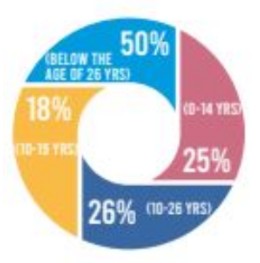
According to UNFPA 2023 report:
• 25% of the Indian population will be in the 0-14 years bracket.
• 18% of the Indian population will be in the 10-19 years bracket.
• 26% of the Indian population will be in the 10 – 26 years bracket.
• A little more than 50% of the Indian population are below the age of 26 years.
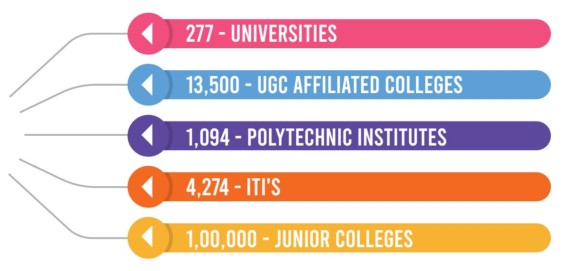
India has the world’s largest youth cohort with 254 million in 15-24 years bracket. Predominantly, 68% of the Indian population are within the 15-64 years bracket. Around 77 million are elderly people. The population of people aged above 60 years is increasing at a faster rate than the general population, which has doubled in only 25 years. 300 million middle class Indians lie in the influential; educated; opinion makers, global consumer sector. The rural population is moving to urban centers at an increasingly rapid rate. It is estimated that within the next two decades more than 50% of the Indian population will live in an urbanized context. Accelerated urbanization is already occurring in 310 plus cities. There are about 53,000 minority institutions (mostly Christian educational institutions) in India. These include accredited universities and colleges, polytechnics, junior colleges, and professional training Institutes.
[15]
Technologyand knowledge management skills are also becoming more significant and progressing. India plays a significant role in tech manufacturing.
It also retained the 40th position out ofl32 economies in the Global Innovation Index (GII) 2023, reflecting a remarkable journey from its 81st rank in 2015 to this notable achievement. In 2021, India had 34% of total global graduates in science and Engineering courses. [14]
India is the largest English-speaking population in the world today. 77.7% of the Indians are literate. Our film, television, radio; and print media reach out to almost every Indian in multiple languages. This is a big opportunity to inculcate gospel values, yet few Christians are involved in the secular media. Tentmakers are growing in the context of growing hostility to traditional missionary roles.
Rethinking Missions
India’s current realities require rethinking missions both in the country and beyond. Today’s difficulties fill the minds of missions and church leaders in the ministry within the country. Yet, the prophetic words of Todd Johnson and Gina Zurlo echo the significance of missions in the Global South and the strategic part that the Indian church and missions contributes to it.
A new chapter is emerging in Indian missions. Dialogue between the Global North and South will help to shape it. According to David Ro:
“Asia is now participating in global missions. In the 20th century; despite numerous religious and political challenges, growing nationalism and persecution,societal turmoil through urbanization and globalization, and the influences of secularism and materialism, Christianity in Asia has nevertheless grown twice as fast as the population, representing 8.2% of the population of 4.5 billion people. The Asian church is preparing for the challenge of global missions in this next century.”
The three leading countries – Korea,China,and India – are already positioned in the global scenario in every aspect of development. It is more than the differentiating between developed and developing; rich and poor,or the North and South poles.
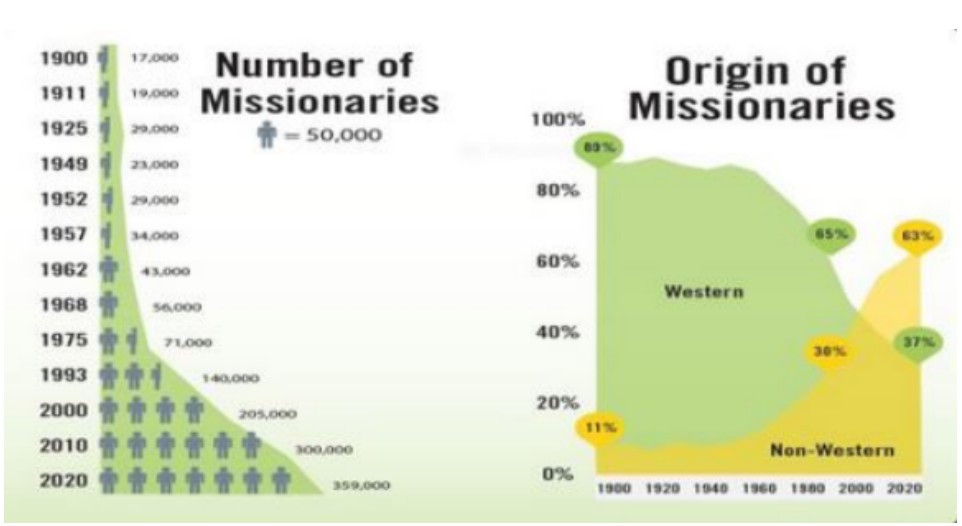
There are several areas in which we need to understand and build relationships with each other. We need more exposure to each other’s cultures, and greater appreciation and value for our dignity and service to one another. Sharing resources; expertise, and experiences through forums; consultations; workshops; research, work, and training is now glocal. [13]
Mission Possible in India: Global Mission
Dr. K. Rajendren defines a paradigm shift as a change in concepts and practices. The change in concepts affects the normal way of doing things until the new paradigm becomes the normal way. Subtly; slowly, and constantly there are many changes in society. He urges missions to move toward globalization. [3]
According to Bijoy Koshy, globalization is about economic and cultural imperialism – creating a new economic order and cultural ethos for profit motives. [4] It uses a policy of dividing the market and aims to dominate every segment by eliminating indigenous products and services. Christian missions has also had its share of division among denominational and doctrinal lines. How could ministry change when the process of global economic integration is happening at the cost of regional political and social disintegration? God is raising a new consciousness for the next generation of the missionary enterprise to respond to this. As we enter the new era of globalization, will India show to the world the shape of new frontiers in missions? Will our next generation of Christian leaders in India, give shape to the post-modern missionary movement?
In the global context of change and movements, migrants and diasporas are key players setting a missiological trend for the global missions. According to John Amalraj, globalization is not limited to how the world influences and changes India but includes the other way, too [5] Indian immigrants have changed the texture and idiom of their host societies. It is said that Indian are all over the world – possibly in every country and nation. In fact; there are nearly 25 million Indians spread all over the globe. Indian communities control the politics and economies of several countries forming the backbone of their health services, construction industry, computer industry, scientific research; retail industry, financial trade, agriculture; bureaucracy; food industry, and much more.
Today the global Indian is often better educated and more skilled in intellectually competitive situations than members of other migrant communities. India is at the threshold of becoming a global player, and an economic, political, and, possibly; technological superpower. Yes) missions is possible for India in the global arena of reaching peoples of the world with the gospel of Jesus Christ.
And we need to send out Indian Christians as bearers of the good news not just within India but also beyond India. According to Dr. Yamamori, “65% of the world’s people live in countries that either partly or fully restrict traditional missionary approaches… and by the year 2000, between 83% and 84 % of all those people who have yet to make a decision to follow Christ.”[6] But these countries are open for professionals; businesspeople; and students. An Indian tentmaker seeking employment, business; and study opportunities can enter these countries and serve these isolated and hidden people groups incarnating Christ and sharing the good news with them. (10) As the Western church faces decreasing missions participation, Macedonian calls for Indian Christians come from every part of the world.
Global Church and Global Mission
Enhancing partnerships globally can enable Indian missions as well as local indigenous missions everywhere in the world to participate more fully in global mission. This is not about a dividing the Global North and Global South; but facilitating partnerships for a global mission that takes the gospel of Jesus Christ to the ends of the world.
Every part of global church needs to prepare for global participation in Missio Dei beyond their own regions. That begins with observing, understanding,and appreciating the background and the culture of others. It can involve studying global cultural and geopolitical environments; and learning to be sensitive to community issues and needs in different nations. (11.) It also means being open to the way people in different places do missions and follow the Spirit of God. True partnership in global mission between the Global North and Global South will require making room for one another in communication, ideology; research, and missiology.
Re-Thinking Missiology
The post-modern world is enhanced with technological innovations and new economic patterns. This is moving us beyond the colonial understanding of the poles (Global North and Global South); languages; and strategies.
LalsangkimaPachuau explains; “The early Western missionary movement; aimed foremost at the saving of the souls from eternal damnation. Mission as expansion of Christendom through conversion and church growth was a dominant view during the Western colonial period. Then came the concept of Missio Dei, in which Christian mission was understood as Christian participation in God’s mission. But this was too broad: ‘If everything is mission, nothing is mission.’’’ Instead, he proposes using “witness across religious boundaries” as the defining principle of mission and as the integrating principle of missiology. [8]
Charles E. Van Engen takes this further. He says, “Mission is constantly innovating. As contexts change; so, too, does the work of the church. Today, in the face of a rapidly changing world and a growing global church, the task of mission must continue to innovate in unexpected ways.”
Now is the time to re-think missions from a new theological perspective. Global North and Global South can share and appropriate strategies from each other. But to do that, deep learning and formation must occur to develop a reinvented global missiology.
This begins with examining the biblical principles of Missio Dei as they are understood across cultures. We must study indigenous mission and people group movements and their impact on cultures, fai仕i, and nation building. Finally, investment in global mission collaboration across cultures and regions should be prioritized.
Potentials and Possibilities to promote Global Missions India is one of the largest Christian nations in the world in terms of population. As the youngest country positioned uniquely and strategically with well-equipped medical personnel; IT specialists and educators, the following are a few avenues to engage Beyond the Boundaries.
Potentials
1. India has more Mission agencies than many of the other Asian countries.
2. India has both human resources than other Asian countries.
3. India has already contributed great minds/intellectuals and mission leaders for the welfare of World Mission and World Economy.
4. India has more than enough financial resources than many other countries in the world.
5. Indians have the capacity and capability to adapt well in any part of the world when they involve in Cross cultural Mission.
6. Indians have better understanding of Cross cultural missions as they are already living a cross cultural context (India itself is a country of countries in terms of culture and language).
Possibilities
a. Promoting Global Missions in Indian/Asian Churches must begin with mobilization of Seminaries and Theological Institutions in their contexts. If the Seminaries and Theological institutions fail to understand their role of producing missional pastors and future missionaries, churches will fail in their understanding and participation in mission locally and globally. Missions in Theological Institutions must be taught by Theologians who have personal missional experience and missionaries who served on mission fields. Then they will be able to influence students in Seminaries and theological institutions.
b. Our Church and Mission need to make sure that they are first in touch with World missions. We need to first believe in the needs of the Global mission harvest fields and then only they can challenge their congregation members regarding those needs. We can consider sending their members/missionaries to reach out the Indian Diaspora scattered in huge numbers around the world through the existing international mission organizations. We can motivate; equip and send their students to countries which have less access to the Gospel in order to use their academic platform to bring the Gospel to those who are living and dying without Christ
c. Identity and motivate Indian entrepreneurs and businessmen to enter countries where Gospel has not reached to use their business platforms to bring the Gospel to those who do not know Christ.
d. Send Indian academicians intentionally to serve as their ambassadors of the Gospel in Global Mission.
e. Invite International Mission Agency Leaders who are sending missionaries to different parts of the world to expose Indian churches to the opportunities in global mission. Develop partnership with Global Mission Organizations in participating in World Evangelization. Globalization made communication, cultural understanding and connective points easier to think beyond the boundaries. Indians are spread in many other countries. Diaspora ministry can be initiated.
f. Lack of awareness among the young professionals to serve in the other countries as Tent Maker、Market Place Evangelist,Professionals in partnership. So we can present the need, guide them to the right place and link with the local partners.
g. More collaboration among Indian Mission Agencies will bring synergy to common avenues of ministry possibilities. Partnership will strengthen the Member Care, Monitoring and Evaluation.
h. An intentional collective effort to bring an awareness in mobilizing people in the churches to send people outside countries. Special training can be give n to the people as Kingdom Builders in their work place as salt and light in the global context. We need to pray, promote and persevere that God will raise up many more mature and dedicated missionaries for the work among the various groups of people both within and outside our country.
Conclusion
Indian missions is now positioning in a global context for a wider, meaningful and strategic partnership to move beyond their regions. The recent Global Mission Summit facilitated by India Missions Association is a clear indication of this new Missional movements in Indian Missions. New global; missiological partnerships can only emerge in a context of open minds and hearts to respect; accept; accommodate; and work with multiculture, multilingual; multisocial (communities); Multinational; multigenerational and multidenominational towards fulfilling the Great Commission of Christ to the ends of the world (Acts 1:8). It is the time for us to re-unite as peers for this global mission. This interdependence with God and by the empowerment of the Spirit of God will transform us towards the effective God driven engagement in the mission of God in our generation even beyond our regions.
Isac Soundararaja PhD (generalsecretary@imaindia.org), serves with India Missions Association as the Secretary General. He became a Christian when he was 19 years old. He has had various responsibilities in missions in India including serving as specialized faculty in cross- cultural communication, facilitating non-formal theological training for rural church planters, andworking in member care initiatives. He is basically a researcher initiating various studies among
the ethnic communities in India.
——————————————————————————————————–
ENDNOTES
1. Gina Zurlo and Todd Johnson, eds., World Christian Encyclopedia, 3rd ed. (Edinburgh: Edinburgh University Press, 2019).
2. UNFPA State of World Population 2023, “8 Billion Lives, INFINITE POSSIBILITIES: The Case for Rights and Choices,” accessed September 1, 2023; https://www.unfpa.org/sites/default/files/ swop23/SWOP2023-ENGLISH-230329-web.pdf.
3. Krishnasamy Rajendren,“Paradigm Shift,” unpublished article, IMA, 2006.
4. Byoy Koshy,“Globalization and Colonization/^ unpublished article, IMA, 2006.
5. John Amalraj, “Survey Of A Changing World,” unpublished article, IMA, 2006
6. David J. Price; “The Tentmaker’s Mandate,” International Journal of Frontier Missions, Vol 14:3 (July-Sept. 1997): 108.
7. COMIBAM (Cooperacion Misioneralberoamericana), GEMA (Ghana Evangelical Missions Association), NEMA (Nigeria Evangelical Missions Association), KWMA (Korean World Missions Association), IMA (India Missions Association)
8. LalsangkimaPachuau, “Missiology in a Pluralistic World,” International Review of Missions 89, no. 355 (March 25, 2009): 539-555,https://doi.Org/10.llll/j.1758-6631.2000.tb00243.x.
9. Charles E. Van Engen, ed., The State of Missiology Today: Global Innovations in Christian Witness (Downers Grove, IL: IVP Academic, 2016).
10. Rajasingh Elias, “Ministry to different countries – IEM Beyond the Borders”. Unpublished article, Paper presented at the Global Mission Summit, India Missions Association, Mizoram. June 2024.
11. Isac Soundararaja, “ Rethinking Indian Mission for a changing world”,Evangelical Mission Quarterly, Nov. 2023
REFERENCES
[10] An Analysis Developed During Discussions Within Interserve India Leadership Gatherings- December 2005
[11] Tom Sine, Mustard Seed vs. McWorld: Reinventing Life And Faith For The Future, (Grand Rapids, MI: Baker Publishing Group, 1999), 218.
[12] OM India News. India Area Communique. July 1997
[13] Krishnasamy Rajendren – ‘New Leaders For Contemporary Missions’, IMA 2006
[14] India Blooms News service 30th September 2023.
[15] Rajesh Duthie, “‘Opportunities in Tent making in India and Abroad,” Indian Missions, April- June 2009.
3. COALA3.0
John Lee (Vision 800)
In 2023, the Korean church convened its regular Mission Strategy Consultation; which takes place every four years. Throughout 38 years of service as both a field missionary and a mission organization leader, I have had many opportunities to meet local church leaders on the mission field. In those encounters, I came to realize that Korean missionaries often do not show as much respect for the local church as we should.
At the NCOWE (National Consultation on World Evangelization), the Korean church acknowledged this shortcoming, repented; and reaffirmed its commitment to honoring local churches. Above all, we renewed our conviction that mission must proceed as a partnership rooted in the leadership of local churches.
In response, many Global South mission leaders sought closer fellowship with the Korean church. This led to the Second Global South Mission Consultation (COALA: Christ Over Asia/Africa/Arab Latin), held in Bangkok in April 2024. Subsequent gatherings followed: COALA 2.5 in Busan, COALA 3.0 in Panama (April of 2025),and now COALA 3.5 in Seoul, during the WEA General Assembly. At present; more than fourteen international mission networks are participating.
Leslie Newbigin described Western-centered mission as Christendom Mission. While it was once the most effective strategy of its time, Andrew Walls reminds us that its “expiration date” has now passed. Today, mission scholars agree that we live in a polycentric era of mission. As Western missions have declined, non-Western churches are now simultaneously sending missionaries around the world.
Missionaries, however, have an inherent limitation: they must one day leave the field. Outsiders, whether missionaries or sending churches; can never truly be the owners of the local church. I believe that in this era, the central actors in mission must be the local people themselves. Therefore, partnership with them in mission cannot be emphasized strongly enough.
There are compelling reasons why partnership mission is essential:
• Many non-Western churches face significant economic limitations.
• Missionaries, as outsiders, cannot assume ownership of local churches. Their role is temporary serving as partners who provide support in contexts where churches may lack sufficient capacity for a season.
On August 18; 2025; the leaders of Korea’s major denominations gathered and recommended that Korean missionaries on the field pursue partnership-based mission. Their exhortations were as follows:
1. Leave the leadership of ministry in the hands of the local church.
2. Focus on disciple-making (Matt. 28:19).
3. Pastoral leadership belongs to local believers; while missionaries should focus on evangelizing those outside the church.
4. Relate to the local church by invitation, serving as part of their fellowship.
The upcoming COALA 3.5 will provide non-Western churches, both those sending and those receiving missionaries, an opportunity to put these principles into practice: welcoming missionaries as partners in mission; under the leadership of the local church. This book contains a selection of presentations from the past three COALA gatherings. It is my sincere hope that it will serve as a valuable resource for leaders who long for healthy and faithful mission. Thank you.
Peter Oyugi (MANI)
Building a common ground in the Majority World
Abstract: This paper explores the growing interest for collaboration and partnership from and within mission circles in the Majority World. Considering that there is an increase growth in missional dynamism and youthfulness within the church in the majority world, this paper will explore unique qualities; priorities, and practices necessary for building a common ground across diverse cultural and linguistic contexts within the Majority World. Grounded in biblical principles of unity and shared vision, the paper oAers practical recommendations for immediate, mid- term, and long-term actions aimed at strengthening missional collaboration within the Majority World for a more impactful global witness.
I. INTRODUCTION
The 21st century marks a significant shift in the landscape of global Christianity, with the Majority World emerging as a vibrant and increasingly influential centre for mission (Jenkins, 2002). Churches in Africa; Asia; and Latin America are no longer solely recipients of mission but are actively engaging in cross-cultural outreach, both within their regions and globally. This emerging and growing missionary movement from the Majority World presents a unique opportunity for collaboration and partnership among churches themselves within this Region. Building a robust common ground for mission within this Region is crucial in order to leverage on the Region’s collective strength, contextual wisdom) and cultural proximity to reach diverse peoples with the gospel since many of the world’s least reached people are still found within these same Regions. Forging this common ground requires intentionality; a recognition of shared experiences and challenges; and a commitment to biblical principles that foster unity and shared vision.
II. BIBLICAL BASIS FOR UNITY AND SHARED MISSION
The contemporary global Christian landscape in the Majority World; despite its expansion, is often marked by fragmentation. Biblical unity is not merely an ethical ideal but a foundational theological imperative intrinsically linked to the eAicacy of global mission. The oneness of believers serves as a potent catalyst for the propagation of the gospel across diverse cultural and geographical contexts.
Jesus’ high priestly prayer in John 17 provides a cornerstone for understanding this imperative. His fervent plea for his followers to be “one, just as you. Father, are in me” (John 17:21, ESV) reveals a unity mirroring the divine relationship. This unity; as Carson (1991) elucidates, transcends superficial agreement; representing a deep spiritual connection with the explicit purpose of enabling the world’s belief in Jesus* divine mission (p. 579). Conversely; division among Christians hinders this crucial witness, creating skepticism among non-believers (Beasley-Murray, 1999, p. 305). Jesus’ prayer extends this call for unity to all future believers (John 17:20), establishing its enduring and universal significance.
The early church, as depicted in the Book of Acts; oAers a compelling historical illustration of this principle in practice. Their unwavering devotion to core apostolic teachings; fellowship, the breaking of bread; and prayer (Acts 2:42) fostered a strong sense of community (Stott, 1990, p.71). Furthermore; their communal living and radical sharing of resources (Acts 2:44-45, 4:32-35) demonstrated a tangible expression of their deep spiritual connection and mutual care (Marshall) 1980, p. 88). This internal cohesion directly correlated with their outward witness, earning them favour with the people (Acts 2:47) and empowering their bold proclamation of the resurrection (Acts 4:32; Peterson, 200% p. 178).
Paul’s extensive metaphor of the Body of Christ in 1 Corinthians 12 provides a crucial theological framework for understanding unity within diversity. With Christ as the head, believers are depicted as interdependent members; each possessing unique and vital contributions to the functioning of the whole (1 Corinthians 12:12-27). This analogy underscores that unity is not synonymous with uniformity but rather a harmonious and purposeful functioning under the Lordship of Christ. The emphasis on shared suAering and joy within the body (1 Corinthians 12:26) highlights the empathetic connection essential for fostering unity and eAectively engaging in mission, particularly amidst hardship and persecution. No single individual or local church can eAectively fulfil the global mission in isolation; collaboration and mutual support are indispensable.
The Great Commission in Matthew 28:19-20 provides the explicit mandate for the Church’s global mission: “Go therefore and make disciples of all nations…r This universal call inherently necessitates a unified eAort that transcends geographical and cultural boundaries. The sheer scope of the task demands a shared sense of responsibility among all believers, leveraging their diverse gifts and resources. Echoing the principle articulated in John 17, the eAectiveness and credibility of this disciple-making endeavour are significantly enhanced by the visible unity of those carrying it out (Bosch, 1991,p. 373). A fractured and divided witness undermines the power and authenticity of the gospel message.
Overcoming denominational, cultural; and theological divides; fostering genuine interdependence; and prioritising the unifying power of the Holy Spirit are not merely desirable ideals but practical necessities for a credible and impactful witness to the world;ultimately reflecting the very heart of Christ’s prayer for his followers.
III. QUALITIES FOR CULTIVATING COMMON GROUND WITHIN THE MAJORITY WORLD
Building a robust common ground among Majority World churches and mission practitioners requires the deliberate cultivation of specific relational and contextual qualities. This paper argues that identity and solidarity; contextual empathy, humility and reciprocity; intercultural sensitivity, and trust and transparency are foundational for fostering eAective and sustainable missional partnerships within the Majority World.
1. Shared Identity and Solidarity
A powerful basis for collaboration lies in the shared historical and socio-economic realities that often characterise the Majority World. The enduring legacy of colonialism, persistent economic disparities; and, in many instances, converging cultural values can foster a profound sense of solidarity and mutual understanding (Said, 1993). This shared identity transcends geographical boundaries; creating a powerful foundation for collaborative endeavours rooted in the acknowledgment of common challenges and shared aspirations in the pursuit of mission (Escobar; 2003). Recognizing this common heritage allows for a deeper level of empathy and a unified front in addressing systemic issues that impact missional outreach.
2. Contextual Empathy
An inherent strength within Majority World missional collaboration stems from a deep and nuanced understanding of local socio-cultural and spiritual landscapes. Churches originating from similar contexts often possess an intuitive contextual empathy, enabling them to navigate cultural intricacies and communicate the gospel with greater understanding; relevance, and eAectiveness than external partners might (Van Engen, 1991). This perspective from within local cultures allows for mission approaches that are organically rooted in the local worldview; fostering greater receptivity and minimising cultural missteps that can hinder the gospel message (Walls; 1996).
3. Humility and Reciprocity
As Majority World churches increasingly recognise their growing missional agency and capacity; approaching collaboration with humility is paramount (Bediako, 1995). Acknowledging the diverse strengths; experiences, and theological insights within the Majority World fosters an environment of mutual respect and learning. This necessitates a spirit of reciprocity, where churches actively engage in both giving and receiving support – be it theological resources; practical expertise; or financial aid – cultivating sustainable partnerships built on mutual benefit rather than hierarchical dependencies (Myers, 1999).
4. Intercultural Sensitivity
While shared histories and values can provide a foundation, it is crucial to acknowledge the significant cultural; linguistic; and theological diversity that exists within the Majority World itself (Sanneh; 1989). Cultivating a deep intercultural sensitivity within this diverse landscape is essential for eAective collaboration. This requires a conscious willingness to learn from one another’s unique contexts, understand diAering communication styles, and appreciate the varied expressions of Christian faith across the Global South (Luzbetak; 1988). Such sensitivity mitigates potential misunderstandings and fosters genuine cross-cultural partnerships within the Majority World.
5. Trust and Transparency
Building and sustaining trust across geographical and denominational lines within the Majority World necessitates deliberate and consistent eAort. Open communication, characterised by honesty and clarity, is fundamental. Transparency in resource sharing, ensuring accountability and mutual understanding in the utilisation of finances and personnel, is equally critical (Stackhouse,2007). Furthermore; a demonstrable commitment to mutual accountability; where partners hold each other responsible for agreed-upon goals and ethical conduct; reinforces the foundation of trust essential for long-term and impactful missional collaboration within the Majority World.
These qualities., rooted in mutual respect and a deep understanding of shared and diverse realities, are essential for fostering eAective, sustainable, and ultimately more impactful missional partnerships within the Majority World.
IV. PRIORITIES FOR MAJORITY WORLD MISSIONAL COLLABORATION
Several key priorities should guide the development of common ground among Majority World churches and mission practitioners:
1. Contextualised Theology and Practice
Sharing and developing theological frameworks and missional practices that are deeply rooted in Majority World contexts and address local realities is a significant advantage of collaboration within the Majority World.
2. Resource Sharing and Capacity Building
Pooling resources; both human and material, within the Majority World can empower churches with limited access to traditional Western mission structures. Collaborative capacity-building initiatives; such as joint training programmes; can strengthen local leadership and missional eAectiveness.
3. Addressing Shared Challenges
Collaborating on addressing common challenges such as poverty; disease; social injustice; and persecution from a shared cultural and theological perspective can lead to more eAective and relevant solutions.
4. Regional and Inter-Regional Mission Initiatives
It can be highly eAective to focus on reaching least reached peoples within and across Majority World regions; leveraging the cultural proximity and linguistic understanding of partner churches.
5. Strengthening Indigenous Leadership
Majority World collaboration can prioritise the empowerment and development of indigenous leaders within their own contexts, fostering sustainable and locally-led mission movements.
V. PRACTICAL RECOMMENDATIONS FOR ACTION
1. Immediate Actions
a. Facilitate Regional and Inter-Regional Mission Forums
Organise gatherings, conferences; and online platforms that bring together mission leaders and practitioners from diAerent Majority World countries to share experiences; build relationships; and explore potential partnerships.
b. Establish Mission Networks Within the Majority World
Create formal and informal networks focused on specific regions or missional priorities, enabling churches and organisations to connect, share resources, and coordinate efforts.
c. Promote Cross-Cultural Exposure and Learning
Encourage short-term mission exchanges and immersion experiences between Majority World churches to foster mutual understanding and appreciation for diverse contexts.
d. Develop Online Resource Hubs
Create digital platforms for sharing contextualised theological resources; missional best practices; and information about potential partnership opportunities within the Majority World.
2. Mid-Term Actions
a. Develop Joint Training and Capacity Building Programs
Collaborate on designing and delivering theological and missiological training programmes that are relevant to Majority World contexts and accessible to leaders from diAerent regions.
b. Establish Inter-Church Resource Sharing Mechanisms
Create transparent and accountable systems for churches and organisations within the Majority World to share financial resources; personnel, and expertise for mission initiatives.
c. Undertake Collaborative Research on Areas of Missional Needs
Partner on research projects to better understand the cultural; linguistic,and spiritual needs of least reached peoples within the Majority World, informing more eAective outreach strategies.
d. Support the Development of Indigenous Mission Sending Agencies
Encourage and resource the establishment and growth of mission sending agencies rooted within Majority World churches and led by indigenous leaders.
3. Long-Term Actions
a. Foster the Development of Contextualised Missiologies
Encourage theological reflection and the articulation of missiologies that emerge from and are relevant to the diverse contexts of the Majority World.
b. Establish Sustainable Partnership Frameworks
Develop long-term partnership agreements based on mutual respect; shared ownership, and clearly defined roles and responsibilities.
c. Promote Inter-Denominational and Inter-Faith Dialogue (where appropriate for mission
strategy): Facilitate dialogue and understanding between diAerent Christian denominations and, where strategically relevant and ethically sound, explore appropriate engagement with other
faith communities within the Majority World.
d. Celebrate and Share Success Stories
Actively document and disseminate stories of successful Majority World mission collaborations to inspire and encourage further partnership.
VI. CONCLUSIONS
This paper explored the growing interest in collaboration and partnership within the Majority World mission circles; driven by the region’s increasing missional dynamism and youthful churches. It submits that building common ground requires specific qualities: shared identity and solidarity rooted in colonial history and similar values; contextual empathy arising from inherent understanding; humility and reciprocity in partnerships; intercultural sensitivity within the Majority World’s diversity; and trust and transparency. Grounded in biblical principles of unity (John 17, Acts, 1 Corinthians 12) and the Great Commission (Matthew 28), the paper outlines immediate actions like regional forums and networks; mid-term strategies such as joint training and resource sharing, and long-term goals including contextualised missiologies and sustainable partnerships to strengthen impactful global witness.
—————————————————————————–
References
Beasley-Murray, G. R. (1999). The Gospel of John. Word Biblical Commentary, Vol. 36. Thomas Nelson Publishers. Bediako, K. (1995).
Christianity in Africa: The Renewal of a Continent. Edinburgh University Press.
Bosch, D. J. (1991). Transforming Mission: Paradigm Shifts in Theology of Mission. Orbis Books.
Carson, D. A. (1991). The Gospel According to John. William B. Eerdmans Publishing Company.
Escobar, S. T. (2003). The New Global Mission: The Gospel from Two Worlds. InterVarsity Press.
Jenkins, P. (2002). The Next Christendom: The Coming of Global Christianity. Oxford University Press.
Luzbetak, L. J. (1988). 1 The Church and Cultures: New Perspectives in Missiological Anthropology. Orbis Books.
Marshall, I. H. (1980). The Acts of the Apostles: An Introduction and Commentary. Tyndale New Testament Commentaries, Vol. 5. InterVarsity Press.
Myers, B. L. (1999). Walking with the Poor: Principles and Practices of Transformational Development. Orbis Books. Peterson, E. H. (2009).
The Acts of the Apostles. The Message Remix. NavPress.
Said, E. W. (1993). Culture and Imperialism. Alfred A. Knopf.
Sanneh, L. (1989). Translating the Message: The Missionary Impact on Culture. Orbis Books.
Stackhouse, J. G., Jr. (2007). Making the Best of It: Following Jesus in the Real World. Oxford University Press. Stott, J. R. W. (1990). The Message of Acts: The Spirit, the Church & the World. InterVarsity Press.
Van Engen, C. (1991). God’s Missionary People: Rethinking the Purpose of the Church. Baker Book House. Walls, A. F. (1996). The Missionary Movement in Christian History: Studies in the Transmission of Faith. Orbis Books.
Paul Noh (KWMA)
Christology of Mission (Missio Christi):
A Study of Common Biblical and Missiological Foundations of the Global South Missions Movement
1. Diversity and Commonality: Foundation for the Development of the Global South Mission Movement:
1) The Era of World Christianity and the Global South Mission Movement
Christianity has moved beyond the Western era and entered the age of World Christianity; which is centered by the Global South churches. In 2020, the Christian population in the Global South was 69%, 1.3 billion Christians. By 2050, it is predicted that 3.32 billion Christians, representing 75% of the global Christian population, will reside in regions like Africa; South America; and Asia.1
With the weakening of Western churches; the Christendom mission system of Western churches is continuously declining. The Global South churches; which were once mission fields; have transformed into mission forces. Global missions are being restructured by Global South churches; and the future of global missions in the 21st century will be led by Global South churches. Global South churches and Global South missions movement are expected to be the main force of global missions.
2) Diversity and Strategic Cooperation in Global South Missions
Global South churches share a non-Western identity as their commonality. However, it exhibits remarkable diversity. The churches on the African continent spread out 55 nations; with Sub- Saharan churches growing at an astonishing rate. While African Christianity shares a common trait of rapid growth., it also reflects diversity in local traditions, cultural characteristics; and church traditions (Western church models or indigenous churches).
Asia, including the Middle East, India; Indochina; China; and East Asian, demonstrates significant cultural diversity. There are Arab churches enduring persecution under Islam, Indian churches growing amid Hindu oppression, Chinese churches thriving despite Communist persecution, widespread Chinese diaspora churches; and Singapore and Korea that have been influenced by Western traditions.
Another significant branch of Global South missions is the Latin missions, COMIBAM, comprising 24 countries in Latin America and the Iberian Peninsula. Although Latin missions share commonalities such as the Spanish language, Latin cultural backgrounds, and Pentecostal movements; churches and missions in the Iberian Peninsula; Central; and South America also shows significant diversity with their regions; ethnicity and church traditions.
The three continents that lead the Global South missions—Africa^ Asia, and Latin America—can transform their diversity into strengths through strategic alliances and cooperation. For this. Global South churches should embrace their diversity; recognize one another, and support each other’s weaknesses and strength through strategic partnerships.
3) The Need for Research on the Commonality of Global South Missions
Many agree that amid the decline of Western churches and missions. Global South missions should play a central role in 21st-century global missions as its main force. In this context; it is inevitable to define and develop the characteristics of Global South missions. Apart from sharing a common explosive growth that deviates from Western traditions; how else can Global South missions be defined? Diversity is a distinctive feature of Global South missions. However, for continued development; it is necessary to research the commonalities and identity of Global South missions. This requires an exploration of the shared phenomena in Global South missions and the formation of biblical and theoretical foundations of the Global South missions to support them. Identity research based on the commonalities of Global South missions will serve as the foundation for its further progress and development. This presentation aims to research commonalities of Global South missions by using John Stott’s “Christology of Mission.”2
2. John Stott’s Christology of Mission
In John Stott’s book “The Contemporary Christian: Applying God’s Word to Today’s World”, he points out how Western missions have deviated from biblical missions and calls for self reflection on the skepticism and lack of faith within Western churches.
Stott concludes: ‘It seems to me that the church needs to keep returning, for its inspiration and direction, to this Christological basis of mission. The challenge before us is to see Jesus Christ as adequate for our task. Wie Aave to repent of Our pessimism (especially in tihe West), our low expectations, ourcynicaJ unbelief that, although the church may grow elsewhere, it cannot grow among us.
Fiddlesticks!
If only we could gain a fresh and compelling vision of Jesus Christ, incarnate and crucified, risen and reigning, bestowing the Spirit and coming again! Then we would have the clarity of purpose and strength of motive, the courage그 the authority, the power and the passion for world evangelization in our time.’3
John Stott argues that for the modern church to restore the essence of its mission, it must regain a vision of Jesus Christ. To this end, he presents the missiological framework “The Christology of Mission/’ proposing the restoration of six stages of Christ’s life. He asserts that Christological missions must recover Jesus Christ’s “clarity, strength of purpose, authority, power, and passion” to fulfill the mission of spreading the gospel.
The image of Christ presented by John Stott serves as a biblical model for the Global South mission movement. Moreover, this Christ-centered missionary model can be observed as a common characteristic in the field of Global South missions. This text aims to highlight the commonalities of Global South missions by analyzing the six stages of Christology of Mission proposed by John Stott and to affirm how Global South missions follow the model set by Christ.
The six characteristics of the Christology of Mission is like below.
1. The Incarnation of Christ – the Model for mission
2. The Cross of Christ – the Cost of mission
3. The Resurrection of Christ – the Mandate for mission
4. The Exaltation of Christ – the Incentive for mission
5. The Spirit-gift of Christ – the Power for mission
6. The Parousia of Christ – the Urgency of mission
3. The Six Common Characteristics of Global South Missions
1) The Incarnation of Christ – The Model for Mission
Global South missions must break away from the Western-centric unipolar mission model and develop their own indigenous approaches to missions.
a. Indigenous-Centered Missions
Jesus Christ left the glory of heaven and came to earth in human form, becoming fully human
and fully indigenous. Through His incarnation. He became fully God and fully human, fulfilling
His mission in ways that humans could understand.
Due to the revival of Global South churches; the era of World Christianity has moved away from the single system or unipolar structure dominated by Western churches. In every region, indigenous churches led by local believers have emerged. Global missions should no longer be centered on missionaries or characterized by patriarchal Western missions.
Global South missions must be centered on indigenous leaders rather than being missionary driven. The COALA2 document “Recommendations for Mission Practice for the Majority World” states:
”Missionaries must serve with a servant’s heart, humbly and respectfully cooperating with local believers. Missionaries should rely on God’s power rather than external resources or educational superiority.”
At the COALA2 conference, Jonas Kang, a Korean missionary, shared a model of cooperation that respected the leadership of CCT denomination of Thai church and contributed to the growth of the local church. A mission that respects indigenous leaders and fosters deep friendships and collaboration reflects the incarnation model of Jesus Christ.
b. Developing Indigenous Mission Models in the Global South
In 1987, a missionary movement arose in Korea. The remarkable revival of the Korean church in the 1970s and 1980s led to rapid growth in the 1990s. However, at that time; the Korean mission movement uncritically adopted Western or American mission models; which continue to this day. As a result; Korean missions have gradually lost their strength and functionality; facing a crisis. The decline of Korean missions aligns with the downturn of Western missions.
In contrast, Latin America has taken a different path. During a conversation with Allan Matamoro in COALA2, he said to me, ”To the emerging missions in South America; the Western approach to missions felt like asking David to wear Saul’s armor.” When he was commissioned as a missionary in 1987, he did not follow the methods of North American and Western missions, because he felt it is not suitable to adopt Western models. As a result; Latin American
missionaries developed their own approaches.
A generation later, the contrast between Korea and Latin America is sharp. Korean missions, after adopting Western paradigms; are now striving to overcome them and develop a uniquely Korean indigenous mission approach. Latin American missions must also continue refining and strengthening their indigenous mission models. Indigenous-centered Global South missions align with the incarnational model of Christ.
2) The Cross of Christ – The Cost of Mission
Christ’s life was filled with suffering. He fulfilled His mission by sacrificing His life on the cross. I believe that Global South missions reflect this Christ-like suffering. In many regions, such as China; India, Africa; and the Middle East, Christians in the Global South endure beatings, insults; discrimination, arson, and even the threat of death. Despite severe persecution by the Communist Party; Chinese house churches have experienced remarkable revival and continue to send missionaries. The church in India expands into unreached regions despite persecution from
Hindu fundamentalists. The fastest-growing church today is the Iranian church, which operates under the harshest persecution.4 African churches continue to spread the gospel amid poverty and opposition to advancing Islamic forces.
The suffering of Global South churches is a unifying characteristic. The spread of the gospel amid suffering resembles the early church. The relationship between suffering and gospel expansion warrants further study. The church must share in the sufferings of the cross for the sake of its missionary calling. Churches in regions without explicit persecution, such as Singapore, Korea, Japan, and Taiwan, must also remember the cost of missions and participate in Chrisfs sufferings. Global South missions that follow Christ in suffering and demonstrate powerful gospel proclamation mirror the life of Christ on the cross. The participation in the suffering of Christ should be the direction that Western churches follow. If Western churches restore the essence of mission by following the Lord’s suffering, I believe it will open a new way for the restoration of Western churches and missions.
3) The Resurrection of Christ – The Mandate for Mission
Jesus overcame death and rose again to new life. Just as Jesus overcame death and rose again. Global South missions embody a precious Christian legacy that global missions today seem to have forgotten: the diversity of the gospel. The recovery of diversity and mutual respect is one of the core contributions of Global South missions to global missions.
a. The Unipolar Structure of Western Churches
From the beginning, the early church embraced diversity. At Pentecost; people from Parthia; Media; Elam, Mesopotamia, Judea; Cappadocia; Pontus; and Asia heard the gospel in their native tongues through the power of the Holy Spirit. The early Roman church; inheriting this tradition, coexisted with various church traditions within the empire. This included the Antioch church representing Asian churches (Eastern Christianity) and the Alexandrian church representing African traditions.
However, Western churches represented by Rome or Constantinople failed to embrace the diversity of churches both within and beyond the empire. The ecumenical councils’ declarations of heresy to Antioch and Alexandira churches damaged this diversity; leading to church divisions. The unipolar structure of Western churches caused them to lose the dynamism and translatability of the gospel. When Western churches lost their diversity; they lost their spiritual power. This loss led to the rise of the Islamic movement and the onset of the medieval dark ages.
b. Celebrating Diversity
As mentioned earlier, the Global South region is remarkably vast and diverse. It encompasses 55 countries in Africa, 33 in Latin America; 1.4 billion people in India and China; and churches spread across the Middle East; Southeast Asia, and East Asia. God is doing remarkable work in the Global South. The extraordinary revival of Global South churches has made them central players in global missions.
Global South churches must reclaim the diversity that the early church held before it was lost to the Western church’s unipolarity. The diversity within the Global South should be recognized, respected, and celebrated. Latin American churches’ Pentecostal experiences; African churches’ vitality and indigenization, Chinese churches’ resilience under persecution, Indian churches’ spirituality overcoming Hindu persecution; Korean missions’ efforts to change direction, and Singaporean churches* communication strengths between the West and the Global South must all be acknowledged and honored. Mutual recognizing and respecting one another’s diversity pave the way for partnerships through cooperation.
c. Strategic Partnerships through Mission Networks
For the advancement of Global South missions; strategic partnerships and cooperation are essential. To achieve this. Global South churches must reveal their diversity; recognize one another, and assist in areas of weakness. Missionary organizations within the Global South can send missionaries according to shared needs through network formations. Missionaries must share mission resources and support the development of local churches based on trust; friendship; and respect for local leadership.
For example; Sooyoungro Church in Busan, Korea; has supported gatherings for Latin American missionaries working in Asia. These missionaries; despite being from Latin America, gained encouragement and new strength through the cooperation of Korean churches in Asia. Similarly) there have been partnerships between Latin American churches and Indian churches for missions in India; as well as collaborations among missionaries from Africa, Latin America; and Asia in the Middle East.
To foster trust through network-based partnerships, COALA promotes mutual communication and the sharing of resources according to each region’s needs. Through this COALA3 meeting, I hope to see progress in such strategic communication and execution, leading to the sending and placement of missionaries through the COALA network.
4) The Glory of Christ – The Motivation for Mission
a. The Glory of Christ
Jesus, who rose from the dead, ascended to heaven and received glory. The Son of God receives glory alongside the Father and the Holy Spirit, reigning over all nations. Jesus endured the suffering of the cross on earth with His eyes fixed on the glory of heaven. The glory of heaven and the reign of the triune God empowered Jesus to bear suffering and fulfill His mission.
What, then, should be the glory that drives the Global South mission movement; and what should be the motivation that moves us? It should not be financial power, the resulting dominance in global missions, or the oppression and control of others. In 1910, at the Edinburgh Conference, Bishop Vedanayagam Samuel Azariah of the Indian Anglican Church urged Western missions to abandon paternalism, asking not for material resources but for friendship.5
b. The Motivation for Global South Missions: Mutuality – Equality – Partnership
The glory and driving force of Global South missions must be friendship. Its genuine friendship brings out mutual respect; and partnership. Global South missions must avoid the trap of Western paternalism and become genuine friends to one another. The vastness and diversity of the Global South mission movement can only be sustained by authentic friendship and mutual respect as its foundation. Unilateral spending on mission finances leads to distorted influence; hierarchical structures, and paternalism. We should not allow to these wealthy patriarchal influence; and hierarchical structures to dominate Global South missions. To resist the temptation to assert dominance through financial power; we must cultivate partnerships rooted in mutuality and equality.
The COALA movement began with a “KOLA” proposal from Latin and Asian mission leaders who visited Korea in 2023. At the 2023 NCOWE conference; Latin and Asian “friends” (Cristian Castro and Manik Corea) proposed a cooperative mission network between Latin, Asia, and the Korean church. Korean leaders (Jonas Kang) suggested changing the ”K” (which represented Korea) to ”C,” symbolizing Christ. The COALA Steering Committee has no formal chairperson. We are all equals and respect one another as friends. COALA strives to embody a culture of mutual respect and equality; working to realize polycentric missions. Deep friendships and mutuality guide and lead COALA.
We hope that COALA will continue to develop Global South missions through friendship, mutual respect; and partnership. The COALA network should be governed and driven by the glory of friendship, mutuality and partnership, rather than selfish greed. Moreover, I wish for this spirit of friendship and equality to spread beyond the Global South to the Global church.
5) Christ and the Holy Spirit: The Power for Mission
a. The Work of the Holy Spirit
After the Holy Spirit descended on Jesus like a dove (Matthew 3:16), He was led by the Spirit to overcome the wilderness trials (Luke 4:1). By the power of the Spirit; Jesus taught and healed (Luke 4:18-19). After His resurrection, Jesus commanded His disciples to rely solely on the Holy Spirit for power and to become His witnesses (Acts 1:8).
John Stott emphasized that *’the work of the Holy Spirit is irreplaceable.”6 Hwa Yung, in a 2023 ELF lecture, quoted Charles Kraft, who observed that the influence of the Holy Spirit is diminishing in regions dominated by an Enlightenment worldview. Kraft remarked, “Enlightenment Christianity is powerless.”7 It is crucial for Global South missions not to fall into Enlightenment rationalism but to continue relying on the powerful guidance of the Holy Spirit. Just as Jesus’ life was led by the Spirit, Global South missions must demonstrate submission to and reliance on the Spirit.
b. The Experience of Chinese Missionaries
The author recalls a remarkable experience while supporting missionaries sent by Chinese house churches. Despite severe persecution from the Chinese government, house churches have continued to send missionaries to Central Asia; the Middle East, and Africa. During a gathering on the field, we had a chance to listen their testimonies and mission reports from Chinese missionaries.
One key difference stood out: missionaries from urban areas who had joined international mission organizations shared strategic plans and systems, while indigenous missionaries from rural house churches shared testimonies of remarkable transformations and revivals powered by the Holy Spirit. Missionaries from urban areas in China tend to have relatively higher education and more resources; whereas missionaries from rural areas often have lower education levels and lack resources. This experience revealed a stark contrast between missions constrained by systems and missions led by the Spirit. It also showed that the fruit of missionary work is not determined by education; resources, or systems.
c. The Holy Spirit’s Role in Global South Missions
During the COALA 2.5 meeting, Sam George stated; “21st-century missions must overcome the 20th-century system-centered American business mission model.” Global South missions must not be limited by business models and human-centric frameworks. Global South churches relyon the power of the Holy Spirit. The foundation of revival in the Global South churches is not systems; education, finances, or training but the work of the Spirit. The work of the Holy Spirit unites Global South churches and missions as a key common factor. While systems may be necessary, the work of the Holy Spirit in missions is irreplaceable. Global South missions must continue to resist the system-driven, business-oriented mission models that characterized past Western missions. The Global South mission movement must avoid losing the Spirit’s power under the influence of Enlightenment thinking. Instead, Global South missions must grow under the Spirit’s guidance.
6) The Return of Christ – The Urgency of Proclaiming the Gospel
a. The Expectation of Chrisfs Return and the Urgency of Proclaiming the Gospel Jesus Christ commanded that His gospel be preached to all nations before His return (Matthew 24:14). The anticipation of Chrisfs return and the urgency of gospel proclamation form the foundation of His missionary mandate. However, Western churches and the ecumenical movement; influenced by Enlightenment worldviews; often focus on establishing God’s kingdom
on earth while diminishing their expectation of Chrisfs imminent return.
In contrast; Global South missions exhibit a profound anticipation of Chrisfs return and a sense of urgency in spreading the gospel. Many believers in the Global South, who live amid hardship, eagerly await Chrisfs return. This longing, combined with the urgency of gospel proclamation, reflects their deep yearning for eternity beyond their present suffering. This characteristic is evident among persecuted believers in Chinese house churches and converts from Islam who received Christ through Chinese missionaries. The anticipation of Chrisfs return and the urgency of gospel proclamation are common traits of Global South missions and often coincide with profound experiences of the Holy Spirit’s power.
b. Perspectives on Holistic Mission vs. Prioritism
The emphasis on the return of Christ and the urgency of gospel proclamation contrasts with the concept of holistic mission. Holistic mission, as championed by Lausanne movements and its scholars such as Christopher Wright; is a biblical concept that emphasizes God’s rule over all areas of life and the need for mission in every aspect of human existence.
However, Global South missions tend to prioritize the urgency of direct gospel proclamation over holistic mission approaches. First; this is because Global South churches, like the early church, are empowered by the Holy Spirit to evangelize directly, even amid persecution and oppression.
Second; holistic mission strategies often require significant resources for education, healthcare, and social transformation—resources that are often limited in the Global South.
Although holistic mission strategies are biblical and not to be opposed; Global South missions believe that by focusing on Chrisfs return and proclaiming the gospel, the transformative power of the gospel will naturally bring comprehensive change to their societies and nations, highlighting six stages of Chrisfs life: incarnation, suffering, resurrection, glory, empowerment by the Holy Spirit; and return. As discussed; Global South missions display characteristics that align with these six Christological stages. The conformity of Global South missions to the Christology of Mission is encouraging and explains the continuous growth of these missions.
In missiological terms; John Stott’s Christology of Mission is part of the Trinitarian framework of God’s mission (Missio Dei). Within the Missio Dei framework, Chrisfs mission (Missio Christi) can also be recognized as a distinct focus. It is hoped that Global South missions will continue to develop through ongoing research into the Son’s mission (Missio Christi) and the Spirit’s mission (Missio Spiritus) within the Trinitarian missiological framework of the Missio Dei.
4. Conclusion
Jesus Christ, the Son of God demonstrated the concrete model of the triune God’s mission on earth. His mission provides a path for Global South missions to follow and a direction for advancing biblical missions. John Stott called for Western churches and missions to return to the mission of Christ. To this end, he presented the “the Christology of Mission,”
——————————————————————–
1 https://www.pewresearch.org/religion/2011/12/19/global-christianity-exec/
2 John Stott, The Contemporary Christian: Applying God’s Word to Today’s World. 374.
3 Ibid.
4 Chelsea Rollman, Resilient Servants: How Persecution Led to Radical Growth of the Iranian Church https://mtw.org/stories/details/0618-resilient-servants-how-persecution-led-to-radical-growth-of-the-iranian-church
5 Azariah’s speech “You have given your goods to feed the poor. You have given your bodies to be burned. We also ask for love. Give us friends.”
6 John Stott, Baptism and Fullness: The Work of the Holy Spirit Today
7 Charles Kraft, Christianity with Power: Your Worldview and Your Experience. 37.
Patrick Fung (OMF)
“Missiology: The Big Picture of the Global Church in the Future (Continuity and Discontinuity)
First of all, I want to say thank you to the organizing committee for inviting me to COALA 3. I am reminded again what COALA stands for, “Christ over Asia, Latin America and Africa.” Christ is the initiator, sustained and the reason for the COALA movement. Recognizing that global missions are undergoing profound changes with two-thirds of the world’s Christian population residing in the Majority World. We continue to learn and explore how God is unfolding before us what mission looks like after Christendom. There is an urgent need for a new paradigm of mission movements, encompassing mission theology; strategies; and methods in the context of polycentrism.
Today; I have been asked to address the topic “Missiology: The Big Picture of the Global South in the Future (Continuity and Discontinuity). However, I would like to change the title a little to broaden the scope, that is, by changing the phrase, “Global South” to “Global Church.”
Thus; the title of this paper will be “Missiology: The Big Picture of the Global Church in the Future (Continuity and Discontinuity).
I am writing this paper in special remembrance of a special brother and friend,the late Dr Peter Rowan, who passed away a few months ago. He has given much thought to the subject of mission after Christendom. I owe much of my reflections to Peter’s original paper, first published in the OMF Mission Research Roundtable.1 Also, I want to qualify my comments by saying that when I use the term “we” in the paper, I am referring to both the church from the Western World and the Majority World.
1. First, we should ask the key question, “What should the global church continue doing?”
1.1 The Treasure of Unity in Diversity
Paul,in his letter to the Ephesians, made a strong statement of what Christ has done on the cross; “For he himself is our peace, who has made the two groups one and has destroyed the barrier, the dividing wall of hostility (Eph 2:14). Christ, on the cross, has already destroyed the barrier so that we could be one by forming a new society under God.
John Stott describes this new society this way. For God’s new society is characterized by life in place of death, by unity and reconciliation in place of division and alienation, by the wholesome standards of righteousness in place of corruption of wickedness; by love and peace in place of hatred and strife, and by unremitting conflict with evil in place of a flabby compromise with it….For the sake of the glory of God and the evangelization of the world, nothing is more important than that the church should be, and should be seen to be, God’s new society.2
Stott’s statement “by unity and reconciliation in place of division and alienation” has stirred me deeply.
In another letter to the Romans; Paul, in the last chapter; mentioned at least 26 names. The Roman Christians were diverse in race, rank and gender, including Jewish and Gentle members. Names like Hermes (14), Philologus and Julia (15) were common names for slaves. On the other hand, some had links with persons of distinction. For example; Aristobolus (10) was the grandson of Herod the Great and friend of Emperor Claudius. Narcisus (11) was the well-known,
rich and powerful Roman citizen who had a great influence on Emperor Claudius.3 Nine out of the twenty-six persons greeted are women. Paul particularly mentioned Aquila and Priscilla taking risks for him for the sake of the gospel (Rom 16:3). Four times; Paul described some of these names as his friends as being in Christ (3, 7, 9, 10) and five times in the Lord (8, 11, twice in 12, 13).
The church in Rome could be a microcosm of the global church today, a community including the powerful and the powerless; the marginalized and the influential; male and female, as well as diversity in ethnicity and backgrounds etc.
Thus, unity in diversity should be characteristic of Chrisfs church. As Chrisfs multicultural; global community, we are called to participate with others in a faithful witness to that radical, transformative, life-giving kingdom.
A divided Church has no message for a divided world.4 Our failure to live in reconciled unity is a major obstacle to authenticity and effectiveness in mission. While we recognize that our deepest unity is spiritual; we long for greater recognition of the missional power of visible, practical, earthly unity in the pursuit of God’s mission. Partnership in mission is not only about efficiency. It is the strategic and practical outworking of our shared submission to Jesus Christ as Lord.
The Cape Town Commitment from the Third Lausanne Congress has a sober reminder.:
We rejoice in the growth and strength of emerging mission movements in the majority world and the ending of the old pattern of ‘from the West to the Rest’. But we do not accept the idea that the baton of mission responsibility has passed from one part of the world church to another. There is no sense in rejecting the past triumphalism of the West, only to relocate the same ungodly spirit in Asia; Africa, or Latin America. No one ethnic group, nation, or continent can claim the exclusive privilege of being the ones to complete the Great Commission. Only God is sovereign.
We stand together as church and mission leaders in all parts of the world, called to recognize and accept one another, with equality of opportunities to contribute together to world mission. Let us, in submission to Christ; lay aside suspicion, competition and pride and be willing to learn from those whom God is using, even when they are not from our continent; nor of our particular theology; nor of our organization, nor of our circle of friends.5
1.2 Facing the new frontier together- the challenge of pluralisation
Before the Sanhedrin and the leaders; Peter, filled with the Holy Spirit; made a categorical statement about Christ; “Salvation is found in no one else, for there is no other name under heaven given to mankind by which we must be saved” (Acts 4:12). Peter and John were told not to preach at all in the name of Jesus anymore. But Peter and John replied, “Which is right in God’s eyes: to listen to you, or to him? You be the judges! As for us, we cannot help speaking about what we have seen and heard” (Acts 4:19-20). After they were released; they went back to the church and they raised their voices together in prayer to God. “Sovereign Lord,” they said,“you made the heavens and the earth and the sea, and everything in them”. They specifically asked God for two things. First; they asked God for boldness to proclaim the gospel (29). Then they asked God for mercy to bring healing (30). God’s truth and God’s healing are both needed for a broken world.
As the early church faced persecution and opposition, they did not relinquish their missional responsibility. They proclaimed the uniqueness of Christ fearlessly and courageously. They were united in prayer. Dixon E. Hoste, one of the Cambridge Seven, who became the successor to Hudson Taylor, the founder of the China Inland Mission once said, ““Unless we are constantly and faithfully wrestling in the heavenlies against the power of darkness; there is a real danger of us becoming involved in wrestling with our colleagues.”
The early church faced the challenge of persecution. While this might also be true for the 21st century church that we should proclaim Christ boldly and fearlessly, yet we may face a deeper and more subtle challenge that the global church needs to face together; namely; the new frontier of pluralisation, with the plurality of the worldviews that are in the world today. How can we reimagine missional faithfulness in a post-colonial world?
David Smith in his book; Mission After Christendom, has highlighted that Christendom has claimed exclusive access to truth and grace; with the result; that for more than a thousand years, the normative shape of the Christian religion was determined by its interaction with Western culture. In truth; this entire development obscured the reality of a valid theological pluralism resulting from mission in the East and the South, in ancient traditions of Christianity beyond the sphere of Christendom. The phase that involved a more or less translation of the Gospel only among the peoples of the Western world has clearly come to an end. We are witnesses to the emergence of new centres of spiritual and theological vitalities as Christians from the Majority World add their insights to the church’s total knowledge of the incomparable Christ.
According to David Smi仕i, “we are moving from a Christendom shaped by the culture of the Western world; to a world Christianity which will develop new spiritual and theological insights as the biblical revelation is allowed to interact with the many cultures in which Christ is confessed as Lord and Saviour. To ignore this development; withdrawing into a dreamworld in which we imagine that the Christendom model can somehow be revived is to deny the true significance of mission within God’s purpose.”6
According to the missionary- anthropologist, Paul Hiebert; the new shape of the Christian movement in the twenty-first century will require that Christians in Europe and North America be open to a major epistemological shift. Theological definitions can no longer be drafted in Rome,Geneva; London or Chicago as though they had some universal and binding validity: rather the world church must become “an international hermeneutical community” in which Christians from around the globe seek to understand the word of God, dealing with the problems they face in their particular contexts and seeking to develop together a global theology ”increasingly freed from the influence of specific human contexts.7
While developing a global theology is important, we need to go one step further in the context of current mission movements. In a world after Christendom, we are witnessing an historically unprecedented movement of peoples around the globe, religious diversity has become an almost universal fact of life. To refuse to recognize the persistence and strength of other faiths is “to be at odds with existence.8 How can we retell the story of the Gospel in such a way as to recognize the validity of many of the concerns of our postmodern contemporaries, while bearing faithful witness to Christ?
David Smith argues that one of the most urgent requirements of the global church at the new frontier of mission constituted by contemporary pluralisation is the creation of a biblical theology of religions; which is both faithful to the Scriptures and credible. In the globalized world of the twenty-first century, a Christian theology of religions will be credible only if it deals honestly with the actual phenomena of religions.9 In the past; dogmatic assumptions concerning the nature and behaviour of the populations of the non-Christian world, often take no account of the positive elements in other religions. Also, although much has been written on colonialism and Christian mission,race and racism receive little attention in evangelical missiology.10
Similarly, Hwa Yung from Malaysia commented on the failure of the Majority World church in articulating alternative narratives of their faith that are both firmly rooted in Scriptures as well as culturally sensitive and contextually relevant.
Many churches in the Majority World still function as appendages and extensions of the churches in the west. Organisationally and financially they may be independent. But in terms of theology; ways of thinking, and doing church and mission, they still adopt western models and answers uncritically. This failure or inability to articulate alternative Christian narratives within their respective contexts clearly have negative consequences. Firstly, many churches in the Majority World cannot mature fully because they do not have clear identities of their own but are always dependent on western churches for their identities. Next, despite the fact that the centres of growth of the church are located largely in the Majority World; the centres of power and influence remain largely in the West.11
We need a theology of religions that is both relevant and faithful. We need an openness to the total witness of the Bible and to the guidance of the Holy Spirit in giving new light to our understanding of other religions. The global church needs to face this new frontier together. One major need is to have Christian scholars from the majority world who will give attention to the study of major world religions to enable us to proclaim the gospel faithfully and relevantly.
1.3 Cultivating a spirit of generosity – Multidirectional sharing
Whether we refer to Koinonia as “partnership”, “sharing”, “fellowship”, “participation”, or “communion”; the problem is that we do not find practicing Koinonia easy and naturally in the global church and in the mission context with our cultural prejudices and historical baggage. The early church in Jerusalem faced that problem when leaders rebuked Peter when he went to the house of uncircumcised men and ate with them (Acts 11:2). Sharing was not meant to be.
Surprisingly it was the new emerging church in Antioch, the seemingly peripheral group; who collected an offering and contributed towards the needs of the Jerusalem church when they heard about the need in Jerusalem (Acts 11:28-29). I wonder what the response of the established organised Jerusalem church was when they received the gift from the Gentile, young, Antioch Church? It requires humility, respect and acceptance; accepting the “weaker” partner, as equals as well as accepting one’s own inadequacy.
In Romans 15, Paul exhorted those who are strong to bear with the failings of the weak and not to please ourselves. But who are the weak here referred to by Paul? Most likely the weak were, for the most part, Jewish Christians, who had a strong spiritual heritage. Paul exhorted the younger Gentile believers to accept the “weaker” Jewish Christians. With the significant growth of the Global South Church and the decline of the Church in the West,what should be our attitude towards the Church of the Global North?
The Antioch Church shared its resources with the Jerusalem Church. But God’s resources are not only about money and certainly not about the exercise of power which money often brings. In the Antioch Church model; it was the “powerless” which brought resources to the “powerful.” In our global family, some will bring quite different gifts. Some will model faithfulness in the face of suffering and persecution and show us a vital element of authentic gospel living. Some will bring years of experience of commending the Lord Jesus Christ in the context of another world faith. Some will show how to live with shining trust in God despite poverty or injustice. Others will bring deep traditions of believing prayers. The Body of Christ needs all of these; and much
more and in true partnership we shall each bring what we have, not what we don’t have; to bless the world church in its mission. And we will respect and rejoice in diversity,rather than impose one way of doing mission on others.
Thus we need to redefine the “we” in our global mission. Luke; in the book of Acts; has used several key words that have significant missiological implications. The first is the word “we”.
Luke was almost hidden in the missionary service; but he was not passive as indicated in Acts 16:10. There was sensitivity to the work of the Holy Spirit; spontaneity with a sense of urgency.
The second is the Greek word, Homotiiumadon, translated as “with one accord” in the NIV which occurred ten times in the book of Acts out of twelve in the New Testament.
The “inclusive” nature of God’s community, embracing both Jews and Gentiles, was evident throughout the book of Acts. In today’s changing landscape of mission, we are challenged to redefine the “we” as we participate in God’s mission together, sharing resources and manpower. Eldon Porter in his paper; “Partnering with the Majority World in the Global Paradigm” wrote;
In light of the vast diversity of expressions of missions; the intrinsic value of flexibility is essential if one is to become globally friendly. Traditional agencies that were developed in a paradigm where almost all their missionaries came from fairly similar contexts (education, a common trade language; and standard of living,) are faced with a vastly diverse and constantly changing global context. A partnership friendly agency is almost always one that is focused on the essentials and flexible with secondary issues. Every [mission] agency is different, but when membership is tied to structures; policies; and systems; it will be more difficult to truly partner with the majority world and treat their missionaries as equal.12
When we think of evangelisation, often we begin with strategies. However, it would be good to recall the wise words of Michael Green as he described the early church movements, “Growth of the early church movement was not initiated by master plans, not charismatic leaders, not fantastic strategies; but by nameless; committed; fearless disciples..”13
Perhaps the most significant contribution of the Church of the West to world evangelisation today would be discipling followers of Christ; wherever they come from and will be returning to.Churches from Asia; Africa; and Latin America can strengthen the hands of brothers and sisters in Europe by sending workers in step with the Spirit’s leading. Using Michael Griffiths’ words; “what an esteemed privilege to be junior partners with the Holy Spirit” as God unfolds His plan of salvation, far beyond our plans and strategies.14 Indeed; this mission movement phenomena will not only be from the West to the Rest in the past, from the Rest to the West today but more importantly from “everywhere to everywhere” with the gospel of Jesus Christ.
A missiologist from Britian, Paul Woods said, “We can see a rainbow around the table- today we can rub shoulders with brothers and sisters from many different continents; different backgrounds; North and South; East and West. Rather than passing the mission baton from the Western world to the majority world Church, God is adding ‘more hands’ to it.15
2.We now need to ask the second question, “What should the global church discontinue?” Perhaps a more direct pointed question would be, “What should the Western church stop doing?”
2.1 The Western church will cease to become the key agent in global mission.
Western missionaries have been catalysts in planting the seed of the gospel among peoples globally. However, local; indigenous Christians have been the most successful evangelists and crucial for the continuation of gospel work and the development of the theology, discipleship, worship, and mission appropriate for that local context.
According to the historian David Killingray; the spread of the Christian Gospel and the growth of the church across the world over two thousand years have largely been due to the work of countless unnamed Christians who gossiped the good news in their own language and among peoples of their own culture. They are in the records of God, rarely noted in the register of man.16
We each have a role to play in this broken world; but when God calls us to serve, God isn’t asking us to become outsider heroes in the middle of an insider’s story. God is already the hero; and God is inviting us to walk alongside local insiders as sidekicks rather than superheroes. Our role is to amplify the voices of local leaders; to strengthen their hands, and to place them at the front and center.17
More than a hundred and fifty years ago, in the aftermath of the Boxer Incident, Dixon Hoste who was only thirty-nine years old at that time and succeeded Hudson Taylor as the leader of the China Inland Mission reflected on lessons learned from the Boxer Incident. He said.
Under the current system hitherto generally in forces, the work has centred around the missionary; executive authority and financial control have been in his hands. Now the tendency of such a relationship is NOT, to say the least; in the direction of developing in them the independence of thought and initiative in action.
[Now], the native Christian leaders are no longer dependent upon foreign sources for pecuniary support and the missionary may need at times to exercise much humility and patience in dealing with their self-will and self-complacency calling for much tact, power of sympathy and quiet firmness.18
Hoste highlighted that change was a must and necessary. Hoste saw that “the future was pregnant with change” and native Christian leaders will rise to the challenge and serve shoulder to shoulder with western missionaries. We are certainly seeing this vision realized today with the rise of Christians from the majority world.
2.2 The Western Church needs to learn to relinquish power
In one of John Stott’s books; Calling Christian Leaders- Rediscovering Radical Servant Ministry, he highlights that contemporary models of Christian leadership are often shaped more by culture than by Christ. Stott urges that the theme of “power through weakness” is central in the Bible.19
The subject of power has been heavily debated in mission thinking more so than ever. In the Regnum Edinburgh Centenary Series; volume 33 looks at Mission and Power: History) Relevance and Perils. Out of the 20 essays; 13 could be described as touching on aspects of the exercise of power in a positive sense (‘power to’). Many of the remaining 7 essayists; even when touching on power in missions as ‘power over’,do not directly implicate Christian mission in their
discussions of power as domination.20
The notion of “using power in the service of others” sounds innocuous. However, as Peter Rowan pointed out; we need to reflect deeper about power and privilege from the perspective of the Bible’s teachings. Jesus did not use his power at the cross. It is precisely in Chrisfs refusal to use his privilege to overcome the Jews or Romans (Matt 26:53) that God defeated death by raising Jesus from the dead. Likewise; Paul speaks of God’s power in human weakness. A word study on “power” and “authority” in the Greek shows that the vast majority of the usages of those words in the New Testament are references to God’s power and authority^ not the power and authority of the disciples or Jesus-followers.
Christians should not be afraid of losing power. Indeed; it is in our refusal to use power (e.g.,when we are in positions of social or economic power) that we bear witness to God who has triumphed over sin and death.
As Peter Rowan also pointed out; the language of “empowering” others, although commonly used in Christian mission circles; is problematic. The problem is this: only those with power can empower others—and if I can empower, I can also take power away.21
Andrew Walls insightfully highlighted the concept of polycentrism in global mission, and then defines it as the riches of a hundred places learning from each other. He believes that there is no one single centre of Christianity or one single centre of missionary activity. He argues,“One necessitates the other.”22 Each center enriches the other and there is a need for one another. However, despite this inspiring concept,we do face a challenge. While the numeric center of gravity in terms of Christian growth has shifted to the global South, the fiscal center of gravity remains in the global North, though this might be changing. The power appears to remain in the North. The concept and the practice of the “powerful” bringing the good news to the “powerless” is rightly being challenged. Samuel Escobar passionately argued that “missionary and theological tasks have a global dimension wherein neither imperialism nor provincialism has a place.’’23
It may sound strange; but willing to withdraw offering help is one way to relinquish power. I want to refer to the story of a special friendship between Dixon Hoste, a young missionary from the China Inland Mission and a local Chinese Christian leader, Hsi Sheng Mo during the 1880s. Their friendship was tested on different occasions. During a time of famine, there had been failure of the crops. This meant that all the opium refuges that Hsi was running faced added expenses as well as fewer patients who could afford to pay for treatment. Hsi, of course; suffered with the rest. It came to Hoste’s knowledge that Hsi and his household were living upon limited supplies of coarse bread and millet gruel. Hoste’s first impulse; of course; was to help. Hoste had fifteen ounces of silver that he could spare. He decided to take the money to Hsi. During his long walk to Hsi’s home; he felt the inner conviction that giving Hsi the money would not be right as it would only create dependency. When Hoste arrived in Hsfs home; “no complaint was made, and no help was sought or offered. Hoste kept that silver up his sleeve.” 24 Though he felt grief for not being able to help his friend because of his conviction, he refrained from giving the money to Hsi. When the famine was over, Hsi himself brought up the subject one day and expressed his appreciation to Hoste that in the most difficult time, Hoste did not give him any money. “It is a special blessing because during the period of privation, a gift from the missionary w이jld be a hindrance to my work.” This special experience probably shaped the way Hoste thought about the development of the indigenous Chinese Church in the years to come. The Chinese could stand on their own without depending on foreign missionaries, help.
[Yet] the colonial enterprise put us in charge of God’s sending rather than allowing us to be carried by the sending God. The latter involves our really attending to the voice of the ‘other’… allowing ourselves as people of mission to be invited into the space of the ‘other’.”25 Thus while we acknowledge that Christian mission in the past often coincided wi仕i, and was often facilitated by the colonial expansion of European powers; we need to be aware that Christians from across the global church today who attempt to engage in Christian mission may similarly often operate from a position of power and privilege.
However, there is a place for the appropriate use of power according to biblical teaching in a way that builds up and strengthens others. Paul said, “So even if I boast somewhat freely about the authority the Lord gave us for building you up rather than tearing you down, I will not be ashamed of it” (2 Corinthians 10:8).
2.3. We need to stop “transplanting” our theological framework, church models and structures into other cultures as normative in our pursuit of global mission
We need to acknowledge that understanding the gospel; expressions of faith; and the emergence of Christlike communities will take a different shape in different parts of the world. Given the importance of the Bible in evangelical missions; spending a little more time on the questions of context is crucial. And that by reading the Bible with the other, we will ourselves be transformed.
It has been very common for Christians in the West who believe that how they read and interpret the Bible is the way anyone else in any other part of the world should read and interpret it. There are biblical theologians who may say that biblical theology is normative and the contextual factor only comes into play when the message of the Bible is worked out in the world through systematic; practical, pastoral; and other forms of theology. The realities are surely more complex, and the social locatedness of the Bible reader comes into play more than is often acknowledged.26 Peter Rowan gave a relevant example in his UK context;
For instance; to assist students in understanding how our social location influences what we see as important in the biblical text, I often use the IVP New Bible Dictionary as an illustration, asking them to look up the entry for “Poverty”. There; they find approximately one and-a-half columns of text, with one bibliographical entry. I then direct them to the entry for “Pottery”, where in sharp contrast they find about three columns of text; plus a two-page chart showing the development of pottery from the Archaeological Period through to the Roman Period; along with five bibliographical entries. For Majority World Christian readers; what will have the higher importance for their research? What the Bible says about pottery or poverty? The priority given to “pottery” reflects the social location of the editors.27
Jay Matenga, a missiologist from a Maori background in New Zealand, has joined his voice to many Majority World theologians in calling for a Centering of the local, so that local believers have the space to read Scripture in ways that allow the emergence of a localized faith that connects with the lived reality of daily experience. Local churches have the freedom to theologize and express their experience of God in ways that may not look orthodox to outsiders.
Yet, at the same time, a local church will seek to handle Scripture correctly and in conversation with the global church.28 This applies just as much to Western churches as it does to any Majority World church context.
While the theory of Polycentric Mission is attractive and appealing, one cannot escape the notion that the word “polycerrtric” carries implicitly the distribution of power and authority. Thus, I am much more drawn to Jay Matenga’s proposal that we should use the word “pluricentric” rather than “polycentric.” Matenga argues that the term “Polycentric Mission” is an “overbaked term used in an underbaked way.”
The way it is being described bears very little resemblance to the meaning of polycentricity in social and political science and other arenas…we don’t need to speak of polycentrism to describe the dispersed and decentralised nature of World Christianity and missions. I prefer we talk in terms of mutuality in missions—the sharing of unique expressions of God’s grace deposited in our diverse cultural backgrounds, from everyone to everywhere. No, the new thing God is doing isn’t polycentrism. It is the exact thing the Spirit has been doing since Pentecost
nineteen hundred and ninety-one years ago but in new contexts—incarnating and propagating the gospel in tribe after tribe; people after people; language after language; nation after nation. And as human beings hear about and turn to follow Jesus, to pledge allegiance to Him, we begin to participate as the people of God in the purposes of God to co-create New Creation for the glory of God.
In its technical sense, polycentric; polycentricism, or polycentricity has very little to do with “from everywhere/one to everywhere”. When it comes to the universal Church, it is probably best to consider it as pluricentric—the single body of Christ spreading throughout the world. One authority, in many places with different expressions. I believe that “mutuality” better expresses a “from everyone to everywhere” missiology. It is about koinonia, sharing, reciprocity; co-labouring, synergism, equitability. So: mutuality.29
Polycentric Mission still implies the even distribution of power and control when we come to global mission. However; Pluricentric Mission focuses on one authority; that is the authority of Jesus whom we all belong. Thus; as Chrisfs global community, in our theological reflections and understanding of the Scriptures, mutuality, sharing and reciprocity take priority.
However, I must admit that the term “Pluricentric” may work in a language that has multiple, interacting standard forms. However, it raises concerns if we apply it to theological beliefs. What is considered normative? For example, we will be on a dangerous slippery slope if our classical Christian understanding of the Bible is put alongside modern and post- modern interpretations of the Bible, treating both as valid and equal. Thus, this needs to be explored and clarified further. It is beyond the scope of this paper to address this issue.
Conclusion
In this paper) I have attempted to address two fundamental questions related to the future of the global church and mission – what should we continue doing and what should we discontinue? I have highlighted three aspects that the global church should strive to continue.
First, I have argued that the fundamental essence of the global church is that God has formed a new society by the work of Christ on the cross with the beauty of unity in diversity. He has destroyed the barrier, the dividing wall of hostility. Thus; we need to live out the beautiful conviction of diversity in unity in Christ. A divided church has no message for a divided world.
Second, I have pointed out that the global church today is facing even a more subtle but significant challenge; that is the new fron仕er of pluralisation, with the plurality of worldviews that are in the world today. One of the most urgent needs of the global church is the creation of a biblical theology of religions which is both faithful to the Scriptures and credible in the context of contemporary pluralisation. We need an openness to the total witness of the Bible and to the guidance of the Holy Spirit, as well as diligent careful study in giving new lights to our understanding of other religions. The global church needs to face this new frontier together.
Third, we also need to cultivate a spirit of generosity with multi-directional sharing. God’s resources are not only about money and certainly not about the exercise of power which money often brings. Just as the Jerusalem church received the gift from the young Gentile Antioch Church, it takes humility, respect and acceptance, accepting the “weaker” partner) as equals as well as accepting one’s own inadequacy.
In the second part of the paper, I have also addressed three aspects that the global church, particularly the Western church; should discontinue doing.
First, the Western church will cease to be the key agent mission. While Western missionaries have been catalysts in planting the seed of the gospel among peoples globally. However, local; indigenous Christians have been the most successful evangelists and crucial for the continuation of gospel work and of the development of the theology, discipleship, worship,and mission appropriate for that local context. God is inviting us to walk alongside local insiders rather than as superheroes.
Second, we need to learn to relinquish power. The mission of God’s people is always from the position of weakness as demonstrated by the cross. We should not be afraid of losing power. Indeed, it is in our refusal to use power that we bear witness to God who has triumphed over sin and death.
Finally, we should refrain from transplanting our theological framework, church structures and methods onto other cultures and count them as “normative”. We should rejoice in the multiple manifold expressions of fai仕1, and that the emergence of Christlike communities will take a different shape in different parts of the world.
God’s global mission continues to move forward with new paradigms. Global missiology values diversity, considering the perspectives of all peoples; giving equal voice to all.30 Let us walk in step with His Spirit with humility and sensitivity.
——————————————————————————-
1 Peter Rowan, “Should White People Be Missionaries Overseas?,5 Mission Round Tablel8, No.l (2023): 16-26.
2 John Stott, God’s New Society: The message of Ephesians; (Leicester: InterVarsity Press, 1979),10.
3 John Stott, The Message of Romans: God’s Good News for The World, (Leicester: Inter-VarsityPress), 395.
4 Cape Town Commitment, Section IIF, “Partnership in the Body of Christ for Unity in Misson”,102.
5 Ibid.
6 David Smith, Mission After Christendom, (London: Darton, Longman and Todd Ltd, 2003),60.
7 Paul Hiebert, Missiological Implications of Epistemological Shift, (Harrisburg: Trinity Press International, 1999), 113.
8 Kenneth Cragg, Christianity in World Perspective (London: Lutterworth Press, 1968), 65.
9 David Smith, 64.
10 Kirsteen Kim, “Racism Awareness in Mission/’ Mission Round Table, Vol. 18 No. 1 January-June 2023, 383.
11 Hwa Yung, “The shift in global Christianity: Issues, Challenges and the Way Forward”, in Majority World Perspectives on Christian Mission, ed. Nico A Botha and Eugene Baron, (Auckland Park: UJ Press, 2022),141.
12 Eldon Porter, Unpublished Paper, ”Partnering with the Majority World in the Global Paradigm”, presented at the OMF International Mission Research Consultation, 2016.
13 Michal Green, 30 Years That Changed the World, (Leicester: IVP, 2002), 142.
14 An interview with Michael Griffiths, Mission Round Table, Vol 10, No.l January, OMF International.
15 Paul Woods, “Perichoresis and Koinonia: Implications of our Fellowship with God for the Changing Missionary Endeavour/’ Mission Round Table, Vol. 10, No.l (Jan 2015): 4-5.
16 David Killingray,“The Role of Indigenous Christians in the Global Church,” in Shaping Christianity in Greater China: Indigenous Christians in Focus, ed. Paul Woods (Oxford: Regnum, 2017),9.
17 Craig Greenfield, Subversive Mission: Serving as Outsiders in a World of Need (Downers Grover: IVP, 2022), 45.
18 Dixon E Hoste, “Possible changes and developments in the native churches arising out of the present” Chinese Recorder, October 1900.
19 John Stott, Calling Christian Leaders- Rediscovering Radical Servant Ministry, (London: IVP, 2002).
20 Peter Rowan, 16-26.
21 Ibid, 20.
22 Christianity Today, February 2007.
23 Samuel Escobar, “A Movement Divided: Three approaches to world evangelisation stand in tension with one another” in Transformation: An International Journal of Holistic Mission Studies 1991 8:7.
24 Mrs Howard Taylor, Pastor Hsi; One of China’s Christians (London: Morgan and Scott, 1903),283.
25 “An Interview with Amos Yong, YouTube video, 18:33, posted by Wipf C Stock, 21 January 2017, https://youtu.be/T6gnlwVUPeo (accessed 19 May 2023).
26 Peter Rowan, 19-20.
27 Ibid, 20.
28 Jay Matenga, “Centring the Local: The Indigenous Future of Missions,” a seminar originally presented at the Wycliffe Global Alliance/SIL “Together in Christ 2021” conference; https://jaymatenga.com/pdfs/MatengaJ_CentringLocal.pdf (accessed 12 June 2023).
29 Ibid.
30 Todd Johnson, “The Future of Missiology is Global”, yet to be published paper.
4. European Leadership forum
20~25 May 2023, Wisla, Poland
Hwa Yung (MWCLC)
What Can Western Christians Learn from Churches in the Rest of the World?
(FOCL, Forum of Christian Leaders; August 2023; https://files.constantcontact.com/9el0a3d8001/0c5ede20-59b4-49ac-86ad-97cbf75086ca.pdf)
The title of this presentation would have been a non-question had it been asked as recently as the middle of the 20th century. The churches in the non-Western or Majority World (MW)1 were by and large still under Western tutelage. The big fear in Africa then was that the end of the colonial era would lead to Islam sweeping across the whole continent The struggling Chinese church was just entering the darkest hour of its modern history. In South Asia, Christians were a tiny, and often despised; minority in the midst of hundreds of millions of Hindus and Muslims. Yet in just 70 years; there has been a massive change; with some two-thirds of the global church now living in the MW.
Even so, the title of this presentation still appears presumptuous today to many for various reasons. First; the theological centers of power are largely found in the West, with multitudes of students from the MW still treading there on pilgrimage for their PhDs. Although excellent seminaries are now found in the MW, in terms of faculty, financial and library resources; and drawing power, they are no match for the Western institutions.
Moreover) regretfully many churches in the MW still function as appendages and extensions of the churches in the West, consciously or unconsciously. Organizationally and financially; they may be independent. But in terms of theology; ways of thinking, and doing church and mission, they still adopt Western models and answers uncritically. The problem is not only because many churches in the MW have been birthed through Western missions or movements, with many in the leadership trained in Western methodology and theology. It is also because; globally, the political and cultural dominance of the West has been so overwhelming throughout the 20th century. These factors have combined to hold back many Christians in the MW from articulating alternative understandings and narratives of their faith that are firmly rooted in Scriptures on the one hand,and culturally sensitive and contextually relevant on the other.
However, the fact remains that around 1980 the center of gravity of the church had moved out of the West into the MW. With this shift, some of the relative strengths and weaknesses of Western Christianity versus those in the MW have become increasingly clear. Against this background, I offer my presentation as a fellow pilgrim and learner because Christianity in the MW still faces a multitude of challenges. At the same time, I believe that in at least six areas the Western church can learn something from Christianity in the MW.
1. Recovering the Supernatural Dimension
In referring to the advance of the gospel in his work, Paul speaks of “what Christ has accomplished through me to bring the Gentiles to obedience—by word and deed, by the power of signs and wonders, by the power of the Spirit of God” (Rom 15:18f). Over the past hundred years or so, the rapid growth of churches in the MW has been driven largely by the same “signs and wonders” that Paul speaks of. These include deliverance from demonic powers and healing, miracles and prophecies, dreams and visions; and the like. It should be emphasized that this is not due to the influence of American Pentecostalism from Azusa Street making inroads into the MW. In many cases; it was simply indigenous believers taking the Bible seriously and acting on its teachings; or the Holy Spirit coming in revival and manifesting His awesome power to the church.
A comprehensive and careful examination of the records will bear this out again and again, as shown by scholars like Philip Jenkins.2 This is true of the growth of many grassroots churches in the Indian sub-continent, the growth of Christianity in Africa, the breakthroughs among tribal groups all over the MW, the Chinese revival in the last 60 years; the historically unprecedented and ongoing breakthroughs among Muslim peoples all over the Islamic world today, and so forth.
A most interesting illustration of this is the powerful healing ministry of the Korean Presbyterian pastor Kim Ik Du (1884-1950) in the 1920s. The official position of the Presbyterian Church then was that “in the present age, the authority to perform miracles is suspended”一a cessationist position presumably taught by American missionaries. But the impact of Kim’s healing ministry was such that it brought about a fundamental shift in thinking and recognition within the church that God continues to work miracles in the present age.3 In direct contrast; one observer of BraziFs emerging churches said, “Most Presbyterians have a God that’s so great, so big, that they cannot even talk with him openly, because he is far away. The Pentecostal groups have the kind of God that will solve my problems today and tomorrow.”4
Under the influence of the Enlightenment; Western Christianity in the modern era has either rejected the supernatural as outdated superstition; as with liberals, or treated the miraculous as something that happened in the past but no longer happens today. Consequently, much of the Western church has failed to address this whole subject adequately. It has blinded the church to the power of the Holy Spirit and his signs and wonders; as well as to the reality of demonic activity in the world today. The result; as Fuller professor Charles Kraft describes it, is that ”Enlightenment Christianity is powerless.,,5 Herein lies a major flaw in Western Christianity—its captivity to an anti-supernaturalistic Enlightenment worldview. Could this blindness to the spiritual realm be one key reason for the decline in Western Christianity, especially at a time when occult practices of all kinds, including Satan worship, are proliferating throughout the West?
2. Managerial Missiology versus Dependence on the Spirit
The Latin American theologian Samuel Escobar has critiqued a trend within evangelical missiology in the later part of the 20th century, associated especially with the Church Growth School and movements like AD2000 and Beyond. He calls this ”managerial missiology” and describes it as “an effort to reduce Christian mission to a manageable enterprise.’’6 To achieve this; reality is simplified into an understandable picture: “Missionary action is thus reduced to a linear task that is unfolded into logical steps to be followed in a process of management by objectives.7” Thus; for example; mission goals are quantified by the number of converts won or churches planted, and strategic plans are laid to bring about the desired results. The whole exercise is based on secular strategic planning approaches; built on the scientific method which produced our technological age. Crudely stated; in principle; it is no different from the assembly line model of modern manufacturing.
I would like to suggest that Escobar’s critique of managerial missiology is part of a much wider problem in the modern church. Is it not the case that much of our thinking has succumbed to modernity’s scientific-technological approach to doing church and mission? Do not most of us assume that if only there are sufficient resources such as suitably trained personnel; money; proper strategic planning, and sound management, the church will invariably grow and our mission goals will be achievable without fail within our human time frame? In other words, ministry and mission can be done primarily by sound management techniques and good strategic planning, in a manner that is no different from other human enterprises like selling Coca-Cola!
Ultimately,there are two major problems with this approach. The first is that reducing our mission goals primarily to quantitative measures of how many converts are made and churches planted falls far short of Chrisfs command to “make disciples.” As one writer puts it, “When we aim only at what we can measure, we ignore the most important goals of character) discipleship and holiness, which we cannot predict or quantify without falling into legalism ••• Lukewarm churches are the results of this assembly line mindset.’’8
The second problem is that both the New Testament and church history have demonstrated again and again that the gospel never advances by mere human effort alone. Rather, what we find is that revivals and major advances of the church are invariably the result of two powerful intertwining forces at work. On the divine side, we see the initiative and power of the Holy Spirit; and on the human side, we find less tangible factors such as radical holiness; prevailing prayer, obedience; and sacrifice. These; and not human management and strategic planning, are foundational. “The wind blows where it wishes … So it is with everyone born of the Spirit” (John 3:8).
In the past hundred years; we see this repeatedly in mission advances in the MW, e.g., the ministries of Africans like Prophet Harris and Simon Kimbangu in the early 20th century and the phenomenal growth of Pentecostalism in Latin America in recent decades. One of the best illustrations of this in Asia is the ongoing Chinese revival. The most notable Chinese evangelist and revivalist of the first half of the 20th century was John Sung, a brilliant American-trained PhD. On returning to China in 1927, he found that the Protestant churches were only growing
slowly despite the great and sacrificial efforts of the missionaries. As he prayed, God revealed to him the heart of the problem. Western missions had brought in thousands of missionaries and plenty of money, and built many of the finest orphanages, hospitals; schools; and universities in China. And both Western and Chinese leaders were depending on these human resources and not the Holy Spirit for growth. Sometime before his death in 1944, John Sung revealed that God had shown him that a great revival was coming to China. But first, all the missionaries must leave. 10 As he predicted, shortly after his death, every missionary had to leave China with the Communist takeover in 1949. All that the Western missions had brought was confiscated by a hostile government. And then, under intense persecution and left with nothing but God, revival came. As they say, the rest is history. 11
Unfortunately, many in the MW churches have not learnt this vital lesson well. Instead; the tendency for many of us is to draw on Western approaches based on managerial missiological thinking, modelled and taught by our Western teachers; without critically reflecting on them in light of scriptural teaching and the Spirit’s leading. For example; just think of the two thousand or so plans drawn up by the AD2000 and Beyond group for the completion of the evangelization of the world by that date! Human resources; good management and strategic planning all have their proper place in the ministry and mission of the church. But for the gospel to advance; ultimately our dependence has to be on God and on Him alone. How can this truth reshape and drive our ministry and mission in the coming years?
3. Confidence in the Gospel of Christ as Good News
Many in the West today consider Christianity outdated, stale, and irrelevant. The Good News has now become Bad News! This has contributed to the decline and loss of vitality in Western Christianity. This loss is also in part due to the inner spiritual and moral weaknesses of the church. Unfortunately; this has been further aggravated by the revelations of widespread sexual abuse in the Catholic Church and similar reports of sexual and financial scandals; and power abuse involving megachurch pastors and TV evangelists.
But the loss of vitality is also the result of the pressures on the churches in the West from an increasingly militant secularism, rooted in modernity and postmodernity. In much of public life in the West, there is a prevailing hostility; both subtle and open, towards any Christian point of view. If, for example; a Christian leader publicly advocates a biblical view against the LGBT+agenda, it is almost certain that the national media will come down hard on him. In Europe; one of the clearest examples of this public hostility towards Christianity was seen in the debate over the new EU Constitution in 2004. The row was over whether Christianity should be cited as one of the sources of European civilization. Many intellectuals and academics argued against it because they treated Christianity not only as irrelevant to public life, but as an obstacle to the evolution of a secular Europe.12 Against all historical evidence; militant secularists in a post Christian Europe seemed bent on denying that Christianity made any significant contribution to the well-being of European society.
All these have contributed to a loss of confidence in the gospel as “the power of God for salvation to everyone who believes” (Rom 1:16) within the Western church. This is most clearly seen in the liberal wing of the church, which has basically abandoned missions on the grounds that it is religious imperialism and destroys the convert’s culture. Further, liberal Christianity affirms religious pluralism in contrast to the uniqueness of Christ,and champions the rejection of biblical ethics,especially over abortion,marriage and divorce; and LGBT+ issues.
But this loss of confidence in the gospel and the Bible’s distinctives and final authority is now beginning to be seen even among those who identify themselves as evangelicals. For example, some Western evangelicals are unwilling to take a firm stand on the biblical position on LBGT+issues. But the problem actually runs deeper. Many Western evangelicals are reluctant to accept the Bible’s clear teachings on divorce and remarriage, and yet they want to assert scriptural authority on the same-sex issue. But that is clearly a losing battle. You cannot compromise on one aspect of biblical teaching and draw the line on another.
This loss of confidence in the gospel, however, is not shared by most Christians in the MW. To begin with, in many societies and cultures in Africa; Asia; Latin America; and MENA,the encounter with Christ is recent and the experience of its efficacy and power is fresh and liberating. In Asia itself, think about the tens of millions that have been set free from the age-old fear of and bondage to demonic powers and evil spirits. Think of the millions of Dalits in India who have been lifted out of cultural and sociopolitical oppression after thousands of years of existence as a subhuman underclass. Or,consider many intellectuals in China; both Christian and non-Christian, who see clear evidence in history that the gospel of Christ offers the only adequate basis for building a new society based on genuine freedom, democracy, justice; and equity.13 Although this position has been rejected by most secularists, it has nevertheless been argued by many Christian thinkers. Moreover, as one observer notes: “Many conservative intellectuals today now openly confess that Christianity is essential for the survival of Western civilization, but simply cannot bring themselves to believe that Christianity is true.”14 A notable example is Tom Holland, a British public intellectual, who has argued in his latest writings that much of what is good and noble in Western culture owes its roots to Christianity. Writing as a lapsed Christian; he concludes a recent article in The New Statesman as follows: “In my morals and ethics; I have learned to accept that I am not Greek or Roman at all, but thoroughly and proudly Christian.”15
The second point to note is that the beliefs shaped by modernity and postmodernity that underlie militant secularism in the West today are not shared by the cultures and societies in the MW, simply because they are not children of the Enlightenment. Certainly, much of the MW has been hit by the surface impact of secularism through globalization. But few societies in the MW share the modern idea that there is only truth in logic and science; but not in religion and ethics; or the postmodern view that there is no such thing as truth because everything is a matter of perspective. That being the case; modernity and postmodernity must be recognized for what they are, not concepts that are universally true; valid,and applicable everywhere; but narrowly contextual worldviews operative only in the West and in a particular moment in history. Why then should Western Christians be awed and accord them the respect given them by a militant secularism?
Many Christians in the MW are driven by a vision of a new world founded on the gospel of Christ; which holds promise for both now and eternity. With 仕Lem, there is conviction in and excitement over the saving power of the gospel. They find it rationally coherent and intuitively true and satisfying. And most of all, empirically they have seen its power transforming lives and communities. Or,in the language of Julia Garschagen, Christians in the MW find the gospel “emotionally fulfilling, intellectually inspiring; and morally good and beautiful.”16 submit that this sense of freshness and confidence in the gospel should serve as a source of encouragement and empowerment to many Christians in the West who are seriously committed to biblical truth and authority but are battling against a powerful and militant secularism threatening to overwhelm the church there.
4. Mission and the Western Guilt Complex
The late 1940s to the 1960s were the heyday of the anti-colonial movement. Beginning in the late 1960s the liberal wing of the church began calling for a moratorium on or a withdrawal of missionaries. Western missions were perceived to be a new form of imperialism and thus missionaries were told to “Go home!” so that the churches in the MW can find their own identities. The whole idea of preaching the gospel and converting others to Christianity was attacked and derogated as religious imperialism. Furthermore; secular anthropologists often accused missionaries of destroying the cultures of indigenous peoples because the process of conversion also took the converts out of their former cultures. All this gave rise to a pervasive “Western guilt complex’’18 about the whole missionary movement; as well as over other matters.
Addressing this phenomenon head-on; the late African scholar and Yale professor Lamin Sanneh has demonstrated cogently that the accusation of missionaries being culture destroyers does not find support on the ground. In fact, by translating the Bible into indigenous languages; missionaries actually helped preserve many languages and cultures from extinction. In other words, without denying that mistakes have been made; in many parts of the MW, they were in fact the preservers of cultures, not the destroyers.19
More recent studies have gone even further to vindicate the whole modern missionary enterprise as a major factor in bringing social and material advancement to many parts of the MW. This has been demonstrated by the social scientist Robert Woodberry in a piece of groundbreaking and prize-winning research published in the prestigious American Political Science Review.20 He shows that Protestant missionaries in the past hundred and more years made major contributions to socio-political and economic advances wherever they have labored. “Areas where Protestant missionaries had a significant presence in the past are on the average more economically developed today,with comparatively better healthy lower infant mortality,lower corruption; greater literacy; higher educational attainment (especially for women), and more robust membership in nongovernment associations.V21 In fact missionaries contributed greatly to the spread of stable democracy around the world. He argues that they “were a crucial catalyst initiating the development and spread of religious liberty; mass education, mass printing, newspapers; voluntary organizations; and colonial reforms; thereby creating the conditions that made stable democracy more likely.”22 As one of Woodberry’s research supervisors said, “you couldn’t think of a more unbelievable and offensive story to tell a lot of secular academics.”23
Thus, contrary to secularists and liberal Christians, the actual facts on the ground in the MW demonstrate that on the whole; despite genuine mistakes made; missions and the gospel contributed greatly to the preservation of indigenous cultures and the advance of human liberties; democracy; educational levels,and other means of social uplift. What then do we make of the Western guilt complex?
We cannot go into a detailed discussion here, but one vital point needs to be made. We have witnessed numerous conquests and imperial expansions throughout world history. Many of these were done in the name of religion. But I am not aware of a society that has self-critically
developed a guilt complex as deep and extensive over past mistakes as today’s West. One can easily name various non-Western societies and nations that have practiced territorial expansions and oppressed others in the name of religion or national interests. In which of these do we find serious wrestling with guilt? I am not saying those from other cultural and religious traditions are not able to develop guilt complexes. I am saying that; outside Western culture shaped by Christian history; we do not see evidence of such a complex on a similar scale anywhere.
The point is this: the very fact of Western guilt may be one of the most important evidences for the enduring validity of the gospel in the post-Christian West. For it shows that the gospel has the power to shape the conscience of a culture; even when its propositional claims have been forgotten or largely rejected by that culture. Seemingly, despite being abandoned by many Westerners; the gospel continues to simmer in an unquenchable manner in a society that once acknowledged Christ.
What do we conclude from this? That; yes. Western guilt should lead to repentance for presumptuous; insensitive, ethnocentric; and triumphalist missions. The wrong conclusion, however, is to suggest that we must forgo Western missions because such missions have lost integrity. The guilt that troubles the Western conscience over past failures points to the moral power and enduring validity of the gospel. Without this burden of guilt; which the Spirit imparts, this world would be far more cruel, heartless, unjust, and oppressive than it is. Only when our hearts and our cultures have responded to the call of Christ and experienced the work of the Spirit can such a conscience develop on the sort of scale that we find in the West. Thus; the Western guilt complex properly understood is also a profound call to humble confidence and boldness in mission.24
5. Theological education and ministerial training
When it comes to theological education and the training of men and women for ministry, almost all the churches in the MW have copied the academic model used in the West. But increasingly it has been found wanting.25 Among the major issues raised are the following:
• a. The content of much of the theological education is Western because the textbooks used are largely written in Western contexts; addressing Western questions. Clearly,textbooks written for the MW and addressing their questions and realities are needed. But differences in content cannot be cited as an example of the inadequacies of the Western model simply because of the differences in context. More important are the next three points.
• b. Various aspects of the methodology follow a Western academic model. For example; to help the student develop his critical faculties; the average student is introduced to the historical-critical study of the Bible. But the problem with this is that many students end up knowing more about the critical theories on the Bible than the Bible itself.
• c. Too much is taken for granted concerning the practical side of pastoral ministry. The result is that trainees are often thrown into the deep end after three to four years of seminary studies and struggle in preaching, evangelism, church planting) disciple-making, and the like. Using the training of doctors in their clinical years as a model wherein theory and practice go hand in hand, what is missing in the existing Western model of theological education is a much greater integration between classroom learning and field education.
• d.Perhaps, the really crucial question is whether the Western model is centered so much on the training of the mind that character formation and the life of prayer get neglected as a result. It is interesting that Francis Assisi (1181/2-1226); whilst not against learning; is reputed to have given permission for his monks to be taught theology so long as it did not ”extinguish the habit of prayer.”26 How can we put in place a comprehensive and intentional formation process that helps transform trainees into the image of Christ?
The above are merely some of the more pertinent questions. Within Asian and other MW theological education circles, these and similar questions have been raised repeatedly. One attempt to move away from the Western academic model is the increasing use of Theological Education by Extension (TEE), which brings the academic study much closer to the field of practical ministry and mission. Much of what is done under this model is on a part-time basis with participants either in some form of pastoral ministry or under training, or lay leaders who have a full-time or part-time profession but actively serving in the church at the same time.27 TEE takes many forms. Compared with the traditional residential Western model the advantages are: lower cost; training being brought closer to church and the place of ministry and mission thus allowing for better integration between study and practice, and training being provided for the multiple levels of ministry and leadership needed.
But TEE in whatever form is only part of the answer. The challenge of shaping ministers of the gospel into the likeness of Christ and being devoted to a life of prayer needs much more attention than the traditional model provides. Churches in the MW are still struggling with this issue. But it is not possible to discuss this further here.
6. How do we think of persecution?
From the perspective of the Western church; there are two issues related to religious persecution. First; coming from societies that are relatively free, we tend to look at Christians in persecution contexts with a mix of concern and condescension. Second, we need to ask whether religious freedom as presently experienced in the West can be taken for granted. The experiences of the Confessing Church in Germany under Hitler and the churches in Eastern Europe and the Soviet Union before 1990 are relevant here.
Writing at the end of the 20th century, John White notes that the freedom experienced in the West then is unparalleled in world history. He goes on to suggest that the West has now gone past the period of greatest freedom. The freedom we have comes from the Reformation’s biblical view of humanity. “As the biblical influence wanes; it is likely that freedom will not continue.
There are signs that the conditions necessary for tolerance and freedom are already being eroded. Democracy is a fragile flower of late bloom ••• likely to be withered by the scorching winds of impatient hate.”28 I believe that there is sufficient evidence just from the media alone to show that White’s words need to be taken as a prophetic warning to biblical Christians in the West.
How do we respond? First; persecution for our faith should not take us by surprise because it is written all over in the New Testament and in church history. It is only because most of us have gotten used to a Christianity without the cross that we find any talk of Jesus’ call to costly discipleship a problem. Second, a simple look at the Acts of the Apostles shows that persecution never stopped the proclamation and advance of the gospel (4:13-31; 5:17-42). Indeed; Stephen’s
martyrdom and subsequent persecutions led to more extensive outreach through the scattering of the primitive church and greater boldness in witness (7:1-8:40; 9:1-30; 11:19-26; 12:1-18; etc.).
Could it be that we tend to look at persecuted Christians with a mix of concern and pity because mission for the modern church often begins from the centers of power? We, therefore; think that those associated with the center should not be persecuted and suffer. But because mission in the New Testament went from the margins to the center, persecution and suffering were simply accepted as an integral aspect of following Jesus. Hence persecution is approached in a very different spirit than that often found in today’s church.
The above raises crucial questions for us today. First; should Christians see persecution as setbacks for mission or opportunities for Kingdom advance? Remember that the Chinese churchrevival in the last few decades came out of state-sponsored persecution, that grassroots churches are growing in places like India and Nepal despite militant Hindu opposition, and that many churches in MENA, such as those in Iran, are growing in the face of open persecution and martyrdom. Second, how do we pray for those under persecution? One Chinese leader, when asked about persecution some years ago replied: “Don’t pray that God will remove persecution which actually refines the church. But pray that God will give us stronger backs to bear it!” Third, in many Western societies wherein religious freedom is taken for granted or where the Christendom paradigm prevails; is there a real danger that the church can easily be lulled into an easy existence through which spiritual disciplines are weakened, persecution is avoided and mission dies? What about your church?
In conclusion, allow me to say that we in the MW have been richly blessed by the gospel that many from the West brought to us, often at great personal cost and sacrifice. My comments above are offered as pointers to what the Western church can learn from the MW churches and be blessed in a small way in return. I trust that through such exchanges the churches in the West and those in the MW can build genuine; strong; and equal partnerships for the continuingadvance of the gospel.
———————————————————————————————–
1 The term “Majority World” is preferred to “Global South” simply because much of the non-Western world is not in the south, especially Central and East Asia.
2 Philip Jenkins, most well-known book is probably The Next Christendom: The Coming of Global Christianity, 3rd ed. (Oxford and New York: Oxford University Press; 2011).
3 Jun Kim, “A Historical and Theological Investigation of the Healing Movement in Korea: With Special Reference to Ik-du Kim, Seongbong Lee, and Yong-gi Cho/’ PhD diss.,Middlesex University and Oxford Centre for Mission Studies (2021), 77-78.
4 Cited in Jenkins, The Next Christendom, 98.
5 Charles Kraft, Christianity with Power: Your Worldview and Your Experience of the Supernatural (Ann Arbor, MI: Servant Books, 1989), 37-49.
6 Samuel Escobar, “Managerial Missiology/’ in Dictionary of Mission Theology: Evangelical Foundations, eds., John Corrie, et. al. (Nottingham: Intervarsity Press, 2007),216-218, here 216.
7 Escobar, “Managerial Missiology,” 216.
8 Jim Plueddemann, “SIM’s Agenda for a Gracious Revolution/’ International Bulletin of Missionary Research, Vol 23 (1999), 156-160.
9 William E. Schubert, I Remember John Sung (Singapore: Far Eastern Bible College Press, 1976),65-6. See also John Sung, The Diary of John Sung: Extracts from His Journals and Notes, compiled by Levi (Singapore: Genesis Books, 2012), 79, 197-8, 210, 231, 369 & 383.
10 It is impossible to say when the revival began. The best that can be said is that it was quietly birthed under persecutions during the 1950s and 60s, and gained momentum and became publicly known in the 1970s.
11 It is pertinent to note that many older mainline churches in South Asia which benefited from the abundant provision of financial and material resources from Western missions in the same period are not known for their growth today. Moreover, these churches are often bogged down by legal disputes over their vast property holdings inherited from the missions.
12 George Weigel, The Cube and the Cathedral: Europe, America, and Politics without God (New York: Basic Books, 2005), 54-68.
13 E.g., see Samuel Ling and Stacey Bieler, eds., Chinese Intellectuals and the Gospel (San Gabriel; CA: China Horizon, 1999); David Aikman; Jesus in Beijing: How Christianity Is Transforming China and Changing the Global Balance of Power (Washington, D.C.: Regnery Publishing, 2003), 5.
14 Jonathan van Maren, “Malcolm Muggeridge, Lifelong Seeker,” The European Conservative (Jan 28, 2023), https://europeanconservative.com/articles/essay/malcolm-muggeridge-lifelong-seeker/.
15 Tom Holland, “Why I was wrong about Christianity,” The New Statesman (14 Sep 2016), https://www.newstatesman.com/politics/religion/2016/09/tom-holland-why-i-was-wrong-about-christianity; see also his Dominion: The Making of the Western Mind (New York, NY: Little; Brown & Co, 2019).
16 Julia Garschagen, “How the Good News of Jesus Became Bad News/’ European Leadership Forum, May 20-24, 2023; https://www.youtube. com/live/mWoCJtzjMXo?feature=share.
17 For a neat introduction and response to the accusation that missionaries destroy cultures, see Don Richardson, “Do Missionaries Destroy Cultures?” in Perspectives on the World Christian Movements: A Reader, 4th ed., eds. Ralph Winter & Steve Hawthorne (Pasadena, CA: William Carey Library, 2009),486-492.
18 For an introduction to the phenomenon of the “Western guilt complex,” see Douglas Murray, The Strange Death of Europe: Immigration, Identity and Islam (London: Bloomsbury Continuum, 2018), 157-177.
19 Lamin Sanneh, “Christian Missions and the Western Guilt Complex/’ The Christian Century (April 8, 1987), 331-334, also accessible in https://www.religion-online.Org/article/christian-missions-and-the-Western-guilt-complex/https://www.religion-online.org/article/christian-missions-and-the-Western-guilt-complex/. For a more detailed treatment, see his Translating the Message—The Missionary Impact on
Culture (Maryknoll, NY: Orbis,1989).
20 Robert D. Woodberry,“The Missionary Roots of Liberal Democracy, American Political Science Review, Vol. 106 (2), (May 2012), 244-274.
21 Andrea Palpant Dilley, “The Surprising Discovery about Those Colonialist, Proselytizing Missionaries/^ Christianity Today (Jan/Feb;2014), 34-41; here 40.
22 Woodberry, “The Missionary Roots of Liberal Democracy,” 244.
23 Christian Smith, quoted in Dilley, “The Surprising Discovery,” 37.
24 I have discussed this and related points further in “A Fresh Call for U.S. Missionaries,” Christianity Today (Nov 2011), 42-46.
25 As examples, see Manfred W. Kohl & A. N. Lal Senanayake, eds. Educating for Tomorrow: Theological Leadership for the Asian Context (Bangalore: SAIACS, 2002), and Allan Harkness, ed., Tending the Seedbeds: Educational Perspective on Theological Education in Asia (Quezon City: ATA,2010).
26 Cited in Dennis Stock and Lawrence Cunningham, Saint Francis of Assisi (New York, Harper & Row, 1981), 33.
27 See David Burke, Richard Brown & Qaiser Julius, eds., TEE for the 21st Century: Tools to Equip and Empower God’s People for His Mission (Carlyle, Langham: 2021); and Hanna-Ruth van Wingerden, Tim Green & Graham Aylett, eds., TEE in Asia: Empowering Churches, Equipping Disciples (Carlyle, Langham: 2021).
28 John White, Magnificent Obsession: The Joy of Christian Commitment (Downers Grove, IL: InterVarsity, 1990), 97.